Do It Right!

I was named after my great-uncle, Dave Peebler. He was born in 1893 and grew up on a farm. His parents were hard working people so the family always had enough of everything. But, times were tough and money was in short supply. As a result, everything was used and nothing was wasted. All belongings were cared for because replacements were not easy to get. Being frugal and conservative were necessary parts of life.

When I was in grade school I learned a lesson from Uncle Dave that I’ve never forgotten. Uncle Dave and Aunt Rachel had picked up my sister and I and we were in the back seat of their car and going somewhere. We were traveling south on State Street, the main drag in our town. State Street was one of those pretty brick streets that caused your tires to hum as you rolled along. The north end of the street was all residential and at High Street you started down a hill that lasted for six blocks and then the street leveled out for about four blocks of business district.

We got a couple of blocks down the hill and came to a place where some city maintenance men were working. They had placed those sawhorse-type barricades around a hole that they were digging manually. They had removed the bricks from the surface of the street and piled them off to the side. A pile of dirt was beginning to grow as they worked with their shovels and pick axes. We all looked as we went past and wondered just what the problem was but continued on toward wherever we were going.

An hour or two later we were returning and drove past the site again. Now, it was raining and the men were gone. There were three shovels and two pick-axes, caked with mud, and hap-hazardly tossed on the dirt pile and left to rust. Uncle Dave saw this and started shaking his head. He passionately spat out “God damn a man that won’t take care of his tools!” The vehemence of his voice and words made a great impression on me and I have never forgotten it. Even today, if I have done a job and don’t want to put my tools away as I should because I’m in a hurry, or if I don’t want to clean them up, Uncle Dave’s words come back to me. I end up doing the job the right way because I don’t want the guilt that would come from not doing it properly.

Dave Thomas
December 26, 2013


Before the Stair-climbing Dolly

I was thinking about tools this morning. If you go into one of the large warehouse stores like Home Depot or Lowe’s you can be overwhelmed by the number of tools you see. There is a tool for every job you can imagine. As you go up and down the aisles and you see these wonderful objects, most of them shiny, your imagination takes hold and you begin to drool. “If I only had one of these”, you say to yourself, “I could do the job so much better and faster.” You reach for that sleek ergonomically perfect beauty and your fate is sealed. You are going to buy that beautiful tool because it makes so much sense to do so and take it home to do that one job and then put it in the drawer where it will stay for the next forty years. That’s what tools do to us.

The Industrial Revolution has been a tribute to the resourcefulness of man. Machines were invented to make work easier and to multiply the amount of work that a person can do. Naturally, new tools had to be invented to manufacture these machines and maintain them. It was an exponential explosion that created more gadgets and tools than any of the pioneering inventors could have ever dreamed. If you are a real “handyman” type, we might go out into your garage and find a roll-away toolbox full of hand tools, an air compressor, an arc welder, a paint spray booth, an electronic stud finder, and enough gadgets and tools to fill a catalog.

While thinking of these tools, I was letting my mind roam the aisles of Home Depot. The high turn-over stuff and the big-money items are located closer to the entrance or the center of the store. As you get farther away from the action, you get to the more mundane items like brooms and shovels and hand trucks and dollies. As I look at the dollies in my minds-eye I am reminded of the unit I have in my garage. It looks like a regular dolly but if you pull a pin and remove the handle, you can then insert the handle in a position that makes the dolly into a 4-wheel hand truck. I love it! As I get older and less well-balanced when carrying heavy stuff, I appreciate this feature more.

Thinking about dollies, leads me off on another tangent. Have you ever seen a stair-climbing dolly? I was introduced to this marvel of the material handling world back in the 1970’s or 80’s. I was Manufacturing Manager of a company that was moving to a new building. One morning, I was at the new place checking our progress as the equipment was brought in and set up. I was standing on the loading dock when the truck from the vending machine company drove up. The vending machines were scheduled to be installed in the lunch room that day so I was happy to see a number of machines on the truck. I was concerned to see only one man on the truck because the lunch room was on the second floor and I didn’t want anyone to get hurt trying to wrestle those machines up the stairs. Also, my men were all busy and I didn’t want to use my manpower to move the vending company’s machines.

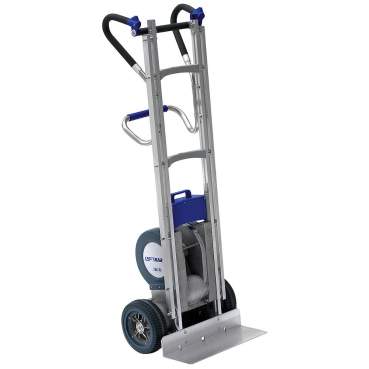
I finished what I was doing and headed for the main staircase to see what was going on. As I got there, I saw a Coke Machine going up the stairs with one man climbing the stairs with it. There was a ½ horse motor and a 50 amp battery doing all the work. It really was amazing.

stair climber


I was fascinated and fortunately had the time to watch the guy take several pieces of equipment up the stairs. There was a Coke machine, 2 sandwich and dessert machines, a hot canned soup machine, a cigarette machine, and a refrigerator. The machines were different sizes, configurations, and weights, but everything went as smooth as silk. The guy told me that the dolly could take things down the stairs just as easy. Amazing!

All this talk about machines that climb stairs brings us to the question, “What did we do before stair-climbing dollies?” Well, I’ve got one answer for that. This story concerns my Dad, Al Thomas, so let me tell you a little about him. Dad was always tall and slim. As a grown man he was about 6 foot tall and for years weighed 168 pounds. He prided himself in being perfectly honest so if anyone ever asked how tall he was, he never said “6 foot”. It was always “five eleven and three quarters.”

When Dad was a freshman in high school, he preferred individual sports so he played tennis and lettered on the track team. The following year, he was diagnosed with mastoiditis and later with rheumatic fever. Fear of heart damage caused the doctor to prescribe bed rest for several months. This pretty much finished his high school athletic career. Re-gaining his strength after high school, Dad began playing softball in an inter-city league and pitched for several years. Jobs were hard to find during the depression and Dad took a lot of hard jobs like digging ditches and scooping wheat. Another hard job was shoveling coal. A gondola full of coal would be delivered to the siding near the downtown area and Dad and a couple other guys would shovel the coal out with scoop shovels and toss it into a bin beside the tracks. Scooping wheat and coal made for strong backs and legs.

Based on what I can remember about my size and the looks of things around me, I must have been 10 or 11 at the time I’m thinking of. That would make it about 1946 or 1947. Dad said he had a little job to do and that I should come with him. That was surprising enough because back in those days kids did “kid stuff” and Dads did “Dad stuff.” We got in Dad’s 1940 Chevrolet and he drove us downtown. He parked there on the west side of the 500 block of State Street, near Cooper Drugs. The buildings were mostly 2 stories although a corner did have a 3rd story. The first floor of every building was a business of some kind and the upper floors were mostly apartments with a couple of offices sprinkled here and there. On the sidewalk, right in front of where we had parked, and up against the building, was a refrigerator. Between the stores were stairways going to the upper floors and giving access to the apartments. Dad said that the lady that lived upstairs from where the fridge was setting was a friend of him and Mom and that she had to buy a new refrigerator. She said she bought a second-hand unit from a family that was moving out of town and they said they would leave it on the sidewalk in front of Cooper Drug but she would have to arrange to get it upstairs. She asked Dad if he could get it up the stairs for her and he agreed to do it.

Dad and I were standing there and looking up those stairs that were scarcely wider than the fridge. There wasn’t room for anyone on the stairs beside the fridge. Being a dumb kid, I had no idea how this was going to work but Dad had a plan. He went to the trunk of the car and came back with a web belt. The belt was yellow, about 2” wide and maybe 15 feet long. He pushed the refrigerator over directly in front of the stairs and tipped it a little and told me to slide the belt under it. I positioned the belt and then we tugged on the ends of it and evened it up. Then, while I held the ends, Dad went around and faced the stairs with his back to the fridge. He crossed the straps and pulled them over his shoulders. Then, he bent his knees, pulled straight down on the ends of the straps to remove the slack, and then straightened his legs. All of a sudden, there he was, standing up straight with a refrigerator on his back! He said “Stay here on the sidewalk and don’t get behind me on the stairs.” He took a couple of steps forward and started climbing. He took one step at a time and didn’t waver a bit. I was worried about him but knew that if he got into trouble he would simply let go of the straps and let the fridge come crashing down the stairs. I still kind of held my breath until I heard him yell that he was at the top and I could come on up. I went racing up the stairs and there he was at the top, safe and sound. As for me, I was in awe of the whole operation. I learned a number of things that day but the main one was that a man with a plan (and a little muscle) could do remarkable things before we even heard of a stair-climbing dolly.

Dave Thomas
October 15, 2015

The Augusta Theaters

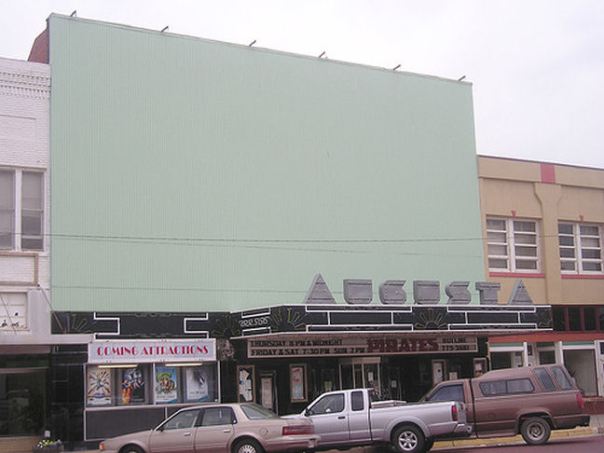
Augusta Theater

After graduating from high school I was working at Howard Motors, the Chevrolet/Buick garage. We worked from 8:00 to 6:00 on weekdays and 8:00 to 1:00 on Saturday. One Saturday afternoon, after work, I went home and cleaned up and came back downtown to have a cup of coffee at the bakery. The P & G Bakery was located in the 500 block of State Street, our main drag and was located just across the street from the Augusta Theater. Actually, there were two theaters across the street. The Augusta was the main theater, open every night and was large and beautifully decorated. Next to it on the south was the Isis Theater. It was well decorated in a modern western motif and was open Friday night, Saturday night and for Saturday matinee. Of course, the Isis only ran westerns. 

The P & G Bakery provided first class bread, doughnuts, and other baked goods but also had a fountain and half dozen booths. I was sitting in a booth, sipping my coffee, and visiting with everyone that came along. Bob Bisagno, the son of the owners of the movie houses, came in and sat down with me and ordered a cup of coffee. He was in his 30’s, was a tall, good looking guy, and was well liked by everyone in town. Bob was the manager of the theaters and every night you could see him at the Augusta taking tickets and welcoming the patrons to the movie. There was a small alcove off the lobby and every night, Bob’s parents, Dave and Aline, were sitting on the couch and greeting the patrons, also.

As an aside, I should tell you a little about the family. Mrs. Bisagno had been the piano player for the silent movies back in the old days. The old movie house was still there, in the next block, but was locked up tight and no longer used. The Bisagno family still owned it. Dave, the old man, had been raised on a farm north of town. He was short, maybe 5’ 7″ or 5’8″ tall with very broad shoulders, and big, powerful hands. One of the local legends was that Dave’s hands were so powerful that using a pinch-grip, he could hand-walk the rafters of a barn from one end of the barn to the other. One time, I saw a couple of old boys that had grown up with Dave and asked them if it was true that he was so strong. They swore that it was.

Bob graduated from Kansas State College at Manhattan and did a hitch in the Air Force before coming home to work at the movies.

Bob and I drank coffee and talked for a few minutes and then he changed gears and asked me if I’d like to work for him as a relief projectionist at the Augusta Theater. I was both flattered and flabbergasted. I had never considered such a thing. The relief projectionist or, operator, would give the regular man a break by working two nights a week and would be available to cover illnesses and vacations. Bob explained the job, the wages, and what would be expected of me. It sounded interesting. I asked a few questions and we shook hands and had a deal. I think I was eighteen at the time.

I don’t remember how long I trained before going solo. The regular operator, Lee, soon started going to the lobby and leaving me in the booth alone. It wasn’t very long before I worked a couple of nights by myself. There were a number of things to learn. Most reels of film lasted 18 to 20 minutes so the features normally had 4 to 6 reels. One of those super-duper blockbuster movies could have up to 8 reels. To get a reel ready, you placed it in the upper projector film housing and then threaded the film through several sprockets and then past the aperture plate which sized the projected image exactly to your screen. Then you went through a couple of sprockets and past the exciter lamp that picked up the sound which was imbedded alongside the 35mm image frames. The light source was a carbon arc with a parabolic reflector behind it to focus the light exactly on the aperture plate for maximum illumination. You had to set the carbons so they burned at the correct rate and you had to check them periodically when changing reels. There were 2 projectors and you switched back and forth between them. When a reel was about done, a mark on the film would show up in the upper right hand corner of the screen. That was the “get ready” cue and you got yourself in position with a hand on each of the 2 switches (one for the picture and one for sound). In a few seconds, the second cue appeared in the upper right hand corner of the screen and you hit both switches at the same time for a near seamless transition to the next reel. You had to learn to splice film, trouble- shoot the equipment, operate the curtains and lights and other chores that soon became second nature.

I learned at the Augusta Theater and then learned at the Isis Theater next door and got to work relief there and ran”B” westerns. Then I got to go to the drive-in and learned that equipment. All 3 movie houses had different projectors and sound systems so there were new things to learn at each job. The regular operator at the drive-in was an Electrical Engineer and that’s the work he did during the day. He was offered a job in another town so I was asked to be the full-time drive-in operator. I was tickled to death and accepted before Bob finished getting the words out of his mouth. I kept working at the garage, too, so I was pretty busy. At the drive-in, I kept the booth clean and repaired speakers while the movie ran.

The drive-in was about a mile and a half north of town on Ohio Street. Ohio Street was a busy road that serviced the farms north of town and served as a secondary way to get to El Dorado or Towanda or Wichita. The drive-in was on the east side of Ohio Street but on the west side was Garvin Park and our City Lake that served as our water reservoir. Across from the drive-in entrance and a little bit south there was an entrance into the park. At the time, I was driving a baby blue 1953 Ford convertible and generally had the top down during the summer months. I’d get off work on those beautiful summer nights, go into the park and head for home on the road that ran along the edge of the lake. It was rare to see another car at that time of night and I enjoyed tooling along, under the stars by myself.

One time, I had the night off and Bob Ford and I were going to go horseback riding. Since we both worked during the day this was the only chance we had. The horses that Bob had access to were only about 1 ½ miles from the drive-in. We got there and were saddling up and Bob says “I’d sure like to see that western movie that’s starting over at the drive-in tonight”. “I’ve been looking forward to going horseback riding tonight,” I says. “Well, let’s do both,” he says. I figured that since I worked there I might get away with it. We rode on over and when we got to the ticket booth, Bob bought himself a ticket. Right beside the concession stand there was a patio area with 4 benches on it. We rode on in and as we were sitting down, Bob Bisagno, the owner/manager came up and asked what we were doing. I told him we came to see the movie. After we all talked it over, Bob said it was ok but I’d have to come back in the morning and clean up after the horses. That was fair so we sat down on a bench to watch the movie and held onto our reins. We wanted to be able to control the horses so they wouldn’t get hurt in case some idiot blew his car horn. We watched the movie with no incidents and rode the horses back to the barn and put them up. The next morning, I got up early and went out and cleaned up the asphalt and then went to work at the garage. Another memorable experience and nobody hurt.

Dave Thomas
December 11, 2013
 

A Rookie On Ice

I was 18 and working at Howard Motors, a Chevrolet/Buick dealership in Augusta, Kansas. It was winter and we had been having some lousy weather. It snowed and then the next day it warmed up enough to thaw a little. Then, that night, the water standing in the streets and roads re-froze and a little bit of snow fell and covered it. This resulted in roads so icy and slick you could barely walk or drive on them.

I had been told the night before that the next day, I would be delivering a brand new 1 ½ ton Chevrolet truck to Great Bend, Kansas, about 130 miles away and bringing back the trade-in. The trade-in was at a dealership in Great Bend and the dealer had already removed the livestock bed from the truck. That meant that neither truck I would be driving had a bed mounted on it so therefore there would be no weight on the rear wheels.

I got to work early and got my instructions and by 8:00 AM was heading out on an adventure. I had never been to Great Bend, had never driven so far, and had certainly never driven a truck that far. I was having an exciting time before I hit the city limit. Touch the brakes and the rear end slid out from under you because there was no weight to hold it down. Try to accelerate and the same thing happened. At that time there was no 55 MPH speed limit on the highway but it didn’t make any difference because I couldn’t get over 20 MPH and neither could anyone else who was on the road. Going west from Augusta to Wichita I never got over 20 miles an hour. When I got to Wichita and took Highway 81 North, it was the same story. I kept hoping it would warm up a little and the roads would thaw. Otherwise, I wouldn’t get home until midnight.

I finally got to Newton and stopped for some pie and coffee. I figured I could kill 15 or 20 minutes there and give the weather a little more time to warm up. I got back on the road and headed west out of Newton. After a few minutes, I was tickled to see patches of road that were free of ice. I was actually able to get up to 50 and 55 miles an hour for short periods of time but had to be careful of bridges because they were always shady and covered with ice. This was nice country with farm towns every few miles. Probably most of the farmers through there were Mennonites as they had settled the area many years before.

I finally got to Great Bend. As I recall, it was called “Great Bend” because it was located on a great bend of the Arkansas River. That’s not pronounced “Arkensaw” like the state. It’s pronounced “R Kansas River”.

I got the paper work taken care of and they showed me the old trade-in I would be driving home. It was a pretty well beat up old 1 1/2 ton with slick tires. They told me the engine had a knock in it and it was burning lots of oil. They also told me to stop and check the oil frequently and they put 4 quarts of oil up in the cab with me. I lit out for home and drove as smoothly as I could. I didn’t rev the engine or let it load up at all. I got it up to 50 miles an hour and held it steady. I watched my gauges and stopped and checked the oil often and was getting on down the road. I got to one of those little farm towns west of Newton, and the engine threw a rod! I pulled off onto the shoulder and looked under the hood. Sure enough, the party was over.

I could see a country store up ahead so I hiked on up there. The people that owned the place were real nice and let me use their phone for a long distance call. I called Kenny Markley, the Service Manager at the garage and my boss, and told him what had happened and where I was. Kenny said it was getting late so he had called the Truck Manager at the dealership in Great Bend and after hearing about the truck was surprised that I had made it that far. He told me to sit tight and he would get in the wrecker and come up and get me.

I hung out at that country store and visited with those nice people until Kenny showed up. We hooked up the old truck to the wrecker and took off for home. It was getting late so we stopped in Newton and Kenny bought me supper. It was a big day and I experienced a lot and learned a lot.


Dave Thomas
December 7, 2014

Chicago, a Sparrow, and a Tattoo

I had been to the U.S. Navy Recruit Training Center at Great Lakes, Illinois for boot camp and had then gone home to Kansas on a 30 day leave. Now, I was headed for Glenview Naval Air Station just north of Chicago where I would spend 5 or 6 months while waiting for orders to school. Coming into Chicago on the train was exciting for me. I had wanted to check out Chicago ever since reading Carl Sandburg’s poem, “Chicago”, in high school. I was already impressed as we rolled through the neighborhoods and saw what a large city it was. Then, as we went through the railroad switching yards and saw track after track I knew it was a big-time operation. No wonder Carl Sandburg called it a “Player with Railroads and the Nation’s Freight Handler”. My gosh, they’ve got more tracks than you can shake a stick at. This is going to be special.

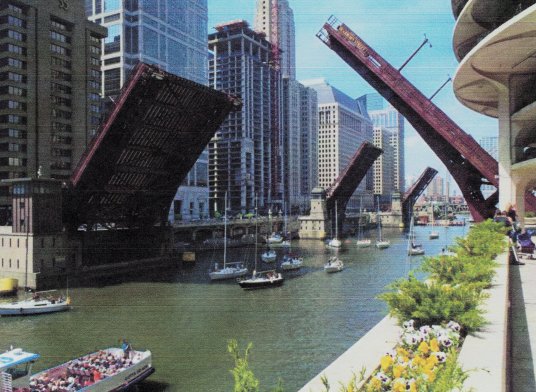
I got checked in at Glenview and started using my spare evenings and weekends to see the city. I’d ride the commuter trains from Glenview into downtown Chicago and get off the “El” somewhere in the loop and just wander around. It didn’t matter where I was for I looked in every store window and went into every building that looked interesting. I checked out Marshall-Field, the giant department store, Navy Pier, Soldier Field, and the Museum of Science and Industry where they displayed U-505, the German submarine captured during WWII. A number of times, I went into the lobby of the Palmer House Hotel just to gaze at the beautiful woodwork and the rest of the décor. After a few visits the doorman recognized me and would nod when I showed up. I was really fascinated by the lift bridges along the river and was highly entertained when I got there at the right time to see the bridge open up and a ship go sailing across the street! I enjoyed a couple of night clubs on the main drag, Randolph Street I think it was, where in the evening you could stand out on the sidewalk and listen to Jack Teagarden and other well-known musicians.

Chicago Bridges

One of my favorite buildings was the John Hancock Building. At this time, 1957, I believe it was the tallest building in Chicago. It had an unbelievable view of the city and Lake Michigan from the top floor where there was a restaurant and bar. You could sit up there and enjoy all the sights. I celebrated my 21st birthday there and it was the day I quit drinking. My hair started turning gray at the temples when I was 17. This gave me access to beer joints, bars, and liquor stores long before I should have been admitted and I was never once challenged or carded.

My excursions in the city were always alone as I wasn’t the buddy-buddy type. On my 21st birthday I did my normal sight-seeing and then went over to the John Hancock. Up in the lounge, I ordered a 7 and 7, my favorite drink, and sat back to enjoy the view and think things over. I was thinking that for the first time, my drink was legal, but my next thought was that I was a pretty poor man if the ability to buy a drink was the highlight of my day. Right then I decided that drinking was a waste of time and money and certainly a waste of life. I’ve adhered to that belief ever since and haven’t ordered another mixed drink.

There were 4 or 5 tattoo parlors in the loop and I had been checking them pretty close. I’d always wanted a tattoo and had decided that this was the time and place to get it done. The tattoo parlors looked like you would expect on the outside. The windows were wildly painted and gave off a cheap, carnival feeling. I started going in and talking to the tattoo artists so I could make a decision on what guy I wanted to do the job for me. In the group, there was only one place that impressed me at all. It was very clean and orderly and the man inside was nicely dressed in slacks and a dress shirt with no tie. I introduced myself and told him I wanted to learn about tattoos prior to getting one. He told me his name was Phil Sparrow and that he was a retired professor from Loyola University. He said he enjoyed doing the tattoos and in his spare time between clients was writing a novel. He said he would be glad to show me how the art of tattooing was done. His warm and gracious manner made me feel comfortable and I decided right then that he was the guy to do the tattoo work for me.

That first day, Phil showed me the plastic templates he used first to trace the outline of the pattern. He used a marker to draw the lines on your skin. Next came the vibrating tool with a large needle installed that was dipped in the black ink from time to time and created the outline. Colors were filled in with a broader tool that actually looked like 5 or 6 needles welded together to form a wider tool. Phil said that as he worked his way across the design he would finish all the work with one color before starting the next. That pretty much took care of the basics for me.

I think it was on my second visit to the shop that Phil asked if I was interested in reading a couple of chapters of his novel. I immediately said yes and got started. I don’t remember the plot but do remember that I liked his style. He had an open and uncluttered way of telling a story. You were able to relax and enjoy it without getting all tangled up in it. I don’t know if he ever got the book published. I enjoyed just hanging out and reading. When Phil had a customer I would watch as he created the tattoo.

I had to pick a design and decide where I wanted the tattoo to be. The only tattoo I had ever seen up close was on the upper arm of my Grandpa, George Sicks. His was located on his upper arm, almost to the shoulder, and was of an old sailing ship under full sail. The thing was probably 1 ½” from end-to-end. I couldn’t imagine getting a tattoo if I was going to hide it. I decided that when I was dressed casually I would display it but if I was wearing my uniform or dress clothes I would keep it covered. I always thought it looked tacky to see a tattoo peeking out from a guy’s cuff or the neck of his shirt. Phil had several designs of eagles that I liked and I finally picked one of an eagle swooping down or landing with talons extended as if to catch his prey. The template fit on my forearm and looked like it was swooping down to grab the I.D. bracelet I wore. The bracelet was awarded to me at the graduation ceremony at the Naval Recruit Training Command when I was named as “Honor Man” of my company at boot camp. it.

After all the decisions were made, it just took Phil a few minutes to execute the tattoo. The base color was indigo and there were small red sections on the leading edges of the wings. The eagle also had a yellow beak and feet. The red and yellow have pretty much faded away after more than 57 years but I’m still happy with the outcome.

I’ve told stories to my wife and kids about Chicago and Phil Sparrow many times. Our daughter, Terri, was intrigued by the name “Phil Sparrow” and looked him up on the Internet. It turns out that Phil was everything he said he was…and more. Terri found articles on Phil and on the famous San Francisco tattoo artist and designer, Ed Hardy. Hardy considers Phil Sparrow to be his mentor and gives him credit for his inspiration and guidance and for being the man who pioneered the inclusion of Japanese design into western tattoo artistry. Hardy, himself, has branched out and designs jewelry and purses and other items. Our grand-daughter, Christie, is very familiar with his creations.

Dave Thomas
January 27, 2014

V J Day

The Victory over Japan that ended World War II was announced August 15, 1945. I was just a couple of weeks shy of my 9th birthday but I remember the war vividly and remember V J Day. The war was part of our everyday lives…friends and neighbors going to war, some getting killed, rationing, black-outs, and horrible news broadcasts as the major battles were fought. Many people have shared their memories of those days so I’ll leave you to ponder their accounts. I’ll just share a few of the things that I remember about V J Day and the way things were.

We had supper with my Grandpa and Grandma Thomas at their house at 315 Walnut Street in Augusta. It was just a few blocks so Mom, Dad, Sylvia, and I had walked. There were some out-of-town relatives there but I don’t remember who they were. After supper, we kids were out on the front porch when the noise started up. We could hear car horns and people yelling and cheering and really carrying on. One of the adults came out and told us that the war with Japan was over and the boys would be coming home. Everyone was excited and we started yelling too.

My Dad came out of the house with a box of wooden kitchen matches and a pair of pliers. He said “We don’t have any fireworks but you kids can make some noise with these.” He then showed us how a kitchen match can make as much noise as a cap gun. If you recall, the tip, the striking part of the match, is a different color than the body. You line up the pliers in the same plane as the match stick and grasp the tip of the match with the pliers. While gently applying pressure you start to turn the pliers as if uncorking a bottle and the tip of the match will separate from the body. Maintaining a firm grip on the pliers, you strike the jaw of the pliers on the sidewalk and that causes the explosion. Pretty neat and as I said, it’s at least as loud as a cap gun. We kids took turns with the pliers until the entire box of matches was gone.

By this time it was dark and we could hear more noise coming from State Street which was a block over including a band that was playing full blast. Dad and Mom came out of the house and got us and we walked over to State Street and went up a block to the corner of 5th and State. The sidewalks were packed. The street was jammed too with cars, trucks, and tractors. One of the flat-bed trucks was carrying the Augusta High School Pep Band. I used to remember the names of all the band guys but now can only recall Corky Smith who played the drums. State Street was the main street in our town and was paved in brick. It ran north and south for maybe 1 ½ to 2 miles. The north end was on high ground and after maybe a half mile you came to High Street where it started going downhill and continued to slope all the way to the end. If you were going to “drag main street” you would drive up to High Street, make a U-turn, then cruise all the way south to 4th Street where you would make another U-turn and head back to High Street. Driving this mindless track used to occupy the kids for hours. High Street was in a residential area that continued south to 7th Street. The business district or “downtown” part of State Street went from 7th to 3rd St. On V J Day, all these cars, trucks, and tractors were making a big loop from High St. to 4th and back and making noise all the way.

That’s all a 9 year old kid can remember…the crowds, the noise, the joy, and the relief that the war was over.

Dave Thomas
October 11, 2014


The Old Barn

I have always liked old barns. When you see them quietly standing there now, they may not look as good or as strong as they once did but they have a resolute and stately quality about them. Their job is done but if needed, they would gladly step up to the mark. This story about the old barn is the only work of fiction I have attempted. I hope you see the barn as a giver and a worthy member of the community.

            Old Barn 1

The Old Barn

Hello! I seldom get visits from pretty young ladies like you. I’ll bet you are a city girl and have never met or talked to an old barn like me. What…you say you would like to take my picture? That’s an unusual request as I certainly don’t look my best now. I’m nearly one hundred years old and am missing some of my shingles and boards and have begun to lean a bit. No, I’ve never had a coat of paint. I hear that in some parts of the country they paint their barns but around here they just let us weather.

How was my early life? Oh, it was wonderful! Barns were a big part of life on the farm. In the early days if someone needed a barn, neighbors came from miles around to take part in a “barn raising”. Generally, the men built the barn, the women cooked a wonderful meal, and the kids got acquainted and played together. The community developed camaraderie and the barn was pretty much built in a day.

The hay mow or loft, which was the upper floor, was large enough to store several tons of hay for the winter. The hay of course fed the cattle and horses but it also insulated the barn and helped me provide shelter for the animals and for my people when they needed it.

They brought the milk cow in twice a day and milked her and when she had a calf, the birthing took place in one of my stalls where they knew both of them would be safe. The farmer had a beautiful team of draft horse that lived here also. They did all the heavy work here on the farm. It was my pleasure to give them a warm, dry home where they could rest and eat and get ready for the next day.

I also enjoyed the hens. There were a couple of them that just wouldn’t stay in the chicken coop. They’d come in here and lay their eggs in the mangers and even up in the hay mow sometimes. The farmer’s wife finally gave up on keeping those hens contained and made a regular trip out here every day to gather their eggs.

Sometimes the boys and girls got caught necking out here in the loft. The farmer would dress them down but he and his wife always chuckled about it later.

I also provided storage for the harnesses and for corn and grain and the many tools it takes to keep a farm going. There are many facets to farming and we tried to be prepared for them all.

Life was good and my people were happy. They didn’t have a lot of money but they always worked hard and as a result had plenty to eat and always had the things they needed.

What happened to me? Well, I don’t have anyone to care for me anymore. The kids all grew up and decided to get jobs in the city where they could get a steady paycheck and not have to work from dawn until dark. The farmer and his wife hung on because this was the life they loved but eventually they became old and feeble and died.

What was that? Oh, you snapped my picture. Well, when you look at it later remember that in spite of what you see, it’s been a good life for me.

What does the future hold? Well, I’ll keep standing here as long as I can. I miss my people and the laughter and the animals. I took good care of them all. It’s been wonderful and I’ll keep looking forward to the next sunrise until there are no more.

Dave Thomas
December 4, 2013


Tupelo, Mississippi

Yesterday a tornado struck Tupelo, Mississippi and seriously damaged the town and killed one person. It’s a small town and could probably be called a “farm town” as I don’t know that there is much in the way of industry there. You don’t hear much about the place so hearing it mentioned on the news was unexpected and it brought back a memory from fifty-six years ago.

I was in the Navy and attending Aviation Electronics “A” School in Memphis. Actually, I think the base was in the suburb of Millington and we had rented an upstairs apartment in a private home there. Pat was working in the accounting department of Kroger Grocery Stores in their corporate offices in Memphis. The building was located on the bank of the Mississippi River.

Pat and I had been adapting to one change after another. We had been married November 9, 1957 thanks to a 3-day weekend due to Veteran’s Day. At that time I was attending the Naval Aviation Prep School in Norman, Oklahoma, just south of Oklahoma City. (I have no idea why a Navy base was in the middle of Oklahoma.) Pat was working in the Accounting Department of Sears Roebuck at the Wichita, Kansas store. On Friday afternoon I got out of school and to conserve money hitch-hiked to Wichita. We got married the next morning and headed for Claremore, Oklahoma for an overnight honeymoon and a visit to the Will Rogers Memorial. Then, it was back to Wichita and on Monday evening Pat dropped me at the bus depot and I headed back to Norman and school and Pat would be back at Sears the next day.

The next week I graduated from the Aviation “P” School and was shipped to Memphis to the Aviation Electronics “A” School. Pat remained in Wichita, working at Sears while we figured out what we were going to do and accumulated a few bucks to do it with. In mid December I rented the apartment in Millington and Pat packed everything we owned into her1952 Chevrolet and drove to Memphis. One of Pat’s good friends rode to Memphis with her and then returned to Wichita on a bus.

Getting back to the story, it must have been in February or March because it was still cold and there weren’t any leaves on the trees and we decided to explore the area. Neither of us had been in Mississippi before so we headed south and enjoyed the ride.

After a time, we came to a large sign saying “Tupelo, Birthplace of Elvis Presley”. That seemed pretty cool and we were getting hungry so we decided to stop for lunch. We were still on the outskirts of town and spotted a restaurant among some trees at the side of the road. We went in and sat down at a table and waited for a waitress to come and take our orders. We talked and killed time and minutes went by and nobody showed. By this time, we had started looking around and at about the same time, we realized that all the other patrons were black and didn’t really look too friendly. About now, I’m thinking I’ve really got us into a jackpot and had better get ready to fight our way out.

Pat and I had come to Memphis totally naïve about segregation. In the 20 years I had lived in my home town we only had one black family and they had only lived there for a year or two. Pat’s home town had a few black families and as far as I know there wasn’t a lot of open bigotry. What this all boiled down to was that Pat and I were too innocent to handle the current situation well.

Getting back to our predicament, we all sat there and stared at each other for a few more minutes and then a man came out from the kitchen and suggested that Pat and I might be more comfortable somewhere else. We left and considered it a lesson learned.

Dave Thomas
April 29, 2014


What To Wear

Here’s a story that Pat witnessed and I enjoyed.

It was one of those Thursdays where a number of the Sears sales staff that had the day off had gathered at Mission Bay to water ski. It was noon and after a lot of skiing everyone was taking a lunch break. Two of the guys had their ski boats there that day and they had nosed their boats in and grounded them on the sand.

A car pulled up and parked and the man that gets out is a new guy, Jerry that is a salesman in the refrigerator department. He gets into the trunk of his car and brings out a water ski and tucks it under his arm as he walks over to the group. He looks pretty sharp as he approaches in his coat and tie. He says “Hi” and then says “I knew you guys were down here at the bay and though I had to work I didn’t want to miss out. I’m on my lunch hour and I would sure like to get one turn around the bay. Can I get one of you to give me a tow?” “Pat” Patitucci, the owner of one of the boats, says “Sure, I’ll give you a tow.”

Pat gets in his boat and fires it up and backs out into the water. Another guy gets the tow rope ready and prepares to “flag” for the ski run. Meanwhile, Jerry has taken off his coat and placed it carefully on the grass. Next, he takes off his shoes and socks, puts them next to his coat, and then rolls his pant legs up to his knees. He walks to the water’s edge, lays down his ski and places his foot in the cup. The flagman in the boat tosses the tow rope which he catches and then he gives Pat the sign to “Hit it!” Off they go! It looks kind of strange to see a fully dressed man making a circle of the bay.

One of the guys on shore knows Jerry pretty well and explains the situation to the rest of the group. It seems that both of Jerry’s parents were water skiers and he’s been skiing almost since he learned to walk. He wouldn’t be getting his clothes wet because he wasn’t going to fall.

Jerry finished a couple of circles of the bay and cast aside the tow rope and glided in. He got dressed, thanked everyone, jumped in his car and went back to work.

Dave and Pat Thomas
March 8, 2015