This is a picture I have liked for some 40 years. It’s an interesting study of an old man that has been down the road a few times. You can read into it anything you like.

Dave Thomas
March 22, 2016
This is a picture I have liked for some 40 years. It’s an interesting study of an old man that has been down the road a few times. You can read into it anything you like.
Dave Thomas
March 22, 2016
The Victory over Japan that ended World War II was announced August 15, 1945. I was just a couple of weeks shy of my 9th birthday but I remember the war vividly and remember V J Day. The war was part of our everyday lives…friends and neighbors going to war, some getting killed, rationing, black-outs, and horrible news broadcasts as the major battles were fought. Many people have shared their memories of those days so I’ll leave you to ponder their accounts. I’ll just share a few of the things that I remember about V J Day and the way things were.
We had supper with my Grandpa and Grandma Thomas at their house at 315 Walnut Street in Augusta. It was just a few blocks so Mom, Dad, Sylvia, and I had walked. There were some out-of-town relatives there but I don’t remember who they were. After supper, we kids were out on the front porch when the noise started up. We could hear car horns and people yelling and cheering and really carrying on. One of the adults came out and told us that the war with Japan was over and the boys would be coming home. Everyone was excited and we started yelling too.
My Dad came out of the house with a box of wooden kitchen matches and a pair of pliers. He said “We don’t have any fireworks but you kids can make some noise with these.” He then showed us how a kitchen match can make as much noise as a cap gun. If you recall, the tip, the striking part of the match, is a different color than the body. You line up the pliers in the same plane as the match stick and grasp the tip of the match with the pliers. While gently applying pressure you start to turn the pliers as if uncorking a bottle and the tip of the match will separate from the body. Maintaining a firm grip on the pliers, you strike the jaw of the pliers on the sidewalk and that causes the explosion. Pretty neat and as I said, it’s at least as loud as a cap gun. We kids took turns with the pliers until the entire box of matches was gone.
By this time it was dark and we could hear more noise coming from State Street which was a block over including a band that was playing full blast. Dad and Mom came out of the house and got us and we walked over to State Street and went up a block to the corner of 5th and State. The sidewalks were packed. The street was jammed too with cars, trucks, and tractors. One of the flat-bed trucks was carrying the Augusta High School Pep Band. I used to remember the names of all the band guys but now can only recall Corky Smith who played the drums. State Street was the main street in our town and was paved in brick. It ran north and south for maybe 1 ½ to 2 miles. The north end was on high ground and after maybe a half mile you came to High Street where it started going downhill and continued to slope all the way to the end. If you were going to “drag main street” you would drive up to High Street, make a U-turn, then cruise all the way south to 4th Street where you would make another U-turn and head back to High Street. Driving this mindless track used to occupy the kids for hours. High Street was in a residential area that continued south to 7th Street. The business district or “downtown” part of State Street went from 7th to 3rd St. On V J Day, all these cars, trucks, and tractors were making a big loop from High St. to 4th and back and making noise all the way.
That’s all a 9 year old kid can remember…the crowds, the noise, the joy, and the relief that the war was over.
Dave Thomas
October 11, 2014
I have always liked old barns. When you see them quietly standing there now, they may not look as good or as strong as they once did but they have a resolute and stately quality about them. Their job is done but if needed, they would gladly step up to the mark. This story about the old barn is the only work of fiction I have attempted. I hope you see the barn as a giver and a worthy member of the community.

The Old Barn
Hello! I seldom get visits from pretty young ladies like you. I’ll bet you are a city girl and have never met or talked to an old barn like me. What…you say you would like to take my picture? That’s an unusual request as I certainly don’t look my best now. I’m nearly one hundred years old and am missing some of my shingles and boards and have begun to lean a bit. No, I’ve never had a coat of paint. I hear that in some parts of the country they paint their barns but around here they just let us weather.
How was my early life? Oh, it was wonderful! Barns were a big part of life on the farm. In the early days if someone needed a barn, neighbors came from miles around to take part in a “barn raising”. Generally, the men built the barn, the women cooked a wonderful meal, and the kids got acquainted and played together. The community developed camaraderie and the barn was pretty much built in a day.
The hay mow or loft, which was the upper floor, was large enough to store several tons of hay for the winter. The hay of course fed the cattle and horses but it also insulated the barn and helped me provide shelter for the animals and for my people when they needed it.
They brought the milk cow in twice a day and milked her and when she had a calf, the birthing took place in one of my stalls where they knew both of them would be safe. The farmer had a beautiful team of draft horse that lived here also. They did all the heavy work here on the farm. It was my pleasure to give them a warm, dry home where they could rest and eat and get ready for the next day.
I also enjoyed the hens. There were a couple of them that just wouldn’t stay in the chicken coop. They’d come in here and lay their eggs in the mangers and even up in the hay mow sometimes. The farmer’s wife finally gave up on keeping those hens contained and made a regular trip out here every day to gather their eggs.
Sometimes the boys and girls got caught necking out here in the loft. The farmer would dress them down but he and his wife always chuckled about it later.
I also provided storage for the harnesses and for corn and grain and the many tools it takes to keep a farm going. There are many facets to farming and we tried to be prepared for them all.
Life was good and my people were happy. They didn’t have a lot of money but they always worked hard and as a result had plenty to eat and always had the things they needed.
What happened to me? Well, I don’t have anyone to care for me anymore. The kids all grew up and decided to get jobs in the city where they could get a steady paycheck and not have to work from dawn until dark. The farmer and his wife hung on because this was the life they loved but eventually they became old and feeble and died.
What was that? Oh, you snapped my picture. Well, when you look at it later remember that in spite of what you see, it’s been a good life for me.
What does the future hold? Well, I’ll keep standing here as long as I can. I miss my people and the laughter and the animals. I took good care of them all. It’s been wonderful and I’ll keep looking forward to the next sunrise until there are no more.
Dave Thomas
December 4, 2013
Yesterday a tornado struck Tupelo, Mississippi and seriously damaged the town and killed one person. It’s a small town and could probably be called a “farm town” as I don’t know that there is much in the way of industry there. You don’t hear much about the place so hearing it mentioned on the news was unexpected and it brought back a memory from fifty-six years ago.
I was in the Navy and attending Aviation Electronics “A” School in Memphis. Actually, I think the base was in the suburb of Millington and we had rented an upstairs apartment in a private home there. Pat was working in the accounting department of Kroger Grocery Stores in their corporate offices in Memphis. The building was located on the bank of the Mississippi River.
Pat and I had been adapting to one change after another. We had been married November 9, 1957 thanks to a 3-day weekend due to Veteran’s Day. At that time I was attending the Naval Aviation Prep School in Norman, Oklahoma, just south of Oklahoma City. (I have no idea why a Navy base was in the middle of Oklahoma.) Pat was working in the Accounting Department of Sears Roebuck at the Wichita, Kansas store. On Friday afternoon I got out of school and to conserve money hitch-hiked to Wichita. We got married the next morning and headed for Claremore, Oklahoma for an overnight honeymoon and a visit to the Will Rogers Memorial. Then, it was back to Wichita and on Monday evening Pat dropped me at the bus depot and I headed back to Norman and school and Pat would be back at Sears the next day.
The next week I graduated from the Aviation “P” School and was shipped to Memphis to the Aviation Electronics “A” School. Pat remained in Wichita, working at Sears while we figured out what we were going to do and accumulated a few bucks to do it with. In mid December I rented the apartment in Millington and Pat packed everything we owned into her1952 Chevrolet and drove to Memphis. One of Pat’s good friends rode to Memphis with her and then returned to Wichita on a bus.
Getting back to the story, it must have been in February or March because it was still cold and there weren’t any leaves on the trees and we decided to explore the area. Neither of us had been in Mississippi before so we headed south and enjoyed the ride.
After a time, we came to a large sign saying “Tupelo, Birthplace of Elvis Presley”. That seemed pretty cool and we were getting hungry so we decided to stop for lunch. We were still on the outskirts of town and spotted a restaurant among some trees at the side of the road. We went in and sat down at a table and waited for a waitress to come and take our orders. We talked and killed time and minutes went by and nobody showed. By this time, we had started looking around and at about the same time, we realized that all the other patrons were black and didn’t really look too friendly. About now, I’m thinking I’ve really got us into a jackpot and had better get ready to fight our way out.
Pat and I had come to Memphis totally naïve about segregation. In the 20 years I had lived in my home town we only had one black family and they had only lived there for a year or two. Pat’s home town had a few black families and as far as I know there wasn’t a lot of open bigotry. What this all boiled down to was that Pat and I were too innocent to handle the current situation well.
Getting back to our predicament, we all sat there and stared at each other for a few more minutes and then a man came out from the kitchen and suggested that Pat and I might be more comfortable somewhere else. We left and considered it a lesson learned.
Dave Thomas
April 29, 2014
Here’s a story that Pat witnessed and I enjoyed.
It was one of those Thursdays where a number of the Sears sales staff that had the day off had gathered at Mission Bay to water ski. It was noon and after a lot of skiing everyone was taking a lunch break. Two of the guys had their ski boats there that day and they had nosed their boats in and grounded them on the sand.
A car pulled up and parked and the man that gets out is a new guy, Jerry that is a salesman in the refrigerator department. He gets into the trunk of his car and brings out a water ski and tucks it under his arm as he walks over to the group. He looks pretty sharp as he approaches in his coat and tie. He says “Hi” and then says “I knew you guys were down here at the bay and though I had to work I didn’t want to miss out. I’m on my lunch hour and I would sure like to get one turn around the bay. Can I get one of you to give me a tow?” “Pat” Patitucci, the owner of one of the boats, says “Sure, I’ll give you a tow.”
Pat gets in his boat and fires it up and backs out into the water. Another guy gets the tow rope ready and prepares to “flag” for the ski run. Meanwhile, Jerry has taken off his coat and placed it carefully on the grass. Next, he takes off his shoes and socks, puts them next to his coat, and then rolls his pant legs up to his knees. He walks to the water’s edge, lays down his ski and places his foot in the cup. The flagman in the boat tosses the tow rope which he catches and then he gives Pat the sign to “Hit it!” Off they go! It looks kind of strange to see a fully dressed man making a circle of the bay.
One of the guys on shore knows Jerry pretty well and explains the situation to the rest of the group. It seems that both of Jerry’s parents were water skiers and he’s been skiing almost since he learned to walk. He wouldn’t be getting his clothes wet because he wasn’t going to fall.
Jerry finished a couple of circles of the bay and cast aside the tow rope and glided in. He got dressed, thanked everyone, jumped in his car and went back to work.
Dave and Pat Thomas
March 8, 2015
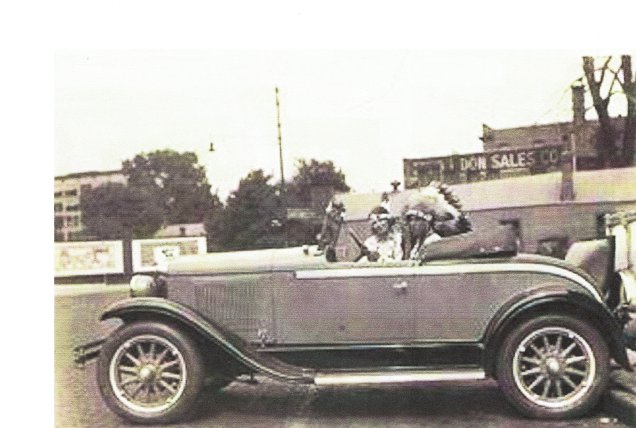
Chief Eagle Feather, a full-blooded Cherokee, toured the country’s vaudeville circuit and was billed as “America’s premier Indian tap dancer.” The Chief, also known as Frank Bell, married our cousin, Myrtle Thomas. The story goes that after their marriage, she was adopted by the tribe and given the name “White Fawn.” She joined Eagle Feather in his adventures as he persued his vaudeville career.

Dave Thomas
September 16, 2015
Pictures from cousin Dave Dunn.
These last few years I haven’t been in many small-town diners or cafes and I was wondering if they still serve chili like they used to. I’m asking because what I’ve seen lately in these plastic franchise eating places makes me wonder. Have we lost the art of serving chili or do those small-town folks still do it right? I’ll tell you how it used to be done and you can keep your eyes open and make sure it’s done right.
I’d go into the 7th Street Café, by Fowler’s Mobil Station, and sit down at the counter. The waitress would ask me “what’ll you have?” I’d say “chili” and she’d go turn the order in to the cook. Then she would come back and make sure I had everything I would need. First, she would come up with that little jug of vinegar. Next, she would make sure the catsup and mustard was at hand. Then, she’d go away and come back with one of those white bowls full of oyster crackers and set it right close. By now, the cook has got the chili up and she brings it to me with one of those big, round spoons. There it is…its perfect! Can you name a place today that will set you up with the fixin’s like that?
Dave Thomas
December 7, 2014
 Some cities have Polar Bear Clubs that award memberships on New Year’s morning to those who dive into the Hudson River or Lake Michigan or some other freezing cold body of water. Here in San Diego, we have the Penguin Club. To qualify, you must water ski a couple of laps around Mission Bay and then lie on a block of ice for a pre-determined period of time. I’ve got a couple of stories about Pat and Terri and the Penguin Club but first I’d like to tell you some of the things that transpired and got them to that shivering group.
Pat was working in the Auditing Department at Sears in San Diego. For many years, that was the only Sears store in the county. The first new store was built in the South Bay at Chula Vista though the original store was still the place to be. In the 1960’s, Sears Roebuck was the primo department store in the country. The commissioned sales people and the clerks were all well trained in both product knowledge and customer service. The benefit packages included great insurance and retirement plans.
Pat was working the Payroll desk in Auditing so each month she saw that the commissioned sales people were making a ton of money. More than once, she expressed a wish to have that kind of earning power.
Pat’s supervisor announced that the company making electric knives and fondue pots for Sears was scheduling demonstrations of their products at the Chula Vista store and it would be an opportunity for employees to make some extra money by conducting these demonstrations in their “off” hours. Pat was asked if she would like to take part in this. She acknowledged that she could use the money and though she didn’t know anything about either product, would like to give it a try. She was accepted and worked several shifts at this new job. It turned out that Pat not only enjoyed what she was doing but was very good at it. The story of her success was passed back up to the San Diego store and her supervisor.
Pat continued working the Payroll desk in the Auditing Department. This was the period when computers were being introduced as tools for business use. The computer necessary to do the administrative, book-keeping, and inventory functions of a store the size of Sears required a room larger than the average bedroom. During the infancy of the computer, life was just one mechanical problem or memory or software glitch after another.
The Auditing Department faced some kind of problem constantly with the reports from the computer. Pat’s co-workers became terrified when they heard the word “computer” and they had little success at troubleshooting. Pat had worked every desk in the department, had a solid understanding of them and fortunately had an uncanny knack for solving computer problems. She approached them in a matter-of-fact manner, without hysteria, and solved the problems using good book-keeping practices and common sense. She solved a number of problems that had baffled the “experts”. Her ability raised her profile in the office even higher than where it had been before. At one point, she suspected that an embezzler was at work but hadn’t as yet been able to pin down the department involved and come up with a suspect. She took some print-outs to her boss and explained why she felt something “fishy” was happening. Her boss looked over the reports and agreed that something didn’t feel right. He asked Pat to stay an hour every night, going over the reports, with a person from Security in the room, until she figured out what was going on. She worked at it for several days before turning over her findings. The result was that a man went to jail for embezzlement.
Pat’s supervisor told her that the management team had been considering her for the position as head of the Auditing Department. He said it would take another 2 or 3 years to acquire the experience she would need but they were confident that she could do it. Pat declined and was asked “why?” She said she needed to increase her income sooner than that and besides, wasn’t interested in heading a department of gossipy women.
One day, a problem occurred that the computer people couldn’t find. Auditors were due in from the home office in Chicago in a couple of days. Pat’s supervisor was under the gun and told her that if she could find the problem, he would help her transfer to sales. It took some doing but she found the answer and though he hated to lose her, her boss kept his promise.
Pat got her transfer and became the 4th woman working as a commissioned sales person at Sears Roebuck in San Diego. She was put to work in the Electronics Department selling TV’s, stereo systems, tape recorders, and other electronic items. The first thing she learned was that she had been dumped into the middle of an “old boys club.” The manager didn’t want any women working for him and the salesmen on the floor were sure that no women could possibly do their job. They treated her terribly! The manager withheld information about sales and merchandise and didn’t provide the day-to-day support that would help her learn the business. The salesmen were rude and withheld information and stole deals from her. If a referral or a returning shopper asked for her when she was out to lunch, the men would say it was her day off and would make a deal and write it up in their own names. They pulled every dirty trick you can think of. It was the same as stealing money right out of her pocket. She would come home at night, frustrated and crying and mad. I felt so bad, seeing her this way, I wanted to go to the store and have a little heart-to-heart talk with them. She said no, because that would just make it worse. She had to stand on her own two feet and learn how to out-sell them.
It was tough. Week after week, Pat studied the merchandise and memorized the specifications. Her sales figures started coming up and she was becoming more at ease on the floor. The salesmen started to loosen up, too. The first was the oldest guy in the group. I guess he realized that he had been brought up better than he had been acting and it was time to display some manners. The other guys softened up, too and the working environment became tolerable. Her sales figures steadily increased and she became one of the top salesmen in the store. A couple of times, she was Salesman of the Month at the store and once was 4th on the west coast. She was making a heck of a lot more money than I was as the Manufacturing Manager of an electronics company.
The “big ticket” salesmen, the people who earned the big money, always worked the weekends and took days off in the middle of the week. Several of them liked to water ski and had their own ski boats. They started to gather informally at Ski Beach, on Mission Bay, on Thursdays for a big skiing day. Pat had earned the respect of the group and she was asked if she would like to participate. She told them that she didn’t know how to water ski but would like to give it a try. She started attending the ski parties on Thursdays and loved it and soon discovered that she was good at it. It didn’t take long for her to graduate from two skis to one ski. At this point, she decided that she needed her own ski and soon after that she needed her own boat.
Pat watched the classifieds in the paper and soon located a good ski boat and trailer and we went out and bought it. We both had a lot to learn about the upkeep of boats and trailers when used in a salt water environment. And, since I had to work and wouldn’t be going with her, Pat had to learn how to hitch up the trailer, back it, pull it, gas up the boat, launch and recover it, and a thousand other things. She learned these things along with our daughter, Terri, who Pat was kidnapping from high school on Thursdays.
Pat told me that she and Terri were going to do the Penguin Club stuff on New Year’s morning and earn the shoulder patch and membership card. It sounded like fun so I went along as a spectator. Boats and equipment would be available so we didn’t have to take anything. There was a good crowd there and people were scattered around the parking lot and the beach and a television crew was there from one of the local stations. Pat and Terri went to get in line for their event. I got myself a cup of coffee and milled around while I waited for the girls to have their turn on the skis.
In the crowd, I spotted a guy that I had worked with for several years named Art Ahlquist. Art was waiting for some of his family to take their turn on the skis and ice block so we stood together and watched and talked and drank coffee. This Penguin Club event was at a different part of Ski Beach than where Pat usually skied. At her regular place, when you were done skiing you headed for shore, cast the tow rope aside and coasted right up to the water line and stepped off onto the beach. Here, the water was shallower so you couldn’t ride all the way in and would have to step off your ski earlier. Art and I watched as people glided in and stepped off their ski into the shallow water.
Pat’s turn came and I watched as she got up and was skiing around the bay. Art had been talking to someone else but turned back around to watch as Pat headed in and prepared to dismount. We could see that she was heading almost straight in, rather than paralleling the shore. Art, who was familiar with this beach said “Who’s that dumb s—t coming straight in?” About that time, the skag on her ski hits the mud and Pat lands face first in the water. “That dumb s—t is my wife”, I said. Pat got out of the water, freezing, and with a skinned nose from her fall. She sat on the block of ice, shivered until it was over and got her shoulder patch and official ID card.
Terri made it around the bay without incident (except for freezing) and did her time on the block of ice. She received her shoulder patch and card and about that time was approached by a member of the San Diego Water Ski Club. He said they wanted to form a pyramid and make a lap around the bay for the TV camera but one of their team couldn’t be there that morning. He went on to say that they had watched her ski and it appeared that she was good and could help them with their pyramid. She would be the person at the top so she wouldn’t have to worry about supporting any weight. She agreed to give it a try so they started instructing her right there on the beach about how the climbing sequence should work so she could get safely to the top. After a bit, they went down to the water and started off. Terri struggled a little but got to the top of the pyramid and had the tow rope in one hand and a flag raised high in the other. They made a lap around the bay with everyone looking good, and then told Terri it was time to dismount. She started trying to climb down and realized that no one had explained the proper way to get down or told her of the proper sequence for doing so. She soon knocked one of her cohorts off balance and the whole pyramid came tumbling down. It was quite a pile-up and Terri nearly had the earrings jerked from her head. They didn’t tear through the bottom of the ear lobes but they made some nasty looking gashes. She was mad and when they all got to the beach she made them show her the safe and proper way to get down. Terri was asked to join the ski club but she told them she would pass.

This is a file photo from the Internet, just to refresh your memory on what a pyramid looks like on water skis. Terri said it was quite a thrill.
Dave Thomas
January 16, 2015

I was five years old, a Kindergarten student, when the Japanese bombed Pearl Harbor on December 7, 1941. Naturally, at that age, I had no idea what that meant. As the days, weeks, and months went past, young and old received lessons every day in the meaning of war and the obscene way the young men of our town were called up and then sometimes returned home in caskets to their broken-hearted parents and friends and neighbors. We all learned about the rationing of food and gasoline and bubble gum and about War Bonds and rallies and restrictions of many kinds. As the men went off to war, the women took their places in the factories, war plants, and farms and churned out the goods we needed to support our servicemen and our country.
We all wanted to contribute to the war effort in any way we could and one of the most interesting ways for a kid to do that was to watch out for enemy aircraft. This may sound strange, considering that we lived in Kansas which is located right in the middle of our country. The Japanese flew in and bombed Pearl Harbor and the Germans were shooting rockets and buzz bombs at England so we didn’t know what they would be capable of doing next. Our enemies could possibly build secret air bases in Mexico or Canada or could launch carrier strikes from the Atlantic or Pacific or the Gulf of Mexico. We all had black curtains temporarily installed over each window in the house so that when the Civil Defense people conducted black-out drills as part of practice air raid drills we could take cover in our homes and be sure that no lights would give away the location of our town.
We kids were all excited about learning to identify all the aircraft in the skies so that we could sound the alarm in case of attack. The greatest aid in this endeavor was the pack of Aircraft Spotter Cards which were manufactured by the people who make Bicycle Playing Cards. These cards could be used as playing cards but their other purpose, and most important to our point of view, was to help identify the military aircraft of friend and foe. We learned to identify the P-40, the P-38 Lightning, the B-25, and the P-51 Mustang as well as the Jap Zero and the German Messerschmitt. It was comforting as well as fun to know these airplanes. As I said, we lived in Kansas but we were only 15 miles from Wichita, the location of an air base and the Boeing, Cessna, and Beech aircraft plants. For all we knew the enemy was liable to make a bombing run on those places at any time. We didn’t go around wringing our hands and crying out of fear but our resolve to be alert and prepared was great.
Dave Thomas
November 27, 2008



I’ve known this guy for more than 45 years. He’s a quiet, soft-spoken man who never swears regardless of the provocation. If he hits his thumb with a hammer, he says “shucky-darn!” If he cuts his finger with a knife, he says “shucky-darn!” No matter how bad things get, he reacts about the same. You know this isn’t normal…this man has been in the Coast Guard and has been working as a lineman and a foreman for the electric company for forty years. He knows all the words but chooses not to use them..
I couldn’t believe it at first. I thought to myself that this guy is going to pinch his finger or something and then he’ll cuss a blue streak just like the rest of us normal people. I just couldn’t believe that he was actually a real shucky-darn guy. Over the years I kind of kept this in the back of my mind. I didn’t go nuts about this and try to trip him up or cause him to explode over some stressful event. I just noted his reactions like you note what is happening with the weather. For instance, it’s warm today or there’s a nice breeze blowing today.
Meanwhile, this is causing me to pay more attention to the people I come in contact with. Is this woman with the super sweet personality and the honey dripping from her lips a shucky-darn gal and is this man with the over-enthusiastic handshake a shucky-darn guy? Or, are they just blowing smoke at me while they cuss me and call me names under their breath? I don’t want to be cynical but sometimes it’s hard to get a fix on people and know if they are real or not.
My friend stayed the same. I guess it’s been almost 50 years now and he has been true to his principles and remained a Shucky-Darn Guy! Don’t worry, I still use all those bad words myself and if you’re not a shucky darn guy or shucky-darn gal I’ll still love ya’.
Dave Thomas
February 8, 2014

