Tornado 1945

tornado-augusta

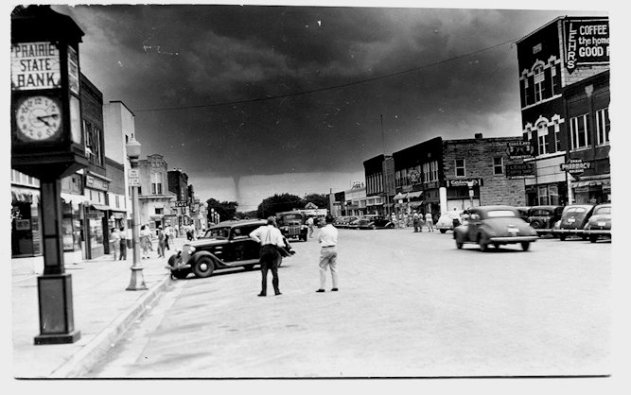
Augusta, Kansas; 500 Block of State Street, looking south. 1945

Fortunately, the tornado veered off and didn’t strike the town but it came close.
Dave Thomas           October 18, 2015


I like this picture because of the drama it displays. The big, black funnel looks like it is coming right up the main drag. The two men in the street seem transfixed and don’t know if they should stay and watch or run for cover.

Since posting this picture, I’ve received information that makes it even more compelling. I have received e-mails from Keith Scholfield and Jack Parker telling me of their connection to the event.

First, let me give you some background. Keith’s Dad, Gene Scholfield, owned Scholfield Hatchery and dealt in feed and grain and chicks. The store, easily identified by its white front, was located on the west side of the 400 block of State Street. Naturally, Keith spent a lot of time there. The first store north of the Hatchery was Bartholomew Furniture, owned by Jack Parker’s Grand-dad, Charles Bartholomew. Jack lived in the neighborhood and spent quite a bit of time at the family store. This information helps explain why the two boys were in the right place at the right time to witness the tornado that was heading for town.

If you look down toward the center of the picture, on the west side of the street, you can see the white storefront of Scholfield’s Hatchery. Keith has seen the picture a number of times over the years. It’s kind of fuzzy because it has been copied so many times, but as Keith points out, if you look closely you will see people standing on the roof of the building. Those are Gene Scholfield’s  employees along with Gene and Keith and Jack Parker. Jack first saw the picture a year or so ago on the museum’s web site and it triggered some fuzzy recollections in his memory of standing on a rooftop and watching an approaching storm. Jack and Keith have conferred about the picture and, though the memories are quite distant, agree that they were on the roof as the tornado was heading for town that day.

Keith says that the day after the tornado was sighted, his Dad took him for a drive southeast of town. They found the track of the tornado crossing Haverhill Road in a spot just north of Smileyberg.

Now, we’ve got a great picture and some people that we know who were associated with it. I think it’s remarkable that 3 old boys like us are communicating through the magic of the Internet about an incident that took place 71 years ago. Keith and I are 80 years old now and Jack is 81 and we have resurrected this story so it can be shared.

Dave Thomas Revised
November 29, 2016


Connections

I grew up in Augusta, Kansas, a small town seventeen miles east of Wichita. Augusta served as a bedroom community for the larger city. Many of our friends and relatives worked in the aviation industry. During WWII, Beech, Cessna, and Boeing hired thousands of people and the city called itself “The Aviation Capital of the World.” There were many small manufacturers before the war and during the evolution of the industry they came and went due to money and growth problems or by being swallowed up by more aggressive entities. One of the success stories after the war was the development of the Lear Jet by Bill Lear and company. I’ve got a few little stories that are loosely connected to Wichita aviation that I’d like to share. I guess they are important only because I remember them. Hope you find them interesting.

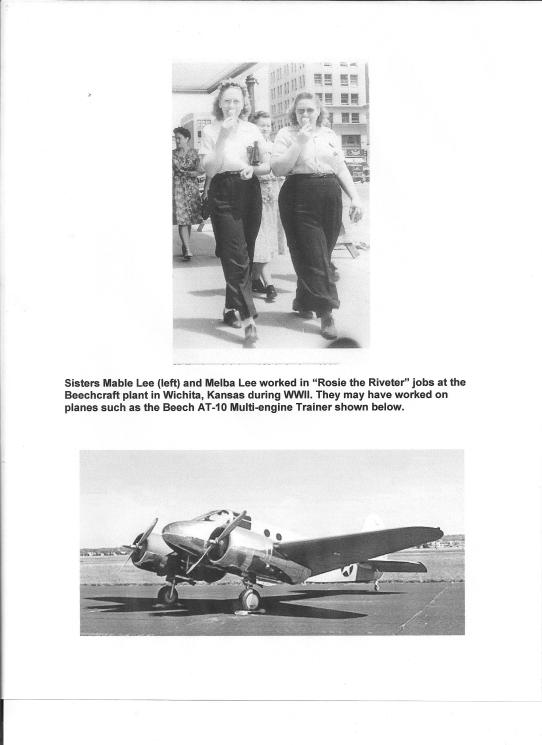
During World War II, Pat’s mother, Melba Lee and her younger sister, Mable did their part by working as “Rosie the Riveter” at Beech Aircraft (later known as Beechcraft). They did well and Melba advanced to a Section Leader position.

rosie-the-riveter

I’m not sure when, but it probably would have been 1945, our Mom was working at the local refinery, and our great-aunt Rachel Peebler was taking care of my sister and I. One summer day, she loaded us up in her green Packard and took us to Wichita to buy some school clothes. We went to Buck’s Department Store on the northeast corner of Broadway and Douglas. We got our shopping done and Aunt Rachel said she was taking us to lunch. Diagonally across the intersection, on the southwest corner, was a big, brown, brick building that I think was a bank. We entered the building, went to the elevator, and rode up to the second or third floor. We stepped out of the elevator into a pleasant-feeling and busy restaurant. Aunt Rachel led us through the tables until she came to the table of a well-dressed older man who rose as she approached and shook her hand. She introduced the man as Mr. Brown and said she had known him for some time. In later years, I figured that he most likely was the man that owned Brown’s Bank in Augusta.

We left Mr. Brown and continued to another table where two ladies were seated. Aunt Rachel introduced us to Olive Ann Beech. We kids knew who she was. She and her husband, Walter Beech, owned Beech Aircraft and were prominent in the business and social life of the city. Their names were in the papers or on the radio every day. Aunt Rachel visited with Mrs. Beech and the other lady for a few minutes and then we had lunch and went home.

The first jet airplane I ever saw was heading for the air base in Wichita. I don’t know the exact year but can establish some brackets on the time. We were at Augusta Junior High School. The school served grades 6,7, and 8. That means I was probably 11, 12, or 13(1947-1949). It was during the afternoon recess when we spotted the plane heading west toward Wichita. The development of jet fighter planes had been in the news quite often. I can’t remember what model it was but the next day the papers carried the story about the plane and its arrival at the base in Wichita.

When I enlisted in the Navy in 1957, I sold my car, a baby-blue 1953 Ford convertible. The morning I was to leave, Johnny Luding drove me to Wichita and dropped me off at the Navy Recruiting Office. After I got out of boot camp in June, I came home on a 30-day leave. Jack Watson was working in the Auditing Department at Sears Roebuck in Wichita. He said there was a cute girl working there and worked it out to introduce me to Pat. We started going out but I was hampered by my lack of transportation. Johnny was working second shift at Boeing and said I could use his car. So, I would drop Johnny off at Boeing and then go spend the evening with Pat. At the proper time, at the end of the evening, I would be back at the Boeing gate waiting for John. Pat and I got acquainted and made up our minds about each other and got married that November on a 3 day Veterans Day weekend. Since we just celebrated our 59th wedding anniversary, I want to say “Thanks again” to Jack and Johnny.

After my 30-day leave, and courting Pat, I checked into Glenview Naval Air Station. It was located just outside of Chicago. Naval Reserve Squadrons “Weekend Warriors” trained there so there was a lot of flying done on the weekends. The pilots had to get in some “stick time” to maintain their proficiency and would fly short hops locally or to nearby cities. They usually tried to get in 4 hours at a time. When I wasn’t working, I would hang out at the Operations Building and catch a ride. For multi-engine aircraft, the base had R4D’s (same as U.S. Air Force C-47) and SNB’s. I only took one hop in an R4D and was bored out of my mind as there was nothing to do but look out the window. The Navy SNB was a variant of the Beech Model 18 or “Twin Beech” as it was known. It was a smaller twin engine aircraft, made for small airfields and was a very reliable aircraft. I forget how many seats it had but you could sit up close to the pilots and watch what they were doing. I probably took half a dozen hops in the SNB’s for a total of 25 or 30 hours. Fun stuff.

I don’t know all the details but sometime during the early 1960’s, my friend, neighbor, and classmate, Glenn Douthitt, was working at Boeing, in Wichita, as a draftsman. Bill Lear moved Lear Jet to Wichita in 1962 and began work on Lear Jet #1. Glenn went to work for Lear and played a big part in the design and layout of the innovative new instrument panel. Glenn went on to become the Chief Contracts Negotiator for the Avionics branch of Lear, located in Grand Rapids, Michigan.

Now, you’ve read a bunch of little stories that are connected in some way to Wichita and its aviation history. I think it is interesting to see how memories can be attached to a common thread. If any of this aviation talk has piqued your interest, one story you might enjoy pursuing is the history of Bill Lear and Lear Jet.

Finding George P. Sicks

November 25, 1996

Here’s a story that I have enjoyed telling for the last couple of weeks. It could be titled “It’s a small world in the genealogy business” or some such.

My Grandpa, George F. Sicks, and Grandma, Ruby, were divorced when my Mom was about 6 years old, and that would have made it about 1919. Mom was raised by her family in Kansas and that was where I grew up also. Grandpa moved around a lot and spent time in Kansas, Arizona, and Los Angeles but he always kept in touch with Mom. She knew that Grandpa had a nephew named after him that was living back in Grandpa’s home town, Iola, Kansas. Grandpa always referred to the nephew as “Young George”. Mom never got to meet Young George and, during the depression, when she heard he had moved to Los Angeles 9she figured she never would. Through his letters and occasional visits, and until he died in 1958, Grandpa kept Mom and the rest of us up to speed on Young George.

A couple of years ago, I got interested in genealogy and started gathering information about the various branches of the family. I didn’t have much luck with Grandpa’s side of the family. I didn’t know a single person named Sicks.

About 6 weeks ago, to help with the research, I bought a computer program called “Home Phone” that is supposed to contain 80 million phone numbers and addresses. Two weeks ago, I was doing some research and opened the Home Phone program. I typed in Grand-dad’s last name and asked the program to search all the western states. The computer did its stuff and came back with a list of about 50 people named Sicks. At first, I didn’t see anything I recognized, but right in the middle of the page was the name “George Sicks” and the address given was only 10 or 12 blocks from where I lived in El Cajon, California! I thought that if I was lucky it might be a son or grandson of “Young George”. I called and had to leave a message on their answering machine. I said, “I’m Dave Thomas and my Grandpa was George F. Sicks of Iola, Kansas. Do you think we might be related?” The next day

Pat answered the phone and it was George. He said, “I’m George Sicks and tell your husband I was named after his Grandpa.” By gosh, I had found Young George, himself!

I went over and visited with George and his wife, Justine, that evening. They told me a lot of family history and had pictures of 6 generations of the family. When I showed them the printout from Home Phone they identified 4 relatives that they had met.

Well, that’s the story. I finally got to meet a guy I had heard about all my life and we hit it off right away. George is 82 years old and I’m 60 now but I hope to see a lot of him in the future.

P.S.

November 9, 2016

George lived to be 94 and passed away in 2008. We had plenty of visits at their house and ours and we enjoyed a few meals at various Mexican restaurants around town. They knew a lot of family history for when George retired, they bought a travel trailer and spent a year traveling around the country and called on a lot of relatives.

When George turned 86, he wanted a big birthday party so his wife, Justine, and step-daughter Kathy Kingsbury put together a memorable one. The plan called for a cruise to Santa Catalina Island with a morning spent sight-seeing in Avalon, a big lunch at a local restaurant, and more sight-seeing in the afternoon. They invited kids, grand-kids, and cousins like me from all over the country. There were at least 30 of us and maybe more. Pat and I drove up to Long Beach the night before and stayed in a motel instead of trying to fight L.A. traffic on the day of the party. We all met down at the pier at 7:00 AM and drank coffee and got acquainted until it was time to go. While we were milling around, Kathy was passing out baseball caps to everyone. The ball caps were well conceived in that they had been stenciled “80 Sicks” in honor of George’s 86th birthday.

g-p-sicks-1

In 2002, Pat and I moved to Keller, Texas, on the north side of Fort Worth and stayed for 7 years. George and Justine flew over and visited us twice. They enjoyed sight-seeing and especially enjoyed our trips to Old Fort Worth and the Stockyards. We always got there in time to watch the cattle drive before we had lunch.

In 2004, while still in Texas, we got a call from Justine saying that there was going to be a big party for George’s 90th birthday. They were inviting everyone back for a day at the San Diego Zoo. It would be a day of visiting and looking at the animals and meeting for lunch at the zoo’s restaurant. I was told that since I lived in Texas I would have to wear my cowboy hat. Pat drove us to San Diego and we went to George’s party and spent a few days visiting with our kids. It was a lot of fun to meet new relatives and visit with those we had met previously. George seemed to enjoy every minute of it.

November 25, 1996

Here’s a story that I have enjoyed telling for the last couple of weeks. It could be titled “It’s a small world in the genealogy business” or some such.

My Grandpa, George F. Sicks, and Grandma, Ruby, were divorced when my Mom was about 6 years old, and that would have made it about 1919. Mom was raised by her family in Kansas and that was where I grew up also. Grandpa moved around a lot and spent time in Kansas, Arizona, and Los Angeles but he always kept in touch with Mom. She knew that Grandpa had a nephew named after him that was living back in Grandpa’s home town, Iola, Kansas. Grandpa always referred to the nephew as “Young George”. Mom never got to meet Young George and, during the depression, when she heard he had moved to Los Angeles 9she figured she never would. Through his letters and occasional visits, and until he died in 1958, Grandpa kept Mom and the rest of us up to speed on Young George.

A couple of years ago, I got interested in genealogy and started gathering information about the various branches of the family. I didn’t have much luck with Grandpa’s side of the family. I didn’t know a single person named Sicks.

About 6 weeks ago, to help with the research, I bought a computer program called “Home Phone” that is supposed to contain 80 million phone numbers and addresses. Two weeks ago, I was doing some research and opened the Home Phone program. I typed in Grand-dad’s last name and asked the program to search all the western states. The computer did its stuff and came back with a list of about 50 people named Sicks. At first, I didn’t see anything I recognized, but right in the middle of the page was the name “George Sicks” and the address given was only 10 or 12 blocks from where I lived in El Cajon, California! I thought that if I was lucky it might be a son or grandson of “Young George”. I called and had to leave a message on their answering machine. I said, “I’m Dave Thomas and my Grandpa was George F. Sicks of Iola, Kansas. Do you think we might be related?” The next day

Pat answered the phone and it was George. He said, “I’m George Sicks and tell your husband I was named after his Grandpa.” By gosh, I had found Young George, himself!

I went over and visited with George and his wife, Justine, that evening. They told me a lot of family history and had pictures of 6 generations of the family. When I showed them the printout from Home Phone they identified 4 relatives that they had met.

Well, that’s the story. I finally got to meet a guy I had heard about all my life and we hit it off right away. George is 82 years old and I’m 60 now but I hope to see a lot of him in the future.

November 9, 2016

P.S.

George lived to be 94 and passed away in 2008. We had plenty of visits at their house and ours and we enjoyed a few meals at various Mexican restaurants around town. They knew a lot of family history for when George retired, they bought a travel trailer and spent a year traveling around the country and called on a lot of relatives.

When George turned 86, he wanted a big birthday party so his wife, Justine, and step-daughter Kathy Kingsbury put together a memorable one. The plan called for a cruise to Santa Catalina Island with a morning spent sight-seeing in Avalon, a big lunch at a local restaurant, and more sight-seeing in the afternoon. They invited kids, grand-kids, and cousins like me from all over the country. There were at least 30 of us and maybe more. Pat and I drove up to Long Beach the night before and stayed in a motel instead of trying to fight L.A. traffic on the day of the party. We all met down at the pier at 7:00 AM and drank coffee and got acquainted until it was time to go. While we were milling around, Kathy was passing out baseball caps to everyone. The ball caps were well conceived in that they had been stenciled “80 Sicks” in honor of George’s 86th birthday.

In 2002, Pat and I moved to Keller, Texas, on the north side of Fort Worth and stayed for 7 years. George and Justine flew over and visited us twice. They enjoyed sight-seeing and especially enjoyed our trips to Old Fort Worth and the Stockyards. We always got there in time to watch the cattle drive before we had lunch.

In 2004, while still in Texas, we got a call from Justine saying that there was going to be a big party for George’s 90th birthday. They were inviting everyone back for a day at the San Diego Zoo. It would be a day of visiting and looking at the animals and meeting for lunch at the zoo’s restaurant. I was told that since I lived in Texas I would have to wear my cowboy hat. Pat drove us to San Diego and we went to George’s party and spent a few days visiting with our kids. It was a lot of fun to meet new relatives and visit with those we had met previously. George seemed to enjoy every minute of it.

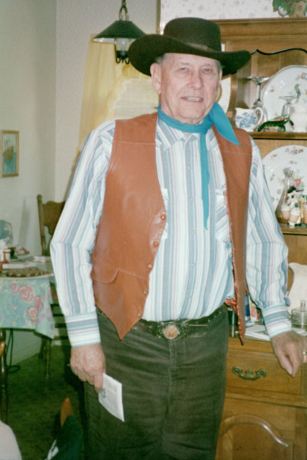
Here’s George at 91 or 92 and headed for a western party.
cowboy-george


The Ball-Point Pen

What if you stopped off at the bank to cash a check and they wouldn’t accept it because it was written with a ball point pen? That’s what happened at our bank and many others in the 1950’s. As a tool being used in the transfer of money, the pen had to function in a near perfect manner to protect the banks from great liability.

The ball point pen was marketed during the late 1940’s but didn’t do well. They clogged and skipped and just weren’t satisfactory. At least two companies went out of business because they couldn’t make the things work consistently.

In the 1950’s, here they came again. The public was really enamored of them. The ball point was so much cleaner and more efficient than the old pens, ink wells, and blotters. There had been problems with the manufacturing of the balls and reservoirs and the ink itself. The pens clogged and skipped until you couldn’t figure out what the number or letter was supposed to be. There was even speculation that the ink might just disappear. This was giving the banks major headaches. When the pens skipped a few letters it might be impossible to read the date, the amount, or the signature. The pens were causing so many problems that our local bank and others finally said “whoa”. After World War II the world was hungry for new technology and we were being held back. The high-handed bank was keeping us from using these new toys. How dare they? This became a topic of conversation at the dinner table, at work, at school, and certainly at the barber shops and beauty shops of our town.

Over time, the kinks were worked out, the pens became reliable and the bank lifted the restriction against using them. However, this didn’t solve all the problems. Suddenly, there were chains affixed to the pens and they were being attached to the writing tables in the bank. The town was buzzing again! Doesn’t the bank trust its own customers? They think we are thieves! The problem was that the bank was buying high quality pens…much better than the public was getting at the dime store, so people wanted the good ones. Eventually it all died down and things became as you see them today.

Dave Thomas
10/31/2013

Flight of the Goose

The Flight of the Goose

In the late summer and fall of 1956, I was roughnecking in the oil fields of eastern Colorado. That’s sand hill country and it’s a pretty bleak-looking place. Oil had been discovered and there were a few producing wells. The area was described as shallow-hole country because if oil was found it was generally at 3800 to 4400 feet. Since the holes weren’t very deep, we could move the rig in, drill a hole, and be out in a week.

I worked for a contract drilling company. We were hired to drill holes and hopefully bring in a well but it didn’t always happen. The rig I worked on drilled 20 dry holes in a row. We drilled where the geologist located characteristics that looked good but it was still just a SWAG (Scientific Wild Ass Guess).

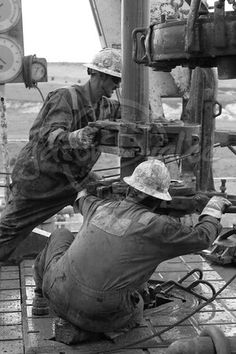
There were 4 men on our drilling crew, the driller and 3 roughnecks. The driller was the boss and operated the controls of the rig and maintained the drilling logs. Two of the roughnecks worked on the “floor” of the rig and the third man worked up high, 20 feet above the floor, and was known as the derrick man. It’s interesting to know how the equipment works but I won’t go into it here.

roughnecks

Working the floor

The pipe is known as “drill stem” and each section is about 30 feet long. If your hole is 3,000 feet deep then that means you have used 100 pieces of drill stem. Actually, 1 piece might be 29’10″ and the next one 30’2″ so the driller records the length of every piece of drill stem before it goes in the hole. The 2 roughnecks working the floor are responsible for “strapping” (measuring) the pipe. They report the lengths to the driller.

The job of the derrick man can be dangerous so an experienced hand normally works that job. I won’t explain it here but you can find a couple of youtube videos that describe it pretty well.

The guy that worked the derrick on our crew was Bud Giese (geez-ee) and his nickname was “Goose”. The Goose was a year or so older than I and had been working in the oilfields since high school. The other two guys in the crew were married but Bud and I were single and shared a room at the hotel where we stayed. Bud was one of those guys that everybody liked and you could probably call him “charismatic”. We could go into a restaurant and in 2 minutes he would have a date with at least one waitresses and possibly two. Mothers would say that he was definitely a “bad boy”. It was fun being around him and watching him operate because to him, life was a picnic and he wanted to taste all the goodies. His “good time” attitude caused a few confrontations but when it was time to fight, he was right in the middle of it. His exuberance was something to see. There was never a dull moment.

This week, we were drilling a hole in the middle of what was reported to be a 100,000 acre ranch. This was the day we would know if we had a well or not. We knew we were close when the drilling got down far enough to hit a certain strata of sand because it had been established when the producing wells in the neighborhood were “brought in”. The night crew had pulled the pipe out of the hole and replaced the drill bit with a core-drilling gadget that would capture a sample of several feet of the strata and the geologist could examine it and determine if we had hit oil-bearing sand. When we got to work that morning, we finished bringing up the core sample and were just loafing around and waiting for the geologist to show up and check it. Goose was still up in the derrick so I climbed up to join him while we were killing time. We were leaning on the rail and looking over the countryside while we talked. All of a sudden, 4 or 5 cars full of people came over the hill toward us. The driller had notified our office by radio that we would soon know if we had a well and they had called the ranch owner and his family. The cars pulled up close to the rig and 10 or 12 people got out and were standing around and hoping for good news.

We watched as time dragged on and the crowd got bored and began shifting from one foot to the other. Goose says “Those poor people are getting bored down there. I think I’ll give them something to get excited about.” He was still wearing his safety harness and started tightening up the straps. He checked his tether to make sure it was anchored securely and he had plenty of slack. Then he climbed over the rail and moved to the outside of it. As he checked his position as regards the derrick legs and the pipe, I noticed that the people in the crowd were talking and a couple of them were pointing toward us. Goose glanced at the crowd, presumably to make sure they were all watching, and then launched himself off the platform in a perfect swan dive! I would swear you could hear the people in the crowd gasp. I was probably gasping or choking a little myself. The Goose had flown!

I would imagine that the faces of the ladies in the crowd turned red as they listened to the driller cussing Bud out. Bud took it with kind of a sheepish grin and didn’t worry about it too much. The geologist soon showed up and told us that we had drilled another dry hole. The rancher and his family wouldn’t remember this as the day they got rich but as the day the crazy roughneck did a swan dive off the drilling rig.

Dave Thomas
April 7, 2015

Derrick man

Pat’s First Car

Pat graduated from El Dorado High School in El Dorado, Kansas in May of 1955. She wanted to get right to work and start earning her way in life. The Wichita Business College was offering a 3 month “crash” course during the summer with a guarantee of employment after successful completion of the course. Pat and her friends Charlotte and Susie elected to take the book-keeping and accounting course and get their working lives started. The school was set up so that if you failed, you had to take the course again. The girls had taken some business classes in high school so were able to breeze right through the course.

The Placement Counselor had noticed that Pat and Charlotte were pretty close and one day called them into her office and asked if they would like to work together. They thought it would be great if it were possible. The counselor said she had already spoken to an employer that was looking for two new people and would hire them both.

Upon completion of school, Pat and Charlotte went to work in the Auditing Department at Sears Roebuck and Company and Susie went to work at Macy’s. The girls were sharing an apartment and getting adjusted to living on their own. Transportation to and from work was possible through the city bus system though it ate up a lot of their spare time. In Pat and Charlotte’s case, the morning bus schedule was easy and caused no problems. However, the evening schedule was a drag in that they had to wait an hour to catch their bus. Going home to El Dorado for the weekend was hard because they had to hope that someone they knew was going that way and would also be able to bring them back.

After being on her job for a while and settled into her apartment and the routine of living on her own and paying bills, Pat decided it was time to buy a car. She enlisted the help of her step-dad, Eddie, who was a fair shade-tree mechanic and for a short time had sold used cars. Pat got home on a weekend and she and Eddie headed for a used car lot on south Main, there in El Dorado. Eddie knew one of the men that worked there and explained to the guy that they were looking for a very reliable car that Pat could drive to work without worrying about it. The salesman said he had the perfect car for her and that it was the most reliable car on the lot. He led them to this car that turned out to be a 1947 Studebaker! What? Was this guy nuts? Maybe we should talk about Studebakers for a minute while you get over the shock. There were five Studebaker brothers (and five sisters). Two of the brothers were blacksmiths and foundry men in South Bend, Indiana who started a company in 1852 making the metal parts for freight wagons. Another brother was in Placerville, California making wheelbarrows for the gold rush miners. He did well and saved up $8,000 and returned home to South Bend and helped the other brothers expand their business to the manufacturing of complete wagons. While building wagons for farmers, miners, and the military, they were also building a reputation for quality and reliability.

In 1902, the company produced a car with an electric motor and in 1904, a car with a gasoline engine. The company continued to build cars and trucks until WWII when they concentrated on the war effort, building great numbers of Army trucks and personnel carriers. Coming out of WWII, the company prepared for the post-war automotive sales surge with radical new designs. When the 1947 Studebaker was introduced, people couldn’t believe their eyes. Due to the radical departure from conventional General Motors and Ford styling, it looked more like a space ship out of a Buck Rogers comic book or like some kid’s idea of what futuristic cars should be like. The flat trunk lid looked so much like the engine hood you couldn’t tell if the thing was coming or going.

Studie 2

Back on the Used Car lot, Pat and Eddie looked the car over. It started easily, ran smoothly and quietly and was a solid, well-built car. The interior was spotless and was upholstered with quality fabrics. After a test drive, Pat and Eddie were convinced they had found a good car. So, now we have a 17-year-old girl that came in looking for a chic set of wheels, picking a

gray Studebaker. Who would have thought?

Pat was able to purchase the car on easy terms. The total price was $150.00. She put $30.00 down and payed it off at $15.00 per month. This was a little tight as she only made $45.00 a week and had to cover all of her living expenses out of what she was earning. One of the good things, at the time, was that gasoline was only $.17 per gallon.

Over the next few weeks the girls all had their 18th birthdays. Pat wanted to take a trip in her “new” car and, being all grown up now, the girls decided to go to Kansas City and dine at the well- known Italian Gardens Restaurant. The ladies wanted to avoid the embarrassment of showing ID so were decked out in their most mature-looking outfits and had applied make-up to match. The trip to Kansas City was uneventful and they had no trouble finding the Italian Gardens. Once in the restaurant, they were seated, examined the menu, and were ready to order when the waiter returned. They gave their orders and the waiter asked if they would enjoy a glass of wine. They all agreed that would be nice and then, the waiter asked if they would like a carafe. Having no idea what a carafe was but wanting to appear cool, they all said “Each, please”. Well, after eating their lunches and drinking their carafe of wine, they got up to leave. For some reason, they found that standing was a very difficult task. Pat realized that she was in no condition to drive. They talked it over and decided that the smartest thing they could do would be to take in a movie and sober up before heading for home.

There you have it…a first car and a first grown-up trip. Pat was ready to be on her own and took seriously the responsibilities of an adult and car owner. And, now that she knew what a carafe was, never had that problem again. The Studebaker was great and never failed her once.

Dave and Pat Thomas
September 2, 2016

Tim McGraw

Last season NBC started airing a new show called “Who Do You Think You Are?” It’s sponsored by the genealogy-based website, Ancestry.com, and they take a celebrity and trace that person’s ancestors back as far as they can. They visit locations in the U.S. and even go back to Europe or Africa or wherever the quest takes them.

Pat and I were watching an episode last night featuring country singer, Tim McGraw. The story told how Tim thought his last name was “Smith” until he was 11 years old and found his birth certificate and learned that his name was really “McGraw” and that led him to the fact that he was the son of Tug McGraw the baseball player.

As they dug into his story, Tim learned that he was part of a pioneer family in Missouri named Chrisman. The Chrismans were tracked back to the Shenandoah Valley of Virginia during the 1700’s. The story told how the Palatines fled religious persecution in Germany and traveled to England and then were recruited to travel to America. Upon arrival in America the people became indentured servants as the British forced them to work off the cost of their passage. The next revelation was that an earlier ancestor was named “Yost Heyd”. Yost Heyd was apparently an enterprising man and went from being an indentured servant in 1710 to being the largest private land owner in Virginia and was known as “The Baron of Shenandoah”. A young surveyor who was surveying the state recorded Yost Heyd’s name in his journal and probably knew him well. That young surveyor was George Washington.

While Pat and I watched the program, I began to perk up as I heard words like Palatine, Shenandoah, and then “Yost Heyd”. I remembered those names from several years ago when I was posting information and names to my Family Tree Maker database. After watching the program, I went to the computer, opened Family Tree Maker, and did a search on “Yost Heyd”. Sure enough, he popped up and the program said he is my 7th great grandfather! So, Guys…Tim McGraw is your cousin! I know that all of you guys would like to say hello to Tim and would certainly enjoy meeting up with his wife, Faith Hill.

Dave Thomas 11/12/2012

Tim -Faith


Tim McGraw and wife, Faith Hill. 


Palapa In Yelapa

Palapa


When I was talking with Doug the other day he mentioned that Penny had purchased some indoor-outdoor carpet for the larger palapa in their back yard. (For any of you not familiar with them, a palapa is an open-sided beach hut with a thatched roof.) This got me to thinking that Pat and I once saw a palapa in Yelapa. I’ll try to clear this up for you. Yelapa is a settlement in Mexico that is located on a beach that is a couple hours boat ride south of Puerto Vallarta. You take an excursion boat that has nice bench seats and a canopy to protect you from the sun. It’s a beautiful boat ride on a blue ocean with varying shades of green in the jungle on shore. Your boat pulls up to a dock and as you get off you can see dozens of palapas scattered along the beach. Many of the palapas contained people selling trinkets and tourist stuff. However, the specialty of the place was pie! They offered coconut, chocolate and lemon meringue that was “to die for”. Another special activity was para-sailing. As you were lifted above the height of the tallest trees in the jungle you could see a beautiful waterfall. So, along with all the sights, thrills, and pies you also got to enjoy the sight of a palapa in Yelapa.

Dave Thomas
June 20, 2011


Our Beach House

It was early 1999 and Pat and I had been living in Avocado Estates for eleven years. Avocado Estates was a gated community of 110 homes in the hills on the south side of El Cajon. The common areas included three avocado groves, a pond, tennis courts, an Olympic-size pool, and a hiking trail. The streets all curved around the hills and gave the development a charming rural look. It was a beautiful place to live and we had thoroughly enjoyed being there. We were getting restless though and were ready to try something different. Pat had taken early retirement and I was just two years away from retiring at 65.

We owned a 3 bedroom condo in University City that we had been renting out for 10 years. We decided that when the current tenant moved out, we would sell our home in Avocado Estates and move into the condo until we decided what we were going to do. By mid year we had received notice from our tenant and we were able to close a deal on the Avocado house. We had the interior of the condo painted, installed new carpet in the bedrooms, replaced the downstairs carpet with wood flooring, and then, Pat remodeled the kitchen. It was a tiny, galley-type kitchen but she designed the cabinets to maximize storage space and bought all new appliances. The kitchen and the rest of the home looked great and you kids were generous with your time in helping us move in. Remember, we had to put a lot of our stuff in storage since we were downsizing considerably.

We enjoyed living in the condo with its proximity to downtown, Old Town San Diego, and the coast. As the crow flies, we were only about 5 miles from the beach and the Pacific. Still, we weren’t quite satisfied with our circumstances and were thinking about a beach house with a view of the water. Since we had just renovated the condo and moved in, it wasn’t practical to just pack up and go somewhere else. After a lot of back and forth conversations, Pat suggested that a large picture or a mural might give us what we were looking for. We decided that a mural would be just the thing and the kitchen was the only place downstairs that would be suitable. The next consideration was that hiring an artist would cost us some big bucks. Pat suggested that we do the job ourselves. Neither of us had ever shown any artistic ability but what the heck…? A coat of paint would cover anything that was too ugly for humans to view.

We bought some paint and got started. Pat and I enjoyed working on it and Jeff got involved for a while. Terri stopped to see us one day and we convinced her to add a few strokes. When we got done it kind of looked as if you were stepping out the kitchen door onto a porch and then a sandy beach. Maybe you could call it “hokey” or even “tacky” but it was fun to do and we enjoyed it all the time we were there.

We only stayed in the condo for 2 years. Pat and I continued searching the Multiple Listings online for the Fort Worth, Texas area. We had some friends down there we had been talking to and ended up buying a new 4 bedroom, brick home in Keller. So much for downsizing but I guess we satisfied our itch for something different.

Beach House

Dave Thomas
February 12, 2015


Such A Deal!

I think I started going hunting when I was about eleven so that would make it about 1947. I went out with two neighbor boys that lived three doors to the south of us. Gary Casner was a good friend and was my age. His brother, Billy Bob, was about four years older than Gary and I. Bill had an old Stevens .22 Single-Shot rifle and he would let Gary and I take a shot now and then. We felt pretty good when we managed to hit a tin can or two.

I dreamed of owning a .22 and my Dad promised I would get one on my 12th birthday. Well, my 12th birthday came and went and no rifle showed up. I didn’t really expect it to happen because I knew there was no money in the household for an extravagance like that. I knew I would have to make it happen myself.

Across the street and two doors north lived the Breeden family. “Red” Breeden was a WWII Army vet who had managed to bring home some souvenirs from Europe. He had a metal helmet, a helmet liner, canteen and web belt, German money, and some German equipment. To me, the prize was a German Officer’s dress knife. It was a beautiful thing and you could see it was made of the finest German steel. Sure enough, stamped on the blade, right under the hilt, was the name “Solingen”. The hilt was a cast piece with some decoration. The knife had a beautiful stag handle and the butt piece was cast in the shape of an eagle’s head. The sheath was also of beautiful and shiny chrome-like steel with cast decorations attached.

Red kept his souvenirs out in his garage and if he happened to be working out there when we came by we would stop and talk and he would show us those articles he had brought back from the war. While looking at his stuff I also noticed that Red had a pair of men’s figure skates. I was really impressed with them because all we kids had at the time were clamp-on ice skates that rarely stayed on more than a few minutes at a time. A pair of shoe skates would have made any kid happy.

Talking with Red I discovered that he was interested in getting his young son an electric train set. I happened to have a nice train set that I had outgrown and never played with. Red mentioned that we might make a trade so I began thinking about the stuff in his garage that I might be interested in.

Meantime, Bill Casner had just acquired a new Mossberg .22 caliber Bolt-Action Repeater. While showing me the new rifle, Bill indicated that he would be getting rid of the old Stevens single-shot. I had already told Bill about my possible trade of the electric train and had told of the items I might trade for. We talked about the shoe skates and I told him they were not my size and he indicated they would be perfect for him. I took this information into account and went home to think about it.

The following Saturday I went over to Red’s house to make a deal. I proposed trading my electric train to Red for the ice skates and the German officer’s knife. Red told me he had taken that sheath or scabbard from the knife and used a hacksaw to cut a couple inches from it so it would fit another knife he had. I couldn’t believe it! That would be like painting a mustache on the Mona Lisa! I couldn’t believe that Red placed so little value on the knife and sheath and was broken-hearted. I still wanted the knife though and went back at him with a new offer…my electric train for his ice skates, the German knife, and an American Army bayonet. Red agreed and we exchanged items.

My target was still the rifle so I went to Bill next. After a couple of days of thinking about it, Bill was eager to swap his old single-shot for the ice skates and an old stripped down Schwinn bicycle with no fenders. (I had a nice Schwinn bike but figured this old one would keep the wear and tear off my good one). I couldn’t have been happier. I hunted with the old single-shot for a few years until I was also able to buy a Mossberg bolt-action. I ran my hands over the German Officer’s dress knife and admired it for its superior craftsmanship and beauty. All of the wheeling and dealing I’ve described took place in 1948. In 2007, I decided to sell my collection of knives and started listing them on E-Bay. The German Officer’s Knife sold for $237.00. Such a deal!

German Knife 

I don’t have my original pictures but found this similar knife on the Internet. My knife had a more attractive stag handle with a silver casting in the center of it.

Dave Thomas

May 14, 2014