Seaplane Story 1

Outbound

As I was going through some pictures this morning I found this picture I can use in this seaplane story but can also tie to some family history.

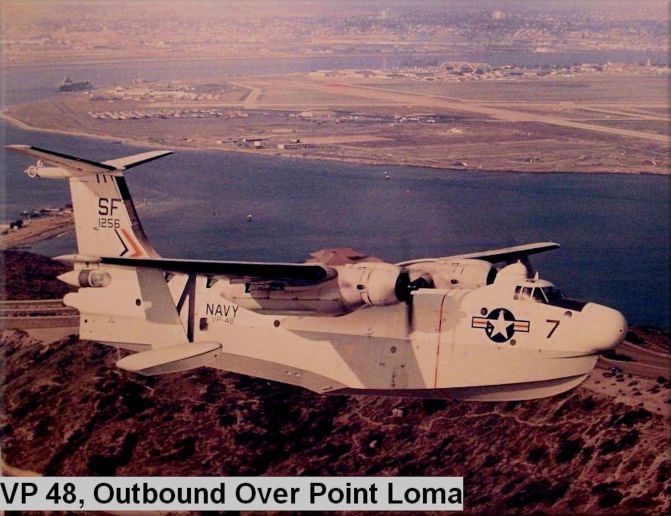
The picture I’ve attached is of a Martin Marlin P5M-2 seaplane. The tail identification, “SF”, indicates that it belongs to Patrol Squadron Forty-Eight (VP-48) and the “7” tells you that this plane is #7 of a 12 plane contingency. So, this plane’s call name is “Sugar Fox 7”. I flew in Sugar Fox 7 a number of times but was normally in Sugar Fox 1, the skipper’s plane, as I was the lead technician in that crew.

The P5M-2 was an Anti-Submarine Warfare (ASW) aircraft and was packed with sophisticated electronic gear in order to hunt submarines. Once a sub was located, the plane was capable of firing rockets or dropping bombs on the target. The cylinder hanging under the starboard wing, near the pontoon strut, was a 1 million candle-power searchlight that created a lot of excitement when you caught a sub running on the surface at night and illuminated him. The plane normally carried a crew of 10 or 11 men with varying job assignments.

In the picture, the plane is heading west and is flying parallel to the edge of Point Loma, a peninsula that juts out into the Pacific. The water that is shown just above the seaplane, from left to right, is the San Diego Channel, connecting San Diego Bay with the Pacific.

Finally getting to the point of my story, on the ground, below Sugar Fox 7, and located along the hillside, is Fort Rosecrans National Cemetery. Among the many veterans buried there you will find the gravesite of our cousin, Donald L. Thomas, a WWI veteran. His wife, Loyce, is buried in the same plot. From their resting places there is a beautiful view to the south of the city of San Diego, the San Diego Channel, North Island Naval Air Station, the city of Coronado, and on the horizon, Tijuana, Mexico. Of course, looking to the right, you see the beautiful blue Pacific.


Dave Thomas
March 13, 2012, revised February 15, 2015

Seaplane Story 3

Here’s an interesting video lasting only 2 or 3 minutes that outlines the development of the P5M-1.One of the interesting innovations was the incorporation of hydro-flaps. They are hydraulically operated appendages built into the rear of the hull that could be energized separately for steering or could be deployed at the same time and serve as brakes when the aircraft was in the water.

Another interesting part of the video is the take-off. As the plane gets up to speed it creates a “rooster tail” higher than those seen at the thunder boat races. At the tail of the plane is a 50mm machine gun turret that has a spectacular view during take-off. The turret was no longer armed or occupied so, with the pilot’s permission you could sit back there during take-off. You are facing backward and as the speed increases, the walls of water get higher and higher until it feels like you are looking down a canyon. What a ride!

http://www.livingwarbirds.com/martin/p5m-marlin.php

Here’s an interesting thing about water take-offs. Sometimes at dawn and for a short time thereafter, San Diego Bay is as smooth as a sheet of glass. No ships or boats have been moving to cause ripples or waves. It sounds like it would be perfect for take-off but you can’t develop any lift and get airborne. On a morning like this, the pilot calls the tower and tells them to watch out for surface traffic while we tear around the bay in circles and try to develop some waves.

I was doing some research and found a YouTube video about the crash of a Martin P5M-2 seaplane from VP-48, my squadron. It crashed in the Laguna Mountains 1/1/1959 on a flight to the Salton Sea. The pilot and co-pilot were killed but 8 members of the crew bailed out successfully. The 2 men in the crew that I knew best were Allen Van Dyke and William Little. The crew roster appears in the last few seconds of the video. Bill Little was an Aviation Electronics Technician First Class (AT1) and we worked out of the same shop so I saw him every day. Both guys said that bailing out was a hairy experience because the plane was just barely clearing the mountain tops.

http://youtu.be/p8d2JgrHrcU

Dave Thomas
March 15, 2012. Revised February 20, 2015 

—————————————————————————————————————

It’s for real: Seaplane ended up in and took off from Ascarate Lake

Trish Long / El Paso Times

POSTED: 05/08/2009 11:31:34 PM MDT

Dear Trish, my name is Eddie Bustamante. I’m not from here. I have heard from people that have lived here all their lives that a seaplane landed on Ascarate Lake many years ago. If it is true, what year? And how was it able to lift off the lake? I keep wondering if people are just pulling my leg. Can you help?

They’re not pulling your leg, Edward. On April 10, 1960, a U.S. Navy P5M Martin Marlin seaplane was made an emergency landing on the 3,000-foot long Ascarate Lake.

The pilot, Lt. M.T. Burke, said he made the decision to land in the “pond” when the starboard engine began cutting out every few minutes.

“The trouble started around Yuma,” Burke told the El Paso Times at the time. “But it didn’t get serious until we were 50 or 60 miles out of El Paso.” The officer decided to come to El Paso rather than try for Elephant Butte Lake.

Before landing, much of the fuel was dumped from the seaplane, which the El Paso Times article also referred to as a “flying boat.”

Burke and his crew had left San Diego en route to Baltimore, via Pensacola, Fla. The seven people on the flight were members of a ferrying group that transported planes across the nation.

The plane landed from south to north, then was towed with the assistance of a Sheriff’s Department boat piloted by Deputy Charlie Barker, and a County Recreation Department boat, handled by Earl Thurston, to the north end of the lake.

Additional personnel, tools and spare parts were flown in to help get the flying boat ready for takeoff while Burke held an “open house” so that Mayor Raymond Telles, County Judge Woodrow Bean and other City and County officials could inspect the seaplane — “a rarity in El Paso.”

The landing, however, wasn’t as complicated as the takeoff later.

Four rockets were added to the seaplane, it was stripped of all unnecessary equipment, and it carried a minimum load of fuel to make it as light as possible. The trees at the south end of the lake were soaked overnight and pushed over with bulldozers.

In the early morning of April 23, an Air Force helicopter hovered overhead and emergency crash trucks stood ready in case of trouble.

Capt. Ted Vogel of the El Paso Police Department and two members of the Sheriff’s Department Boat Patrol were also on watch, and Mexican police had an ambulance and fire truck ready on the Mexican side.

At 6:13 a.m., the 77,000-pound flying boat, using its extra jets and aided by small motorboats kicking up waves, took off successfully from Ascarate Lake.

The pilot was Lieut. Commander William L. Schad, and his co-pilot was Lieut. Gordon R. Williams. They flew from El Paso to Corpus Christi and then on to Baltimore, Md.
___________________________________________________________________________

The pilot mentioned in the next-to-last line, Lt. Cdr. William Schad was the plane commander of Crew 4, SF 4, of VP 48. He was a skilled pilot and I flew with him a number of times.
Dave T


Wal-Mart Greeters

Gary Casner sent an e-mail about the Admiral who was a Wal-Mart Greeter. I’ve enjoyed the story a couple of times before and it always reminds me of my own “Greeter” story.

Four or five years ago, Gene Maness and I were drinking coffee at our favorite McDonalds’s in Keller, Texas. We were mouthing off at each other as we usually did and started talking about getting part-time jobs just to keep ourselves busy. We discussed several possibilities and discarded each of them for one reason or another. Finally, we got to Wal-Mart Greeter and things started looking up. A new Wal-Mart Super Center was just opening up a couple of blocks from where we lived. It looked perfect! There would be no commute to speak of and if your wife needed some groceries or something you could pick them up on the way home and save a trip.

As we continued to discuss the benefits of working at Wal-Mart I mentioned that we would get to hug the good-looking girls as they came in, just as they do in the Wal-Mart commercials. Maness, who was always a “the glass is half-empty” kind of guy, says “do we have to hug the ugly ones, too?’ Well, I had no idea but I remembered that we were going to attend a Homeowner’s Association meeting that would be held at a neighborhood school Thursday evening and that the Manager of the new Wal-Mart would be introduced to the community there. This would be a perfect time for us to ask some questions.

We arrived at the meeting a little early and quickly spotted a guy wearing a Wal-Mart ID badge. We went over and introduced ourselves and before I could blink an eye, Maness says” If we went to work as Wal-Mart Greeters we would hug all the good-looking girls that came through the door but we want to know if we would have to hug the ugly ones, too?” The manager who was pretty quick on the uptake (that’s why he was the manager) said “Yes, you would have to hug the ugly ones, too. We are an equal opportunity company and try to treat all our customers in the same way.” That killed the whole deal for us…it was time to go back to square one and think about other opportunities.

Dave Thomas
November 12, 2012


Old Mrs. Coates

It was about 8:00 AM on one of those joyous summer mornings with the sun shining and heavy dew glistening on the leaves and grass. I had just finished my third grade year and was thankful to be free. I was on the way to visit my Great-grandma Minnie, who lived several blocks from us. It was always a special treat to be invited to breakfast with Grandma Minnie because she always fixed me her special bread pudding with raisins in it.

As I got closer to Grandma’s I could see that her across-the-street neighbor, old Mrs. Coates, was out on her front porch enjoying her morning tea. I yelled, “Good morning, Mrs. Coates!” She yelled back, “Good morning, David, how are you this morning?” (I should explain that Mrs. Coates had a voice that was loud and clear and you could hear her clear to the end of the block.) I responded “I’m OK, how are you?” She bellows back, “Well, David, I had a wonderful bowel movement this morning so I know it will be a great day!” This was more information than a little kid could handle and I felt my face turning red as I ran for Grandma’s door and a chance to get out of sight.

Dave Thomas
March 31, 2012


Grandpa and Billy the Goat

Grandpa, A.A. Thomas, always had something interesting going on. One day I rode my bike down to visit Grandpa and Grandma. I might have been 11 or 12 years old and Grandpa was at least 80. When I got to the house, Grandma said Grandpa was out in the back yard so I went on out there. It turned out that Grandpa had bought himself a cute little billy goat. He was putting the finishing touches on a pen he had built for it. He told me he had named the little critter, Billy, and that I could get in the pen and play with him. Billy was a friendly little guy and enjoyed being petted and fussed over so I played with him that day and pretty often in the days that followed.

Then, for some reason I didn’t get down to see Billy for quite a spell and when I did go to visit, I couldn’t believe my eyes. Cute little Billy, the kid goat, had turned into a full-sized ram with a fine set of horns. Grandpa said he was still just a playful little guy and I should just go on in and give him some attention. Well, Billy was glad to see me and I enjoyed petting him and messing with him. I noticed that he had tipped over his water bucket so I thought I would refill it. I stooped over to pick it up and wham… I got knocked flat when Billy charged up and butted me in the behind. It turns out that “little” Billy had learned how to use those horns and loved butting anyone dumb enough to turn their back on him. Grandpa was laughing so I knew I had been set up. Grandma heard the commotion and came out and chewed on Grandpa and told him  he should be ashamed of himself. Grandpa just laughed more and said “that darned Billy has got me a dozen times!”

I saw Billy a few more times but one day I got there and Billy’s pen was empty. When I asked Grandpa of Billy’s whereabouts, he just said “he got me one time too many!”

Dave Thomas
April 26, 2013


Fired!

If you read my story “AVS Honey”, you will remember that in 1950, after I graduated from 8th grade, I had a 3 or 4 week period before I was to spend the summer in Arizona with my Grand-dad. I told you about the AVS Honey job because it was interesting and it was fun. I almost forgot that for 3 or 4 days prior to AVS Honey, I had a job in a filling station. Maybe I’m blocking it out of my memory because I got fired. Here’s how it happened.

In Kansas, you could get a restricted driver’s license when you were 14 years old. As a result, the schools offered a driver’s training course to 13 year old 8th graders. I took the course and learned the rudiments of driving and how to take care of a car.

Bill Nutter and Ray Tarman took over the management of a Socony-Vacuum (later, Mobil) station. This is the station that had been run by a man named “Heavy” Stevens at the south end of Augusta where State Street and Walnut Street come together.

Just before school was out, my Mom happened to see Bill Nutter down town and visited with him a little. After Bill told about his new business, Mom told him about me needing a short term job and asked if he could use me at his new place. Bill said it so happened that he had hired a college kid for the summer but this kid wouldn’t be out of school for another 3 weeks or so. He told Mom that he could use some help until the college kid showed up and that I should come down and talk to him. I hurried down and talked to Bill and he agreed to hire me.

Back in those days, the gas stations or filling stations were more correctly called “service” stations. A customer pulling into a station for any amount of gasoline expected to have their windshield washed, oil checked, and radiator water level checked. And, if requested, the air pressure in their tires would be checked. Beyond that, if requested, the attendant would grab a whisk broom and sweep out the car.

The work stuff didn’t bother me. I could do all the necessary things or sweep the driveway with no problem. My shortcoming proved to be that I didn’t know enough about cars or engines. Bill or Ray would be working on a car and I would have to interrupt them so they could help me locate something. The first day, it was a cab-over truck and I couldn’t find the dipstick to check the oil level. The next day, I couldn’t find the gas cap on a customer’s car. Earlier models were easy to find. They were normally in plain sight, a shiny chrome thing sticking out of a rear fender. The manufacturers were just starting to get tricky and hide them behind little doors in the rear fender wells. However, on my second day at the station, I had no idea where the gas cap was on this guy’s car. Trying to look “cool” (rather than stupid) I walked into the grease rack and asked Bill where the thing was. “It’s behind the license plate”, he says. “No kidding?”, I say. Sure enough, there it was.

The 3rd day, I was really intense. I wasn’t going to miss anything. The morning went well but in the middle of the afternoon, here comes this late model Cadillac. The driver told me to “fill it up” so I got the hose and was ready to start pumping gas. I’m in trouble again…I can’t find the gas cap! I checked the fenders, the license plate, and the trunk with no luck. Finally admitting to myself that I had failed again, I went in and got Bill out from under the hood of a car and asked him to show me where the gas cap was on a Cadillac. Bill doesn’t say anything but walks over to the left side of the car, takes hold of the tail-light and swings it up and out of the way. There’s the gas cap! The tail-light lens is hinged! That was just too damned cute for words. Who puts a gas cap in a tail light? I gassed up the car and got the man on his way.

At quitting time that night, Bill told me that I just didn’t know enough about cars and they wouldn’t be able to use me after all. I understood and there were no hard feelings.

Dave Thomas
February 12, 2016


The USS Constitution

USS Constitution-Boston 2

Picture Courtesy of Chief Flora, USN Retired.

This picture spans the time from 1797 when the U.S.S. Constitution, Old Ironsides, was launched until now, 2011. Old Ironsides, the sailors on the dock, and the Blue Angel aircraft and their pilots are all on active duty in the U.S. Navy. Old Ironsides was never de-commissioned and is the oldest active duty warship afloat in the world. She is berthed at the Charleston pier in Boston harbor. Her crew is made up of active duty officers and enlisted men of the U.S. Navy.

Another point of interest for me is that our ancestor, William Sprague (my 7th great grandfather), and his brothers helped build the town of Charlestown in 1629.

I feel very fortunate to have a piece of wood from the hull of the U.S.S. Constitution that was cast into a small paper weight. In the 1970’s I was Vice President and Plant Manager of a small manufacturing firm. We fabricated printed circuit boards and also had a department that produced front panels, nameplates, and signage. I was responsible for sales for the company and in that capacity called on the Director of the Aerospace Museum in Balboa Park, San Diego, Lt. Col. Ed Carey, U.S.A.F., Retired. I became acquainted with Col. Carey and the men who restored aircraft or worked as docents at the museum. One day, the Colonel showed up at our shop and said he needed help with a personal project. He had once been in Boston with his family and wanted to pay his respects and take a tour of Old Ironsides. He called, made an appointment, and at the proper time showed up in Class A uniform with his family. As they toured the ship they came to an area where some rotting timbers were being replaced by a crew of skilled craftsmen. Col. Carey, within earshot of other tourists, asked the Naval Officer conducting the tour if he might have a piece of the rotted wood as a souvenir. The officer apologized and said it wasn’t possible. As they completed the tour and were leaving the ship, the Colonel and his family thanked their tour guide and the Officer of the Deck. Colonel Carey saluted the flag and the O.O.D. as is the custom and the O.O.D. returned the salute and handed Col. Carey a sack containing a sample piece of the wood removed from the hull.

After telling me this story, the Colonel said he was going to take pieces of his wood sample and cast them as small paper-weights and wanted a small aluminum nameplate to identify the source of the wood. He provided camera-ready artwork so I made the nameplates myself, over a lunch hour, and provided them at no charge as a goodwill gesture from my company. A couple of months later Colonel Carey showed up at our shop and presented me with one of the paper weights containing an original piece of Old Ironsides. I kept it on my desk and showed it to every visitor to our plant.

Dave Thomas
June 1, 2011

Old Iron PW


Grandpa and the Rocking Chair

My grand-dad was Albert Adelbert Thomas, known to his family as “Del” and mostly to others as “A.A.”. I got to know him best in 1949 and 1950. At that time I was 13 and he was about 85. I saw him daily due to my paper route. I delivered the Wichita Beacon and Walnut Street where Grandma and Grandpa lived was a large portion of my route.

We had a regular routine for my daily visits. I would usually show up around 4:30 P.M., give or take 15 minutes. Grandpa would be sitting in the living room in his rocking chair and listening to the radio. Grandma would be in the kitchen preparing a snack for me. Grandma, “Etta”, was 77 at the time and she felt it was her duty to feed me every day because “a young boy is always hungry”. It was ok with me because Grandma’s snacks were always delicious and usually amounted to a bowl of her home-canned peaches, bread and butter, and a glass of milk.

I would come in the front door, hand Grandpa his paper and go on to the kitchen to see Grandma. I’d sit at the kitchen table and while I ate, we would each tell our stories about the happenings of the day. After eating I would join Grandpa in the living room and listen to whatever serial was playing on the radio. As I recall, the radio networks began playing the 15 minute adventure serials at 4:00 P.M. and continued until 5:30 or 6:00. Some of the shows I remember were The Green Hornet, The Shadow, Roy Rogers, Sergeant Preston of the Yukon, and Jack Armstrong the All-American Boy.

Grandpa loved the noise and the action and as the sound effects grew louder and more hectic he got more and more excited. The stories were gripping and as they developed to the point where the fights started, Grandpa was all fired up and ready for action. His rocking chair would start going back and forth faster and faster and he would start waving his arms and shouting “Get the black-hearted devil” or “Set the dog on him” or whatever words were needed. A few times, Grandpa rocked faster and faster until his rocking chair tipped over backwards. The first time I saw this, I had just come through the front door and saw it happen. I yelled for Grandma and she came running in from the kitchen and saw that he wasn’t hurt. She said it had happened before and when she was by herself she just rolled Grandpa out of the chair and had him get on his hands and knees and then stand up. She said it was hard for him to do so since I was there to help, we would just lift up the back of the chair and set it upright. Well, I wasn’t so sure about that. I don’t know how big Grandpa was but I would guess that he was over 6 foot and probably weighed 240 or 250. I was a 13 year old pip-squeak that hadn’t had the final growth spurt to make him man-sized. Grandma was 77 years old and wasn’t very big. I didn’t know it at the time but Grandma, like all pioneer women, was stout as an ox. We got behind the old man and straining for all we were worth, finally got him upright. He was no worse for the wear and since he couldn’t curb his enthusiasm, I saw it happen one other time. As the Shadow says, “danger is lurking everywhere.”

Dave Thomas
April 23, 2013

Here’s Another One!

Thinking about it, our family has a lot of stories that involve birds and animals. Well, here’s another one.

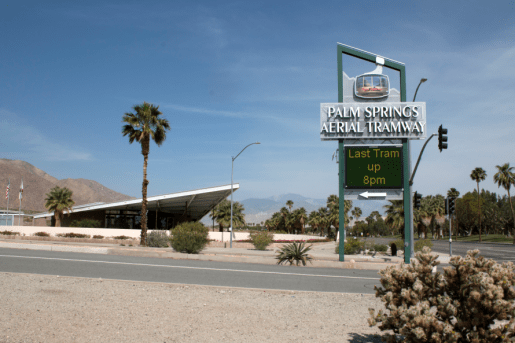
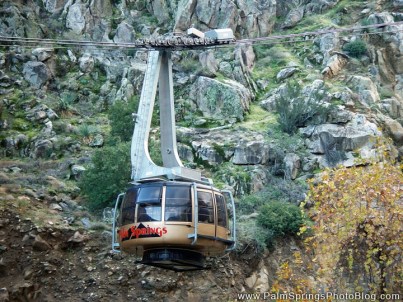
One of the most interesting and enjoyable experiences I have ever had is the ride on the Palm Springs Tramway from the desert floor and up toward the peak of Mt. San Jacinto (haw-sin-toe). The peak, itself is at 10,834 feet. The tramway starts at Valley Station at an elevation of 2,643 ft. and rises to the Mountain Station at 8,516 ft. That’s an increase of 6,000 feet, over a mile, and the ride is actually longer than that because you are riding the hypotenuse of the triangle.

Tram 1

Valley Station

The city of Palm Springs is in the desert and the temperature can easily be 115 degrees in summer. Imagine how good it feels to ride to Mountain Station where you may need a jacket. The temperature difference is usually about 40 degrees. 

Tram 2

The tramcars have windows all the way around for maximum viewing. Pat has ridden the tram 3 times and I have ridden it twice. At the time of our rides, the cars didn’t rotate so we had to move from one side of the car to the other to get a good look at both sides of the canyon. In the year 2000, the new tramcars were installed that slowly rotate 360 degrees and make 2 complete revolutions as you go from the Valley Station to Mountain Station.

Tram 3

In 1967, the first episode of the TV detective show, “Mannix” was shot on the tram and featured some wild scenes on top of the tramcars. (The star of the show, Mike Connors, is a distant relative of our son-in-law, Steve.) Pat and I enjoyed this show and also saw an episode of the TV show, “I Spy” that was shot on the tram. The stuntmen on both shows performed some harrowing stunts.

At Mountain Station there us a large lodge with a restaurant, gift shop, and viewing decks. There is a good selection of souvenirs and post cards in the gift shop in case your own pictures didn’t turn out well. Of course, the brisk mountain air will make you hungry and you’ll need to visit the restaurant for a meal or at least, a hot cup of coffee. The observation deck has telescopes mounted in a number of places and as you look around at this wild, mountain country you will further appreciate the amazing amount of planning and work that went into the building of the tramway.

Tram 4a

The first tower was the only one that could be reached by a road. The materials and workmen to build the rest of the towers were brought in by helicopter. All together, helicopters made 23,000 trips before the tram was completed.

Our daughter, Terri, and her husband, Steve, were taking the kids to Palm Springs for the weekend and invited Pat and I to go along. It sounded like fun to us. Grand-daughter, Christie, was nearly four and grandson, David, was a cute little infant. We enjoyed the ride over as Palm Springs is less than two hours from San Diego and we were looking forward to riding the Palm Springs Tramway.

We got to the Valley Station and Terri decided that she and David would stay at the bottom while the rest of us took the trip. We were mainly interested in the spectacular ride and didn’t plan to be gone long.

Tram 5

The ride to the top was just as extraordinary as it was touted to be. The height, the rugged cliffs, the changing micro-climate zones, the amazing construction of the thing, and the views, added up to an incomparable 10 or 12 minutes. We looked around Mountain Station to see what it was like. Steve read some signs about a hiking trail that went on up the mountain. Farther up, there were even camp sites where you could spend the night. Steve said he wanted to take a look at the hiking trail, thinking that he and Terri might want to return sometime for a hike. We all headed outside to enjoy the amazing view. We found the trail head and probably walked half a city block. The area was populated with pine trees, bushes, boulders, and big flat rocks. Steve found some signs telling about hiking trails and camp sites and was intent on reading them. Christie asked her Dad if she could climb on the big rocks next to the trail and he told her to go ahead but to be careful. She crawled up on one of the big flat rocks that was part of a pile and sat down. I got involved with the view and was busy taking it all in when I heard Pat saying Steve’s name. Steve and I turned toward her about the same time and she immediately pointed toward Christie. We looked and saw Christie sitting on her rock and just behind her was a big bobcat! Steve stayed cool and climbed part way to Christie and told her that there were some neat little animals near the base of the rock and she should slowly and quietly come to him so he could lift her off the rock so she could see them. Christie did as she was told and when she got close enough, Steve grabbed her. The bobcat faded back into the brush and a Dad and two grandparents breathed a sigh of relief. That being enough excitement for one day, we headed back to the tram so we could go down and join up with Terri and David. It was a memorable excursion from start to finish.

Dave Thomas
April 3, 2015


Life Is Hard

Model T

My great grandma, Minnie Peebler, lived at 1120 School Street. Next door, on the south, lived Joe and Rosella Pimlott. Joe was a nice old guy but he didn’t say much or move around too much. Rosella was a stout, grandmotherly type lady. She was a seamstress and a good one. She always had work stacked up. I knew them because they were Grandma Minnie’s friends and because my Mom sometimes had Rosella make things for us. Mom made me a lot of nice looking shirts out of feed sacks but some projects she deemed to be more suited for Rosella.

Joe had a Model T, black in color (of course) and it looked to be in perfect condition though the paint had faded a little. I’d see Joe, now and then, driving the Model T to the store or wherever he had to go. Joe kept the Model T in his garage which was out in back of the house like most of the older places. You entered the garage from the alley.

When we were little kids, Mom always made my sister and I go with her to Mrs. Pimlott’s house. Mrs. Pimlott was perceptive enough to know that I wouldn’t be too interested in dresses and that kind of stuff and would tell me to go on out and check out the back yard and the garage while I was waiting. Joe had tools and all kinds of stuff hanging on the walls so I could entertain myself for quite a while. I could even get up in the seat of the Model T and pretend to drive.

Time passed and then Joe Pimlott passed as well. Meantime I’ve turned thirteen and have started thinking about cars. In Kansas you could take Driver’s Education when you were thirteen and then get a restricted driver’s license when you were fourteen. The year was 1950 and cars were getting more expensive with V-8 engines and all that other stuff. I knew I wouldn’t have much money so I started thinking about old Joe Pimlott’s Model T Ford hidden away in that garage on the alley. Mrs. Pimlott liked me so I could probably get it for a good price. Model T’s were supposed to be easy to drive and easy to fix and practically indestructible. I knew that this was the car for me and now I had a plan. I would save my money and keep a secret that there was a perfectly good 2

Life IS Hard (cont.)

Model T stashed in Mrs. Pimlott’s garage. The weeks rolled by and I was taking Driver’s Ed. And whenever I went up to visit Grandma Minnie I would slip over and look through the crack between the doors to see if “my” Model T was still there. Everything was fine until one day when I was riding my bike down the street and here comes this Model T driven by Ross Larcom, a kid 2 years older than me. “Hi Ross””, I yells, “Where’d you get your car?” He yells back “I got it from Mrs. PimLott for 15 dollars!”

I was wiped out!

Dave Thomas
January 2, 2014