Entrepreneurship

We got a notice in the mail that the El Cajon City Planning Commission would soon hold a meeting to determine if they should allow a 7-11 Convenience Store on property adjacent to our neighborhood. This was in the mid-to-late 1960’s and we were living in a development known as Olive Hills Estates. The houses were nice, modern homes but certainly not “estates.

We considered the notice and talked about it and came up with two objections. We had noticed that in neighborhoods with 7-11’s or mom and pop grocery stores there was a lot of trash scattered up the block. It was all candy bar wrapper, soda cups, and aluminum soda cans that kids cast off as they wandered up the street.

The second problem would be the traffic consideration. The driveway for the 7-11 would be accessed from Greenfield Drive, a busy street.

Pat and I went to the hearing and both spoke our piece. Our eloquence was for nothing, as the Planning Commission voted to allow the granting of the permits to build the store. We got the impression that they were more interested in the tax revenues than they were in our efforts to keep our yard clean.

Time passed and a strip mall was built, anchored by the 7-11. It wasn’t really that bad. The neighborhood kids were good about not stringing trash up and down the block. The 7-11 was operated by a man named Bertolucci. I don’t know if he was the franchisee or a paid manager. He was probably in his late 40’s or early 50’s and was one of those red-haired Italians with a ruddy complexion. He always had a smile and was liked by all ages. The kids called him “Mr. Bert” and I think he knew every kid in the neighborhood by name.

Back in those days, the neighborhoods of the city were pretty safe. Even though our kids were young, we allowed them to make the one block trek to the store. We had to approve each trip but they were allowed to enjoy a Slurpee now and then.

One Saturday morning, Pat and I were going someplace with the kids and stopped at 7-Eleven to pick up some snacks. Mr. Bert greeted us and then asked if he could speak to Pat and I privately. He ushered us to a corner and then started telling us about soda pop bottles and how they were returned for a refund of the bottle deposit. He said that the empty bottles were stored out in back of the building until the distributors picked them up and returned them to the bottling plant. He said that our daughter, Terri, then 6 or 7 years old, would stop in the alley and pick up as many bottles as she could carry and then go around to the front door and go in and collect the deposit money for them. Then, she would use her earnings to buy a Slurpee. Bertolucci said he knew what she was doing and didn’t mind because she was a nice kid. However, the gratuities started to get out of hand. Terri was bringing a little friend with her. Then, it seemed that she was bringing the whole neighborhood with her. That’s when Mr. Bert had to put a stop to the great bottle refund enterprise and why he was talking with us. He wanted to make sure that Terri understood that what she was doing was wrong.

Later, Pat and I were alone with Terri and told her that Mr. Bert had mentioned that she was buying a lot of Slurpees and we wondered where she was getting the money. She said she had found this neat place out in the alley where there were stacks of bottles. She said she would gather enough bottles to buy a Slurpee and then go to the store and sell them. She was just as happy as if she had found buried treasure. We had to burst her bubble and tell her that those bottles in the alley already belonged to the store and that Mr. Bert was buying his own bottles from her. We went on to explain that Mr. Bert knew what she was doing but let her get away with it. Terri was mortified. She was the type of kid that always wanted to do everything right and hated to think she had made a mistake. He next time she went to the store she told Bertolucci she was sorry and we all went back to the status quo…peace in the valley.

Dave and Pat Thomas
February 23, 2017
 

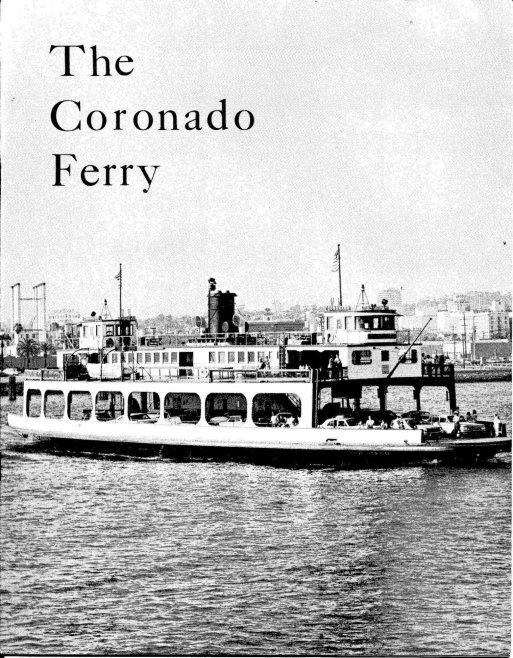
The Coronado Ferry and the Bridge: Part 3

Part 3 is made up of notes, newspaper clippings from the San Diego Union and Evening Tribune and miscellaneous pictures I’ve collected over the years. Some of the clippings date back to 1961.


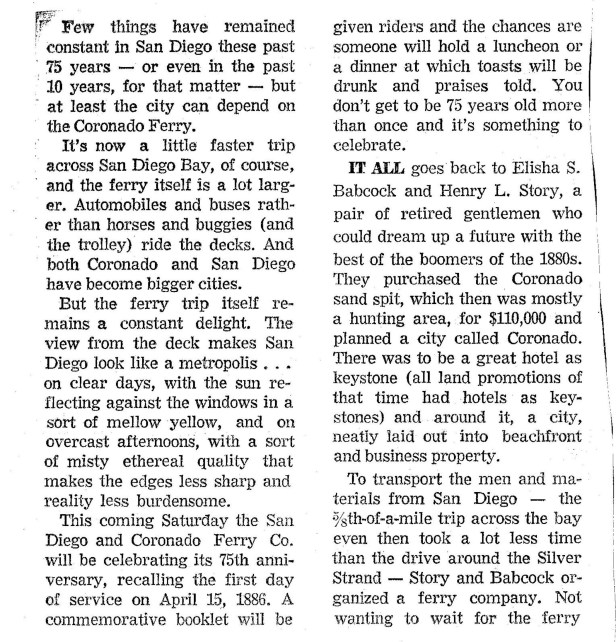
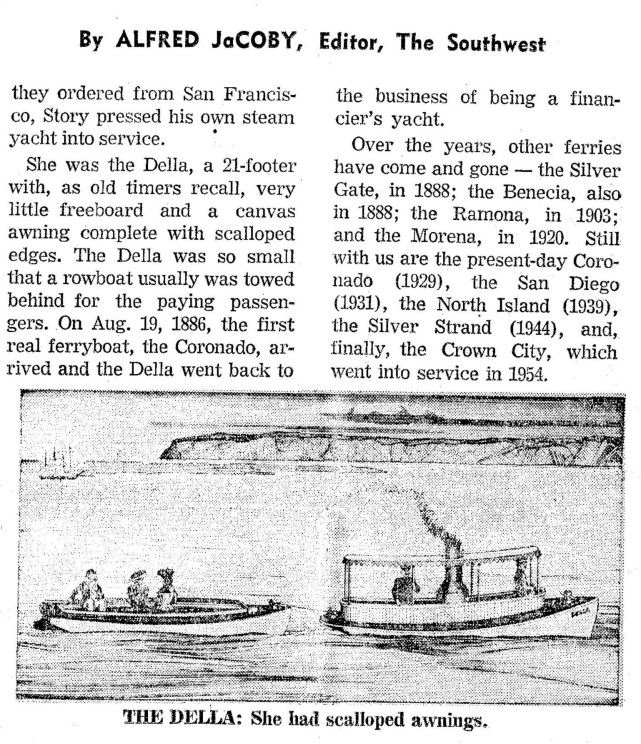
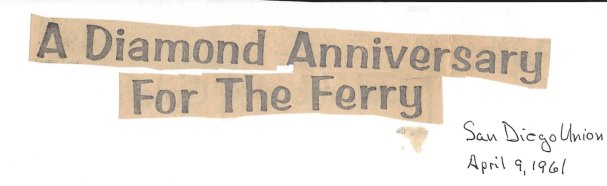
Land speculation and development was going wild in Coronado in the 1880’s. There was talk of grand hotels and resorts being built and the place was sounding like a potential gold mine. Two forward-looking men realized that getting workers and materials and later hotel guests across San Diego Bay quickly would be a great boon for the building and tourist industries. Riding in a buggy the length of the bay, around the south end, and then up the Silver Strand to Coronado seemed to take forever. It was only 5/8 of a mile across the bay and the solution found, was the formation of a ferry company. I have attached a clipping (San Diego Union, August 9, 1961) that tells the story of the first 75 years and gives details about those first days.

b-f_20

b-f_6

b-f_20cb-f_9

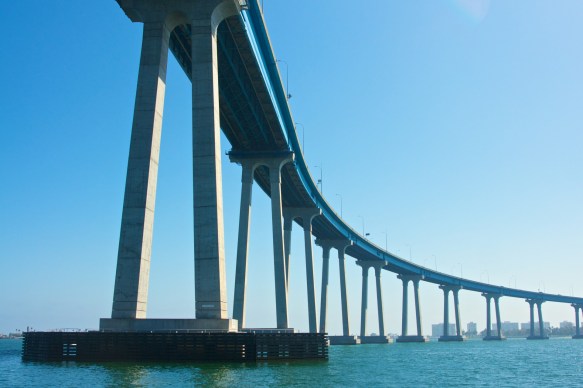
The first day of service for the Coronado Ferry Co. was April 15, 1886 and the last crossing was made August 3, 1969. That’s over 83 years of service and pleasure provided day in and day out. Unfortunately, this picturesque mode of travel reached the end of its era. The last day of service occurred on the opening day of the beautiful San Diego-Coronado Bridge. Crossing the bridge is a beautiful and unique experience in its own right. The bridge is 200 feet high because at the time it was built, the Navy insisted that the center span be tall enough to clear their tallest ships, diesel-propelled aircraft carriers. That condition was met, though the bridge isn’t high enough to clear the nuclear carriers. The height requirement had a lot to do with the long and curving lines of the final configuration. Also, there is a story that says the bridge had to be over a mile long to get federal funding so the curvature was added to give additional length.

The first day of service for the Coronado Ferry Co. was April 15, 1886 and the last crossing was made August 3, 1969. That’s over 83 years of service and pleasure provided day in and day out. Unfortunately, this picturesque mode of travel reached the end of its era. The last day of service occurred on the opening day of the beautiful San Diego-Coronado Bridge. Crossing the bridge is a beautiful and unique experience in its own right. The bridge is 200 feet high because at the time it was built, the Navy insisted that the center span be tall enough to clear their tallest ships, diesel-propelled aircraft carriers. That condition was met, though the bridge isn’t high enough to clear the nuclear carriers. The height requirement had a lot to do with the long and curving lines of the final configuration. Also, there is a story that says the bridge had to be over a mile long to get federal funding so the curvature was added to give additional length.

***********************************************************************************************

A lot of people are terrified when going over the bridge because, at the center, it is 200 feet tall. You can look out over the waterfront and the city and it’s a lot like being on the side of a mountain and looking into a vast canyon. A few years ago, Pat’s aunt and uncle had come from Wichita to visit us. On Saturday, Pat had to work so I decided to show them the beautiful bridge, San Diego Bay, the city of Coronado, and the Hotel Del Coronado. As we came off the approach and started up the bridge, these flat-landers from Kansas immediately started yelling. By the time we reached the center span, the highest point, they were really freaking out. The best I could come up with was that we were half way and would soon be on the ground. We lived through that experience did our sight-seeing. They had calmed down enough that they let me drive them back across the bridge rather than driving all the way down the Silver Strand and around. They actually enjoyed the view on the way back.
  san-diego-coronado-bridge

san-diego-coronado


The Coronado Ferry and the Bridge: Part 2

One day, Pat had been doing her regular chores and chasing the boys, who weren’t quite 3 years old, and trying to keep them in line and she was exhausted. She read the boys a story and put them down for a nap. Satisfied that the boys would be “out” for a while, she fastened the security chain to the front door, laid down, and promptly fell asleep.

Sometime later she was awakened by someone ringing the door bell. As she walked to the door, she realized that a chair had been pulled up to the door and that the security chain was undone. Pat experienced a feeling of panic as she got to the door, not knowing if she would open it to the Police or someone else with bad news. She threw open the door and saw a lady she recognized holding the hands of our two boys. She remembered that the lady lived 2 blocks away, across a busy street, and that the bus stop was in front of her home. The woman had seen Pat and our two boys at the bus stop before and was quite concerned to see the boys there by themselves. She asked them where there mother was and where they were going. They told her that their Mom was asleep and they were going to ride on the ferry and see the boats. Fortunately, the boys knew where they lived so the lady grabbed them each by the hand and walked them home. As Pat and the lady talked they quizzed the boys and discovered the rest of the caper. When getting on the bus in the past, they had seen their mother drop coins into the fare collection box so before leaving the house they had found her purse and grabbed all the change she had and put it in their pockets. That’s pretty good thinking for a couple of outlaws who couldn’t count or make change. Pat thanked the Good Samaritan and after that lady left, gave the boys a good chewing out and grounded them.

Having twin boys messes up your understanding of mathematics. You grew up thinking that 1+1=2 so it would follow that 1 boy plus another boy equals 2 boys but that’s not the way it works. This is why they invented the word “synergism”. One imaginative boy added to another imaginative boy equals 5 times more trouble than you can cope with.

As the time got closer for Pat to deliver, I had to make up my mind on driving the long way around or taking the ferry to Coronado. I decided to drive the long way because there were fewer stoplights and less traffic. Taking the ferry would have meant taking Highway 94 which frequently was jammed up and then going through all the stoplights downtown and hoping there was no delay at the ferry landing.

When the time came, we drove the long way around and everything worked out well when we got to the hospital. Pat had a few tough hours of labor but delivered a healthy baby girl that we named “Terri”.

b-f_5

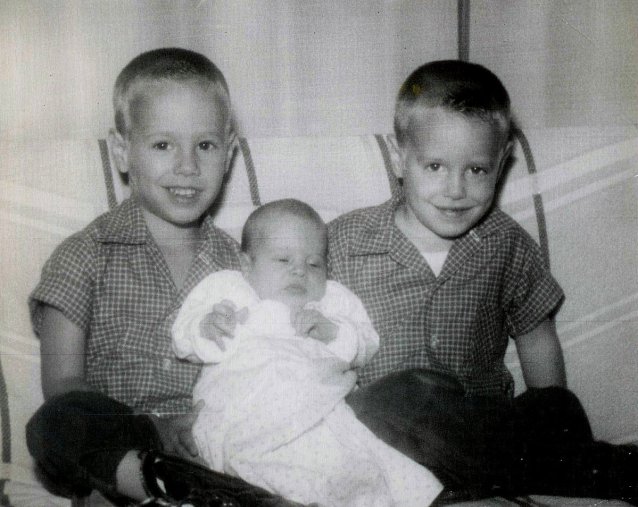
Doug and Russ and their new sister, Terri


The Coronado Ferry and the Bridge: Part 1

My original intent was just to tell you about the Coronado Ferry but after thinking about it and discussing it with Pat the story grew a little. Back in the late 1950’s and 60’s San Diego Bay was a busy place. There was a fair amount of merchant shipping doing business at the 10th Ave. Terminal. The Navy had a lot of ship traffic at the 32nd Street Pier. National Steel and Shipbuilding was building and overhauling ships so there was a lot of traffic around their docks. There were usually 2 to 4 seaplane squadrons stationed at NAS North Island and they made take-offs and landings in the bay at all hours of the day and night. There were also Navy fighter squadrons stationed at North Island and they were visible from many spots around the bay.

The Navy had an Overhaul and Repair Facility at North Island taking care of aircraft that had returned from Westpac deployments via aircraft carriers. The carriers and other ships were docked at the North Island piers and sometimes there were other Navy ships at anchor in the bay. Convair was developing the Sea Dart, a jet-powered seaplane that could be seen taxiing in the bay. The tuna fleet was still operating out of San Diego. The fishing grounds within reach of this port were being “fished out” but the fleet was still pretty large. Toward the west end of the bay at the sub base there was traffic consisting of both diesel subs and the new nuclear boats. The ferry boats were on regular schedules and were plowing back and forth all day long. There were motor launches known as “nickel snatchers” that picked up passengers, mostly sailors, at the foot of Broadway and delivered them to the ships at anchor or over to North Island. Take all of this traffic and throw in the tour boats and private sail boats and you can imagine the apparent chaos all day long.

b-f_1

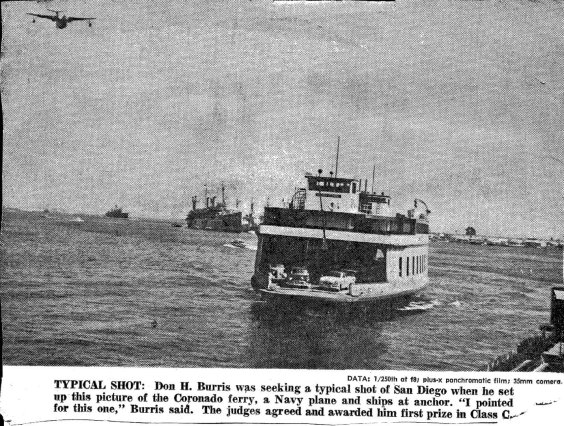
The picture below will give you some indication of the variety of traffic on the bay. The airplane in the upper left hand corner is a P5M-2 seaplane such as I flew in and it is coming in for a landing. The planes flew up the bay (north) and when over the ferry landing made a slight turn to port to follow the curvature of the bay. As they crossed over the ferry slips, the pilot keyed his mike and announced “Ferry slips” and the Air Controller in the tower would take a final look at the sea lane for traffic and acknowledge with “Cleared to land.”

b-f_2-copy

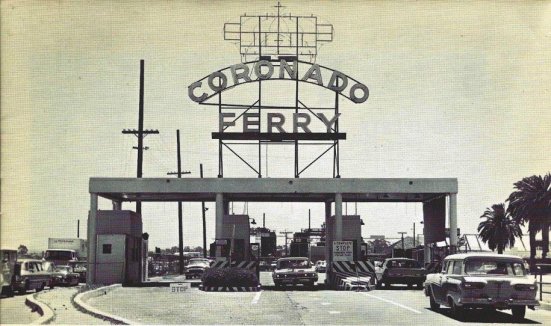
Being from Kansas, Pat and I weren’t used to large bodies of water or waterborne transportation so riding the ferry was a unique and wonderful experience for us. The bay crossing only took a few minutes but there was enough time to jump out of your car and go lean on the rail or go to the top deck and have a seat and enjoy the ride. I believe there were a total of 5 ferry boats. Our favorite was the Crown City because there was no roof over the cars. The other boats had large superstructures that covered the cars on the deck and made you feel like you were in a garage.

b-f_3

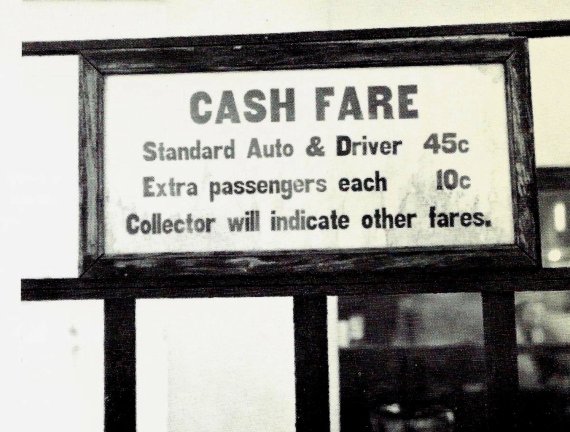
I was stationed at North Island, in Coronado, and we lived in Coronado for 2 years. In 1960, we bought a home in San Diego and that’s where my life as a commuter began. I found that even though it was farther to go south and around the bay and up the Silver Strand, it was faster than going through downtown San Diego and catching the ferry. Also, there was the money consideration. I was still in the Navy and riding the ferry would have cost me 90 cents a day but gasoline for driving the long way around was only 27.9 or 29.9 cents a gallon (I can’t remember exactly).

I was discharged from the Navy in March of 1961 and got a job with an electronics firm on Kearney Mesa which meant that I still had a long commute. We soon found out that Pat was pregnant and that made it tough because our doctor, Jim Turpin, was in Coronado and besides his practice being there, he was also associated with the Coronado Hospital. Our boys, Russ and Doug were born in the Coronado Hospital and we thought it would be a nice thing to have the new baby there as well.

b-f_4

A booklet published by Home Federal Savings

Being new on the job, I couldn’t take time off to drive Pat to the doctor for her pre-natal visits. She figured out that she could ride the bus to downtown San Diego, transfer to the Coronado bus and get off right in front of the doctor’s office on Orange Ave. She would take the boys with her rather than trying to find and pay a babysitter. I guess the bus ride wasn’t bad and the best part was that the bus could go on the ferry! Pat and the boys loved that! To be on a boat and crossing the San Diego Bay with all the other boats and ships was pretty heady stuff.


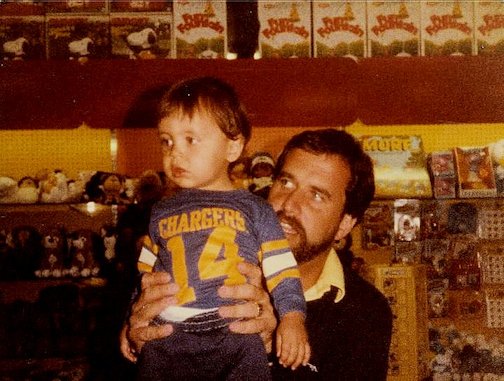
San Diego Chargers: Still Here

talking-football

“Me and Fouts…talkin’ football.”

Grandson, Jeff, and San Diego Chargers Quarterback, Dan Fouts.
Our son, Russ, took the picture.

I see on the evening news that disappointed San Diego Charger fans are having trouble dealing with the fact that the Chargers are moving to Los Angeles. They are whining and crying and burning their Charger memorabilia and are most certain that the end of the world has come. Well, folks, everything has an expiration date. The triple-crown winner retires, the aircraft carrier is de-commissioned, or maybe a favorite movie actress dies. Everything expires.

Let’s stand up and look this right in the eye. Over this past 56 years, or your part of it, you have stored up some wonderful memories. For the rest of your life you will have that treasure trove to draw on. Thanks to Air Coryell and some interesting and talented quarterbacks, you will remember the excitement. I’m talking about Jack Kemp, John Hadl, Dan Fouts, Drew Brees, Doug Flutie, and Philip Rivers. We even had the great Johnny Unitas toward the end of his career. And, not a quarterback but the scourge of quarterbacks, there was defensive end, Deacon Jones. The Deacon was exciting to watch as he beat opposing linemen and he always had something to say.

We saw some other exciting players, too, like Speedy Duncan, Chuck Muncie, and L.T. How about Lance Alworth? I got to meet him once. My son and grandson got to meet Dan Fouts. We will definitely remember those times.

You may have gone to Jack Murphy/Qualcom Stadium to attend your first Pro-Football game. Or, you may recall watching the games with good friends or relatives who are no longer with us. You will remember these times together.

In the coming years there will be many times and many circumstances that will spark your memory and cause you to pull up a giggle or a cherished remembrance. That’s the stuff that keeps us warm.

Dave Thomas
January 13, 2017


Prairie State Bank Robbery

We were recalling things from the time the kids were small and Pat reminded me of this story.

We had gone back to visit with friends and relatives in our home towns of Augusta and El Dorado, Kansas. In Augusta, we were staying with my great uncle and aunt, Dave and Rachel Peebler. Our twin boys, Russ and Doug, were probably between 2 ½ and 3 years old. That would put us in 1961. Aunt Rachel and Uncle Dave were always gracious hosts and fun to visit. Aunt Rachel was all excited about having an outing with just the boys and her so she could take them to town and show them off to her friends.

Aunt Rachel got all gussied up, jewelry included. The boys were all excited and Pat got them slicked up and they piled into Aunt Rachel’s car and she took off with them. She decided she would stop at the Prairie State Bank first and pulled into a parking place out front. I don’t know who she expected to see but I imagine that Roy Haines was still the bank’s president  and Noah Morris and Dixie Wisner and the other long-time employees were still there. I don’t know what happened to tip her off but as Rachel and the boys got to the door, she realized that the bank was being robbed. She whirled around and since she was holding hands with both boys, almost jerked them off their feet. She took off directly across the street and rushed through the front door of Larson’s shoe store. Russ Larson was an old friend and she yelled at him and told what was happening. He shooed them to the back of the store and then called the police. They waited for some time before leaving the store and making the rounds of Rachel’s friends. When they got home, all three were still wide-eyed and excited. They were all talking so fast it was hard to understand what had happened. We finally got the boys settled down and Aunt Rachel told the story with the boys chiming in with their comments as she talked.

I tried to authenticate this story by searching the Internet. I even found an abbreviated history of the Augusta Department of Public Safety but nothing mentioned this incident. After Pat and I discussed the story, we were talking with Doug on the phone and asked him if he remembered going to town with Aunt Rachel and seeing a bank robbery. He jumped right in by saying “Yes, and she rushed us across the street to the shoe store.” Doug will be 57 next month and remembers something that made a big impression on him when he was 3.

We just talked to Russ a few minutes ago. He remembers something happening but says that Aunt Rachel down-played it and he doesn’t know what it was. However, he says he does remember meeting a lot of people that day.

Dave Thomas
October 25, 2015


The Slumber Party


Y-Teen is a Christian organization for girls created and guided by the YWCA. The club was organized in 1918 as the Girl Reserves. In 1946 the YWCA decided to modernize the club and make it more appealing and part of that effort caused the name to be changed to Y-Teen. At Augusta High School the club was well received and at one time had as many as 135 members. Two of the high school faculty members were designated as sponsors of the club each school year. The Y-Teens enjoyed a number of social functions each year. Two of the most popular activities were the Mother and Daughter Banquet and the Slumber Party.

We were sophomores in the 1951/1952 school year and when the date of the annual slumber party was announced several of us thought it would be a good idea to crash it. As we all know now, the brain of a teen-ager is not fully developed. That’s what causes them to come up with one dumb idea after another. I’m not sure what crashing the slumber party was supposed to accomplish. We might see 40 or 50 girls in their pajamas but that was about as titillating as it would get.

The slumber party was held in the high school gymnasium on the night of November 16th. After dark, we met at the school and immediately started making plans to crash the party. The first obstacles to consider were the two faculty sponsors, Edna Chapin and Averil Hawes. I didn’t know Miss Hawes but was well acquainted with Edna Chapin. At school, boys and girls alike were afraid of her. She taught Health and Home Economics and took them both very seriously. Her normal attire was a starched white dress that looked like a nurse’s outfit. She was normally tight-lipped and unsmiling and her countenance was enough to put the fear of God in you. In high school I was always tickled by the reaction of the other kids to her. You see, I knew she was just wearing her “work face”. Miss Chapin lived across the street from the high school and I grew up just a half a block from her. When we kids were running around the neighborhood, Miss Chapin often would come out with a plate of cookies or some delicacy she had just baked. I got to know her as a nice, warm, giving person. However, don’t forget that at the slumber party she was “on the job”.

Under cover of darkness, we split up and prepared to breach the walls of Miss Chapin’s fortress. A couple of the guys went to check the windows on the west side of the gym. The windows were in plain sight but no one ever paid any attention to them. An examination showed that the glass was all painted white and there was a steel mesh covering each window on the inside to protect it from hits by volleyballs and basketballs. This was observed through small places where the paint had flaked off. After seeing this, the guys headed back to the front of the building.

Some of the boys decided to try the main entrance doors that were located in the first floor hallway. Night lights were on in the hall but only gave off enough light to keep you from running into something. The guys had split up to try both entrances and just as they reached for the doors, the doors were opened from the inside! It turned out that some of the girls were just as excited at the possibly of a rendezvous as the boys were. At this moment, Miss Chapin and Miss Hawes arrived at the doors. What a sight! Girls squealing and trying to get back inside and the boys were yelling and trying to get some traction so they could get out of there. “Bedlam” is the word that fits this situation! It was like the Keystone Cops all over again.

The guys returned from their points of failure and humiliation and gathered in front of the building. As they licked their wounds, they were suddenly startled by one of them yelling “Here come the cops!” Sure enough, the cops were pulling into the parking lot and the culprits scattered like a covey of quail. Some headed for the bushes at the neighboring Junior High School and the rest were ducking behind trees and trash cans. The police caught two of them who were taken to the station and lectured before being sent home. Altogether, this was a mission that should have been aborted.

You’ve probably noticed that we didn’t mention any names in order not to embarrass any of the participants. Remember, however…we know who you are.

Dave Thomas and Keith Scholfield
October 28, 2015


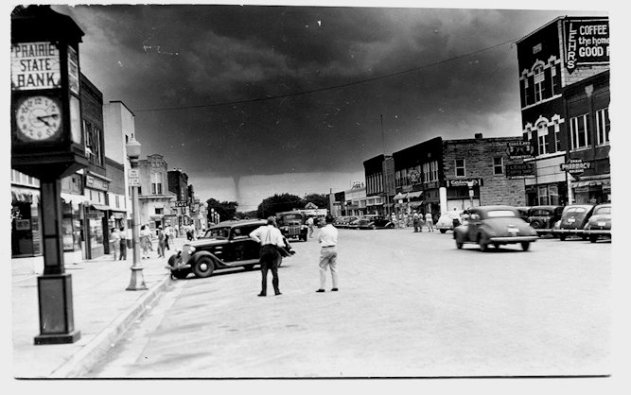
Tornado 1945

tornado-augusta

Augusta, Kansas; 500 Block of State Street, looking south. 1945

Fortunately, the tornado veered off and didn’t strike the town but it came close.
Dave Thomas           October 18, 2015


I like this picture because of the drama it displays. The big, black funnel looks like it is coming right up the main drag. The two men in the street seem transfixed and don’t know if they should stay and watch or run for cover.

Since posting this picture, I’ve received information that makes it even more compelling. I have received e-mails from Keith Scholfield and Jack Parker telling me of their connection to the event.

First, let me give you some background. Keith’s Dad, Gene Scholfield, owned Scholfield Hatchery and dealt in feed and grain and chicks. The store, easily identified by its white front, was located on the west side of the 400 block of State Street. Naturally, Keith spent a lot of time there. The first store north of the Hatchery was Bartholomew Furniture, owned by Jack Parker’s Grand-dad, Charles Bartholomew. Jack lived in the neighborhood and spent quite a bit of time at the family store. This information helps explain why the two boys were in the right place at the right time to witness the tornado that was heading for town.

If you look down toward the center of the picture, on the west side of the street, you can see the white storefront of Scholfield’s Hatchery. Keith has seen the picture a number of times over the years. It’s kind of fuzzy because it has been copied so many times, but as Keith points out, if you look closely you will see people standing on the roof of the building. Those are Gene Scholfield’s  employees along with Gene and Keith and Jack Parker. Jack first saw the picture a year or so ago on the museum’s web site and it triggered some fuzzy recollections in his memory of standing on a rooftop and watching an approaching storm. Jack and Keith have conferred about the picture and, though the memories are quite distant, agree that they were on the roof as the tornado was heading for town that day.

Keith says that the day after the tornado was sighted, his Dad took him for a drive southeast of town. They found the track of the tornado crossing Haverhill Road in a spot just north of Smileyberg.

Now, we’ve got a great picture and some people that we know who were associated with it. I think it’s remarkable that 3 old boys like us are communicating through the magic of the Internet about an incident that took place 71 years ago. Keith and I are 80 years old now and Jack is 81 and we have resurrected this story so it can be shared.

Dave Thomas Revised
November 29, 2016


The Story of Pat’s Picture

My wife, Pat, turns 79 today. Two years ago, I sent the kids and grand-kids a little story about the picture she had taken for her 50th birthday. It is my favorite picture so I’m posting it to the blog today.
Dave Thomas  
November 29, 2016

53h-1987

My wife, your Mom/Grandma/Great-Grandma, Pat, has always been self-conscious about having her picture taken and usually dodges the issue. However, as she approached her 50th birthday she thought it might be a good idea to have her portrait done. Being a Sears employee, she made an appointment with the Sears Portrait Studio. She showed up at the proper time but had to wait because the little boy who was scheduled ahead of her wasn’t cooperating. He was unhappy, wouldn’t smile, and just flat didn’t want to be there. His Mother was doing her best to encourage him but it wasn’t helping. The photographer, an old hand at dealing with kids, reached into a cabinet behind him and came up with some sock puppets. He put one on his hand and started talking in a goofy voice and quickly had the kid laughing. The photographer soon had all the shots he needed of the boy and it was Pat’s turn. The photographer got Pat situated with a proper background, made suggestions for posing, and was ready to take pictures. However, Pat went into her normal tight-jawed, picture-taking mood and wouldn’t smile. The guy kept talking to her and trying to get her to lighten up but it wasn’t working. Finally, in desperation, he asked “how do I get you to loosen up and smile?” She says ”Well, you might try treating me like that little boy.” So, the photographer puts on the sock puppet and starts talking in a goofy voice and all of a sudden Pat is laughing! The guy starts snapping pictures and gets some fantastic shots. He captures the Pat I know so well with laughing eyes, maximum dimples, and full of fun. The picture I’m including is the best and most real picture you will ever see of her. You might want to save it.

Dave/Dad/Grandpa Thomas
October 9, 2014


Connections

I grew up in Augusta, Kansas, a small town seventeen miles east of Wichita. Augusta served as a bedroom community for the larger city. Many of our friends and relatives worked in the aviation industry. During WWII, Beech, Cessna, and Boeing hired thousands of people and the city called itself “The Aviation Capital of the World.” There were many small manufacturers before the war and during the evolution of the industry they came and went due to money and growth problems or by being swallowed up by more aggressive entities. One of the success stories after the war was the development of the Lear Jet by Bill Lear and company. I’ve got a few little stories that are loosely connected to Wichita aviation that I’d like to share. I guess they are important only because I remember them. Hope you find them interesting.

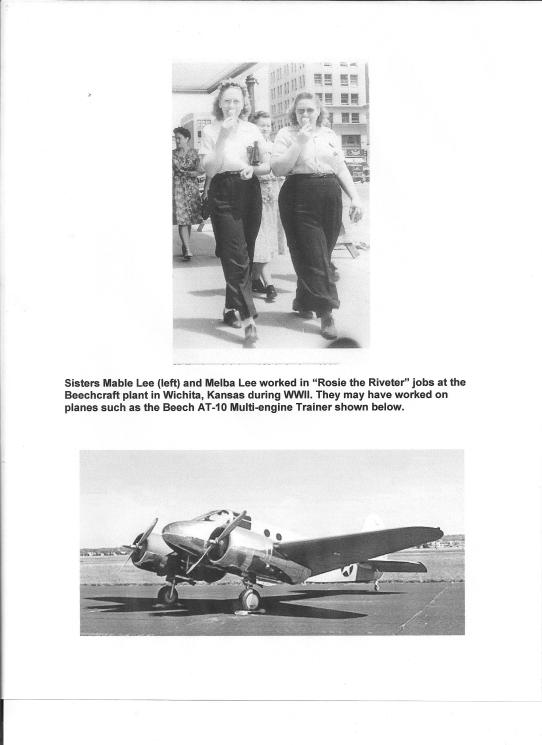
During World War II, Pat’s mother, Melba Lee and her younger sister, Mable did their part by working as “Rosie the Riveter” at Beech Aircraft (later known as Beechcraft). They did well and Melba advanced to a Section Leader position.

rosie-the-riveter

I’m not sure when, but it probably would have been 1945, our Mom was working at the local refinery, and our great-aunt Rachel Peebler was taking care of my sister and I. One summer day, she loaded us up in her green Packard and took us to Wichita to buy some school clothes. We went to Buck’s Department Store on the northeast corner of Broadway and Douglas. We got our shopping done and Aunt Rachel said she was taking us to lunch. Diagonally across the intersection, on the southwest corner, was a big, brown, brick building that I think was a bank. We entered the building, went to the elevator, and rode up to the second or third floor. We stepped out of the elevator into a pleasant-feeling and busy restaurant. Aunt Rachel led us through the tables until she came to the table of a well-dressed older man who rose as she approached and shook her hand. She introduced the man as Mr. Brown and said she had known him for some time. In later years, I figured that he most likely was the man that owned Brown’s Bank in Augusta.

We left Mr. Brown and continued to another table where two ladies were seated. Aunt Rachel introduced us to Olive Ann Beech. We kids knew who she was. She and her husband, Walter Beech, owned Beech Aircraft and were prominent in the business and social life of the city. Their names were in the papers or on the radio every day. Aunt Rachel visited with Mrs. Beech and the other lady for a few minutes and then we had lunch and went home.

The first jet airplane I ever saw was heading for the air base in Wichita. I don’t know the exact year but can establish some brackets on the time. We were at Augusta Junior High School. The school served grades 6,7, and 8. That means I was probably 11, 12, or 13(1947-1949). It was during the afternoon recess when we spotted the plane heading west toward Wichita. The development of jet fighter planes had been in the news quite often. I can’t remember what model it was but the next day the papers carried the story about the plane and its arrival at the base in Wichita.

When I enlisted in the Navy in 1957, I sold my car, a baby-blue 1953 Ford convertible. The morning I was to leave, Johnny Luding drove me to Wichita and dropped me off at the Navy Recruiting Office. After I got out of boot camp in June, I came home on a 30-day leave. Jack Watson was working in the Auditing Department at Sears Roebuck in Wichita. He said there was a cute girl working there and worked it out to introduce me to Pat. We started going out but I was hampered by my lack of transportation. Johnny was working second shift at Boeing and said I could use his car. So, I would drop Johnny off at Boeing and then go spend the evening with Pat. At the proper time, at the end of the evening, I would be back at the Boeing gate waiting for John. Pat and I got acquainted and made up our minds about each other and got married that November on a 3 day Veterans Day weekend. Since we just celebrated our 59th wedding anniversary, I want to say “Thanks again” to Jack and Johnny.

After my 30-day leave, and courting Pat, I checked into Glenview Naval Air Station. It was located just outside of Chicago. Naval Reserve Squadrons “Weekend Warriors” trained there so there was a lot of flying done on the weekends. The pilots had to get in some “stick time” to maintain their proficiency and would fly short hops locally or to nearby cities. They usually tried to get in 4 hours at a time. When I wasn’t working, I would hang out at the Operations Building and catch a ride. For multi-engine aircraft, the base had R4D’s (same as U.S. Air Force C-47) and SNB’s. I only took one hop in an R4D and was bored out of my mind as there was nothing to do but look out the window. The Navy SNB was a variant of the Beech Model 18 or “Twin Beech” as it was known. It was a smaller twin engine aircraft, made for small airfields and was a very reliable aircraft. I forget how many seats it had but you could sit up close to the pilots and watch what they were doing. I probably took half a dozen hops in the SNB’s for a total of 25 or 30 hours. Fun stuff.

I don’t know all the details but sometime during the early 1960’s, my friend, neighbor, and classmate, Glenn Douthitt, was working at Boeing, in Wichita, as a draftsman. Bill Lear moved Lear Jet to Wichita in 1962 and began work on Lear Jet #1. Glenn went to work for Lear and played a big part in the design and layout of the innovative new instrument panel. Glenn went on to become the Chief Contracts Negotiator for the Avionics branch of Lear, located in Grand Rapids, Michigan.

Now, you’ve read a bunch of little stories that are connected in some way to Wichita and its aviation history. I think it is interesting to see how memories can be attached to a common thread. If any of this aviation talk has piqued your interest, one story you might enjoy pursuing is the history of Bill Lear and Lear Jet.