A Rookie On Ice

I was 18 and working at Howard Motors, a Chevrolet/Buick dealership in Augusta, Kansas. It was winter and we had been having some lousy weather. It snowed and then the next day it warmed up enough to thaw a little. Then, that night, the water standing in the streets and roads re-froze and a little bit of snow fell and covered it. This resulted in roads so icy and slick you could barely walk or drive on them.

I had been told the night before that the next day, I would be delivering a brand new 1 ½ ton Chevrolet truck to Great Bend, Kansas, about 130 miles away and bringing back the trade-in. The trade-in was at a dealership in Great Bend and the dealer had already removed the livestock bed from the truck. That meant that neither truck I would be driving had a bed mounted on it so therefore there would be no weight on the rear wheels.

I got to work early and got my instructions and by 8:00 AM was heading out on an adventure. I had never been to Great Bend, had never driven so far, and had certainly never driven a truck that far. I was having an exciting time before I hit the city limit. Touch the brakes and the rear end slid out from under you because there was no weight to hold it down. Try to accelerate and the same thing happened. At that time there was no 55 MPH speed limit on the highway but it didn’t make any difference because I couldn’t get over 20 MPH and neither could anyone else who was on the road. Going west from Augusta to Wichita I never got over 20 miles an hour. When I got to Wichita and took Highway 81 North, it was the same story. I kept hoping it would warm up a little and the roads would thaw. Otherwise, I wouldn’t get home until midnight.

I finally got to Newton and stopped for some pie and coffee. I figured I could kill 15 or 20 minutes there and give the weather a little more time to warm up. I got back on the road and headed west out of Newton. After a few minutes, I was tickled to see patches of road that were free of ice. I was actually able to get up to 50 and 55 miles an hour for short periods of time but had to be careful of bridges because they were always shady and covered with ice. This was nice country with farm towns every few miles. Probably most of the farmers through there were Mennonites as they had settled the area many years before.

I finally got to Great Bend. As I recall, it was called “Great Bend” because it was located on a great bend of the Arkansas River. That’s not pronounced “Arkensaw” like the state. It’s pronounced “R Kansas River”.

I got the paper work taken care of and they showed me the old trade-in I would be driving home. It was a pretty well beat up old 1 1/2 ton with slick tires. They told me the engine had a knock in it and it was burning lots of oil. They also told me to stop and check the oil frequently and they put 4 quarts of oil up in the cab with me. I lit out for home and drove as smoothly as I could. I didn’t rev the engine or let it load up at all. I got it up to 50 miles an hour and held it steady. I watched my gauges and stopped and checked the oil often and was getting on down the road. I got to one of those little farm towns west of Newton, and the engine threw a rod! I pulled off onto the shoulder and looked under the hood. Sure enough, the party was over.

I could see a country store up ahead so I hiked on up there. The people that owned the place were real nice and let me use their phone for a long distance call. I called Kenny Markley, the Service Manager at the garage and my boss, and told him what had happened and where I was. Kenny said it was getting late so he had called the Truck Manager at the dealership in Great Bend and after hearing about the truck was surprised that I had made it that far. He told me to sit tight and he would get in the wrecker and come up and get me.

I hung out at that country store and visited with those nice people until Kenny showed up. We hooked up the old truck to the wrecker and took off for home. It was getting late so we stopped in Newton and Kenny bought me supper. It was a big day and I experienced a lot and learned a lot.


Dave Thomas
December 7, 2014
Colored Chicks

Gene Scholfield and his Dad had a feed and grain store on the west side of the 400 block of State Street. I believe they called it Scholfield Hatchery. I remember that in the spring they would have brooders on the floor in the front room where you could look in from the sidewalk and see the chicks. Of course, you could go inside the store and see them too.

A brooder is a heated cage where baby chicks are raised. It keeps them warm and safe and together.

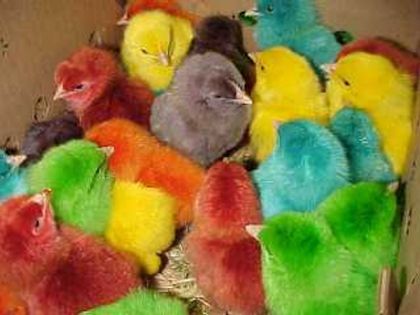
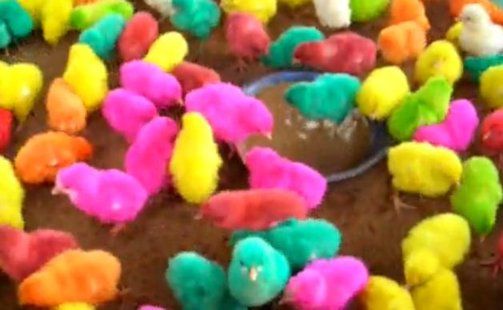
As Easter drew near, colored chicks were added to the brooder and the chicks were so cute all the little kids wanted one. Like bunny rabbits they were a big part of Easter. So, after a lot of tears and begging a lot of kids took one of those cute chicks home. The excitement lasted for a few days and then the chicks were neglected and succumbed. It’s doubtful that many lived through the holiday season.

Colored Chicks 1

I was thinking about the colored chicks this morning and got to wondering how they dyed them. It seemed like the simplest way would be to just dunk the chick in a bowl of food coloring and then let it hop around until it dried off. I went to the Internet and discovered that coloring chicks is not at all what you would think. Some might even call it creepy!

You’ve got your eggs in an incubator, so on the 13th day you remove an egg. You hold it with the pointed end up. Wipe the tip with alcohol to sterilize it. You’ve already loaded a syringe with the proper amount of vegetable dye (3% or less concentration). Measure down about one inch from the tip of the egg and make a hole. Inject the vegetable dye, Seal the hole with a small bandage and return the egg to the incubator. Now it’s just a question of waiting the allotted time and you will have cute little colored chicks all over the place.

Colored Chicks 2

Dave Thomas
January 2, 2014


Just Whistle

Mobil_Pegasus[1]

I grew up in Augusta, Kansas, a small town of 5,000. Our lives were regulated by the steam whistle at our local oil refinery. The refinery was originally called the White Eagle Refinery. Then, it became Socony-Vacuum Refinery and later, Socony-Mobil. The logo was the very distinctive Flying Red Horse.

The refinery was the main employer in our town and I guess the company wanted to make sure that there were no punctuality problems. They used the steam whistle to regulate the events of the day. Here’s the schedule as I remember it.

            7:00 AM You’d better be getting out of bed.
            7:50 AM You’d better be punched in, helmet on, and ready.
            8:00 AM Start work.
            12:00 PM Stop working and eat lunch.
            12:50 PM Stop eating and get ready for work.
            1:00 PM Go back to work.
            5:00 PM Quit work and go home.

The whistle was a pretty handy item. Back in the 1940’s few people had wrist watches. There were certainly no kids with a watch. The whistles could be heard all over town and at least a mile out into the country.

Dave Thomas
January 9, 2014

Serving Chili

These last few years I haven’t been in many small-town diners or cafes and I was wondering if they still serve chili like they used to. I’m asking because what I’ve seen lately in these plastic franchise eating places makes me wonder. Have we lost the art of serving chili or do those small-town folks still do it right? I’ll tell you how it used to be done and you can keep your eyes open and make sure it’s done right.

I’d go into the 7th Street Café, by Fowler’s Mobil Station, and sit down at the counter. The waitress would ask me “what’ll you have?” I’d say “chili” and she’d go turn the order in to the cook. Then she would come back and make sure I had everything I would need. First, she would come up with that little jug of vinegar. Next, she would make sure the catsup and mustard was at hand. Then, she’d go away and come back with one of those white bowls full of oyster crackers and set it right close. By now, the cook has got the chili up and she brings it to me with one of those big, round spoons. There it is…its perfect! Can you name a place today that will set you up with the fixin’s like that?

Dave Thomas
December 7, 2014


This Is No Bull!

I’m still thinking about animals and their ability to figure things out. I learned early on that even bulls can solve problems and put 2 and 2 together when they have the motivation to do so.

I was 11 or 12 and had spent the night on the farm with my great-great uncle, Will Church, and Aunt Ella. I had breakfast and was in a pen currying Prince, the pinto pony I was going to ride later. Next to the pen I was in, was the corral. I say “corral” but it was sturdy enough to stop an Army tank. The fence poles were at least as big as railroad ties and the fencing itself was 3″ pipe. There were 2 sections of pipe strung between the posts. The lower one was maybe 2 feet above ground and the upper one was maybe 5 feet high. The land naturally fell away to the east toward a spring-fed creek that was 10 or 15 yards east of the fence. You could see that on the east side of the corral the dirt had washed out as a result of many years of run-off from the rains. The distance from the ground to the lower pipe at that point may have been more like 30 “or 36”.

So, there’s this super corral and standing right in the middle of it is Griffin, Uncle Will’s prize shorthorn bull. Griffin is just standing there and staring out into the adjoining pasture. The dairy herd had been milked and turned out and they were strung out in a line across the pasture as they headed for their favorite loafing spot.

I could hardly believe what I saw next. Old Griffin sidles up to that east fence where the wash-out is the greatest. He drops down on his front knees and lowers his body to the ground. Then he starts shoving with his hind legs and wiggling and twists and grunts and kicks until, all of a sudden, he is on the other side of the fence. He slid under it! He gets to his feet and takes off at a fast walk after that bunch of fine-looking cows that are just going over the hill. A little bit of thinking and planning will get you where you want to be.

Dave Thomas
August 19, 2014


Grandpa: To Bee…

Grandpa-To Bee Or Not To Bee

I think it was 1925 when they had a flood there in Augusta, Kansas that had the south end of town running-board deep. I remember my folks had pictures of Walnut Street in front of Grandpa’s house showing the old cars plowing through the water. Grandpa’s house, itself, was safe for it had been built with tall footings and the flood water only made it part way up the front steps.

Augusta was in a sensitive location. It had the Walnut River on the east and the Whitewater River on the west. After the flood the townspeople began talking about building a levee or dike that would protect the town on the east, south, and west sides. The higher ground on the north side was no problem. Grandpa, A.A. Thomas, was highly in favor of the protection offered by a dike and attended the City Council meetings where it was discussed. Of course, a project of this size and cost would require interaction with many county, state, and federal departments and agencies. Grandpa attended many meetings and as a homeowner and business owner (an addition to his home had been constructed to house a grocery store) he always put in his two cents worth.

If you were paying attention to him, you would have noticed that during any conversation regarding the levees or dikes, Grandpa would suggest that these ramparts should be protected from erosion and that the very best ground cover for this purpose was clover. Not many people realized that Grandpa was an entrepreneur with a new idea every minute. In this case, he hoped to set himself up as a beekeeper! He planned to place the hives at strategic places along the dikes and the bees could concentrate on the dikes and not waste time flying all over the county to collect the pollen. Thus, the bees could make more honey and Grandpa could prosper.

The dikes were eventually built but were sewn with prairie grass. Well, so much for that dream.

Dave Thomas
April 27, 2013


Quarry Story 3

Technically speaking, this is not a quarry story but since it took place on the road to the quarry I figured that’s close enough.

Have you ever ridden on an Army tank? Well, I did once, and that’s what this story is about. Pay close attention, learn, and then don’t ever do anything like it.

It was spring and we had been having our share of rain. The rivers were up and had overflowed their banks earlier in the week. The Walnut River, just south of town, was slowly returning to it’s normal size and we decided to check it out. I was 13 or so and my friend, Jack, was 15. You can get your driver’s license when you are 14 so Jack had gotten himself a job at a neighborhood grocery store, saved his money, and bought himself a 1935 Chevrolet. We headed for the river. It wasn’t much of a trip. From the edge of town, at what I remember was 4th Street, you crossed the Santa Fe railroad tracks and wandered down a country road for about a quarter mile to the steel bridge that crossed the Walnut River. It was one of those fine-looking steel bridges that looked like it had been made from a giant Erector Set.

The gravel road was still a little wet and muddy but we got to the bridge, crossed it, and continued along. About 100 yards south of the bridge was a place you could pull off the road and follow the tracks worn by many other cars to get closer to the river. At this point, the river bank was normally 5 or 6 feet above the river. It was a good place to fish from and we were told by older guys that it also served as a lover’s lane. We decided to check the river so Jack pulled off onto this track that paralleled the road and stopped and we got out. We looked at the river and messed around and finally got back in the car. Jack tried to drive off but the wheels started spinning. He was a good driver but couldn’t overcome the wet grass and mud and the fact that the ground sloped toward the river. I got out and tried to push but it didn’t do any good. We decided to walk back to town and call Jack’s Dad for help.

We got back to town and crossed the tracks and the first building in view at that time was the National Guard Armory. We decided to go in there and use the phone. The National Guard guy that took care of the Armory and answered the phone and did all the chores was a friend of ours named Billy Joe Davis. Billy Joe liked baseball and we had both played catch with him and hit a lot of fly balls and grounders with him. We told Billy Joe our story and asked to use the phone. Billy Joe said there wasn’t any point in making the call and upsetting Jack’s Dad because he’d be happy to pull us out. He said we should go out in the street and wait while he locked up and we could close the gate behind him when he came out. After a few minutes we heard an engine revving up and here comes Billy Joe driving a National Guard tank and yelling at us to shut the gate and climb on. We scrambled up onto the thing and Billy took off across the tracks. It just took a few minutes to get to the bridge and as we approached it, Jack and I looked at each other. Billy Joe may have crossed the bridge many times in a tank but it scared the devil out of us. That bridge looked pretty flimsy compared to this big chunk of iron we were riding on. Billy didn’t even slow down. He rolled over that bridge like it was him and Patton crossing the Rhine.

The rest of it was kind of anti-climatic. It just took a couple of minutes to get to the car. Billy Joe had brought a chain and he hooked up to Jack’s car and pulled us out. We thanked him and waved good-bye and headed back to town. I don’t even want to think of the possible consequences of “borrowing” a tank or running it off into the river. If you’ll excuse me I’ll just say “tanks for the memory”.

Dave Thomas
October 24, 2013


Old Mrs. Coates

It was about 8:00 AM on one of those joyous summer mornings with the sun shining and heavy dew glistening on the leaves and grass. I had just finished my third grade year and was thankful to be free. I was on the way to visit my Great-grandma Minnie, who lived several blocks from us. It was always a special treat to be invited to breakfast with Grandma Minnie because she always fixed me her special bread pudding with raisins in it.

As I got closer to Grandma’s I could see that her across-the-street neighbor, old Mrs. Coates, was out on her front porch enjoying her morning tea. I yelled, “Good morning, Mrs. Coates!” She yelled back, “Good morning, David, how are you this morning?” (I should explain that Mrs. Coates had a voice that was loud and clear and you could hear her clear to the end of the block.) I responded “I’m OK, how are you?” She bellows back, “Well, David, I had a wonderful bowel movement this morning so I know it will be a great day!” This was more information than a little kid could handle and I felt my face turning red as I ran for Grandma’s door and a chance to get out of sight.

Dave Thomas
March 31, 2012


Grandpa and Billy the Goat

Grandpa, A.A. Thomas, always had something interesting going on. One day I rode my bike down to visit Grandpa and Grandma. I might have been 11 or 12 years old and Grandpa was at least 80. When I got to the house, Grandma said Grandpa was out in the back yard so I went on out there. It turned out that Grandpa had bought himself a cute little billy goat. He was putting the finishing touches on a pen he had built for it. He told me he had named the little critter, Billy, and that I could get in the pen and play with him. Billy was a friendly little guy and enjoyed being petted and fussed over so I played with him that day and pretty often in the days that followed.

Then, for some reason I didn’t get down to see Billy for quite a spell and when I did go to visit, I couldn’t believe my eyes. Cute little Billy, the kid goat, had turned into a full-sized ram with a fine set of horns. Grandpa said he was still just a playful little guy and I should just go on in and give him some attention. Well, Billy was glad to see me and I enjoyed petting him and messing with him. I noticed that he had tipped over his water bucket so I thought I would refill it. I stooped over to pick it up and wham… I got knocked flat when Billy charged up and butted me in the behind. It turns out that “little” Billy had learned how to use those horns and loved butting anyone dumb enough to turn their back on him. Grandpa was laughing so I knew I had been set up. Grandma heard the commotion and came out and chewed on Grandpa and told him  he should be ashamed of himself. Grandpa just laughed more and said “that darned Billy has got me a dozen times!”

I saw Billy a few more times but one day I got there and Billy’s pen was empty. When I asked Grandpa of Billy’s whereabouts, he just said “he got me one time too many!”

Dave Thomas
April 26, 2013


Fired!

If you read my story “AVS Honey”, you will remember that in 1950, after I graduated from 8th grade, I had a 3 or 4 week period before I was to spend the summer in Arizona with my Grand-dad. I told you about the AVS Honey job because it was interesting and it was fun. I almost forgot that for 3 or 4 days prior to AVS Honey, I had a job in a filling station. Maybe I’m blocking it out of my memory because I got fired. Here’s how it happened.

In Kansas, you could get a restricted driver’s license when you were 14 years old. As a result, the schools offered a driver’s training course to 13 year old 8th graders. I took the course and learned the rudiments of driving and how to take care of a car.

Bill Nutter and Ray Tarman took over the management of a Socony-Vacuum (later, Mobil) station. This is the station that had been run by a man named “Heavy” Stevens at the south end of Augusta where State Street and Walnut Street come together.

Just before school was out, my Mom happened to see Bill Nutter down town and visited with him a little. After Bill told about his new business, Mom told him about me needing a short term job and asked if he could use me at his new place. Bill said it so happened that he had hired a college kid for the summer but this kid wouldn’t be out of school for another 3 weeks or so. He told Mom that he could use some help until the college kid showed up and that I should come down and talk to him. I hurried down and talked to Bill and he agreed to hire me.

Back in those days, the gas stations or filling stations were more correctly called “service” stations. A customer pulling into a station for any amount of gasoline expected to have their windshield washed, oil checked, and radiator water level checked. And, if requested, the air pressure in their tires would be checked. Beyond that, if requested, the attendant would grab a whisk broom and sweep out the car.

The work stuff didn’t bother me. I could do all the necessary things or sweep the driveway with no problem. My shortcoming proved to be that I didn’t know enough about cars or engines. Bill or Ray would be working on a car and I would have to interrupt them so they could help me locate something. The first day, it was a cab-over truck and I couldn’t find the dipstick to check the oil level. The next day, I couldn’t find the gas cap on a customer’s car. Earlier models were easy to find. They were normally in plain sight, a shiny chrome thing sticking out of a rear fender. The manufacturers were just starting to get tricky and hide them behind little doors in the rear fender wells. However, on my second day at the station, I had no idea where the gas cap was on this guy’s car. Trying to look “cool” (rather than stupid) I walked into the grease rack and asked Bill where the thing was. “It’s behind the license plate”, he says. “No kidding?”, I say. Sure enough, there it was.

The 3rd day, I was really intense. I wasn’t going to miss anything. The morning went well but in the middle of the afternoon, here comes this late model Cadillac. The driver told me to “fill it up” so I got the hose and was ready to start pumping gas. I’m in trouble again…I can’t find the gas cap! I checked the fenders, the license plate, and the trunk with no luck. Finally admitting to myself that I had failed again, I went in and got Bill out from under the hood of a car and asked him to show me where the gas cap was on a Cadillac. Bill doesn’t say anything but walks over to the left side of the car, takes hold of the tail-light and swings it up and out of the way. There’s the gas cap! The tail-light lens is hinged! That was just too damned cute for words. Who puts a gas cap in a tail light? I gassed up the car and got the man on his way.

At quitting time that night, Bill told me that I just didn’t know enough about cars and they wouldn’t be able to use me after all. I understood and there were no hard feelings.

Dave Thomas
February 12, 2016