The Big Trip of 1944, Part 2

 We spent one day at the Santa Anita race track. Not long after we sat down, Betty Grable and her entourage came in and sat down in the row behind us and about 8 or 10 feet to the left. She had her baby with her and a woman who must have been a nanny and a man who was probably the driver. We were all quite excited to see her. Remember, this was the height of WWII and Betty Grable was the most famous pin-up in the world. Even an 8 year old boy knew about her and her legs that had been insured for a million dollars.

betty-grable-world-war-ii-pin-up-picture-1943

Betty Grable

WWII Pin-up Picture, 1943

The main thing I remember is that she was nursing her baby and I was told not to watch. We saw some other movie stars but the only one I can remember is Pat O’Brien. Grandpa taught us how to bet on the races and we had a good time betting pennies among ourselves. We used the posted odds and paid off on Win, Place, and Show. The main thing I learned was that having a half hour to wait between races made horse racing a boring proposition and I’ve never wanted to go again.

On one of our excursions we went past the Hollywood Canteen. In War-time 1944 it was at the height of its popularity. The movie stars would show up every day to dance with whatever servicemen were there and did what they could to entertain them. As we drove past, we had high hopes of seeing some movie stars but we had no luck on that.

We went past the Brown Derby Restaurant which was a big part of Hollywood celebrity life. I was amazed to see that it really was shaped like a derby.

Brown_Derby_Restaurant

The Brown Derby Restaurant

We visited a lot of well known landmarks that were interesting but didn’t leave me with any stories. Among them were the Griffith Park Observatory, the Rose Bowl, the corner of Hollywood and Vine, and Olvera Street. 

One day we stopped and walked around in front of Grauman’s Chinese Theater. That was another landmark that even we Kansans knew about.

One morning we had breakfast in Hollywood at the restaurant from which they broadcasted “Don McNeil’s Breakfast Club”. It was a radio show that was heard nationally and was one of the most popular morning shows on the air. We got to watch them do the show and enjoyed it a lot. The building itself was quite interesting. The front was built of rough stone and looked like a grotto. There was a realistic looking waterfall that fell from the roof and was caught behind a façade just above the door. It gave the impression you were entering a cave behind a waterfall.

One day we went to the La Brea Tar Pits. In some areas the tar was still hot and bubbling and in others it had cooled off and solidified. Apparently the animals had come in search of water and had stepped into the tar and become trapped. The workmen at the tar pits were cutting out large blocks of the solidified tar and you could see that there were hundreds of bones in each block. We were told that the blocks of tar would be taken to the coliseum museum where the bones would be removed and assembled in their natural skeleton forms. They would find large animals like dinosaurs and mastodons, wooly mammoths and saber-toothed tigers as well as every other animal that lived in the area. Later we went to the Coliseum Museum that is actually located under the Los Angeles Memorial Coliseum and saw the hundreds of skeletons on display there. I remember the skeleton of a saber-toothed tiger on display near the entrance and a 50 foot long dinosaur hanging from the ceiling.

We went to the Huntington Library and Art Museum. Kids under 12 weren’t allowed inside but Mom convinced the attendant at the door that we should at least be allowed to see the Library’s most famous paintings, “Blue Boy” and “Pinkie”. Mom took us in just long enough to view Blue Boy who was hanging near the entrance and Pinkie who was just down the hall to the right. We felt privileged to get to see them as that was all the grown-ups talked about on the way. Mom bought us some postcards with reproductions of the paintings. Since we weren’t allowed to stay inside, the grownups took turns staying with us in the gardens. I remember the gardens as being beautiful and having a lot of cactus, many of which were in bloom.

Dave Thomas
February 4, 1994; Revised and added pictures March 5, 2015.


The Big Trip of 1944, Part 1

This is about a vacation trip my family took just prior to my eighth birthday in 1944. We saw so many extraordinary things that made such an impression on me.

My Mom’s Dad, my Grandpa George F. Sicks, lived in Los Angeles. Mom’s 1st cousin, Ruby Mae (Peebler) Bernard lived in San Diego. Grandpa’s trip to come back to Kansas and get us and take us to L.A. had been scheduled for quite a while. The fact that Ruby was traveling at the same time may have been just a coincidence. She drove back with her baby son, Barney Jr. who was probably 6 months old. Ruby had come back to show off her baby and get her sister, Carol Jean, who lived in Wichita. Carol had three daughters, Vicki Sue, Carolyn Jo, and Carmen Jane. Vicki was the oldest but I doubt that she was more than 4 or 5. Carol, Vicki, and Carmen were going to San Diego for a visit with Ruby and then going on to Klamath Falls, Oregon to visit with our great-uncle, Virgil Peebler and his wife, Peggy. Carolyn Jo was going to stay with Peggy’s sister, Edith, and her husband, Ted. They would take Carolyn Jo to Klamath Falls to join the rest of the family.

Ruby was tall, good-looking, had red hair, and was brash. She was fun but you never knew what was going to come out of her mouth. Her husband, Barney, was in the Navy and was overseas in some war Zone. Carol was tall, good-looking, and had long blonde hair. I hadn’t thought about it before but Terri looks a lot like Carol Jean.

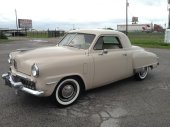
Grandpa and Ruby were both driving 1942 Pontiac, 4-doors, with the “torpedo” rear ends. Grandpa’s was black and Ruby’s was sky blue.

1942-Pontiac-4dr

Mom, Dad, Sylvia, and I traveled with the rest of the group, in the two cars. We swapped cars now and then to keep from getting bored. Cars didn’t have air conditioners back then so it was impossible to keep cool. Most filling stations still had outhouses rather than tiled restrooms and quite often they were 4 or 5 holers in order to take care of crowds. Quite often, you had neighbors on either side as you tried to cope with the stench and the flies in the 100 degree heat.

What must have been our second night was spent in a motel in San Simon, Arizona. This was one of Grandpa’s favorite areas and he knew the people who owned the motel. (When I spent the summer with him in 1950, Grandpa owned 160 acres about 1 ½ miles west of town). When we were loading up to leave the next morning, Grandpa put a couple of boxes with chicken wire covering the ends, in the trunk. He opened one of them and reached in and lifted out a Gila monster and scared the devil out of me. He had already told us a number of stories about Gila monsters and how they bite down on you and won’t release their grip unless you cut their heads off. Grandpa said he had caught these two and was taking them to California. He said he was giving one to the Griffith Park Zoo in Los Angeles and the other to the San Diego Zoo. He said he had provided critters of different types to both zoos in the past.
Gila Monster

Another thing I remember about San Simon is that when you leave town, driving west, you can look to the south, to the Chiricahua Mountains and see what is known as “Cochise’s Head.” When you are in the right area, and several mountain peaks are lined up correctly, you can see the profile of a man’s head as if he were lying on his back and looking up. Cochise is still there looking after his stronghold.

The next thing I remember (besides the stinking outhouses in the desert) is arrival in Yuma in the early afternoon. We were ready to eat some lunch and were looking for a place to stop. Remember, this was during the war and everything was rationed. We were looking for a café when we came to one which had the word “Butter” painted across the window in big, bright letters. Since we were all sick of eating the margarine which had become available during the war. We thought we were in for a treat. We got in, got settled, and ordered a meal. Everything was fine until we were served and Grandpa realized that the stuff in the butter dish wasn’t butter but was the hated margarine! First, he called the waitress over and explained the error to her. Well, she was sorry but margarine was all they had today. Her explanation wasn’t adequate and as Grandpa started getting up a full head of steam he demanded to speak to the owner of the place. When the owner came in from the kitchen where he presided over the grill, Grandpa tried to explain the error to him. He got the same response…”no butter today.” Grandpa was soon shouting at the top of his lungs about people that painted “Butter” on their windows to lure people into their place and then had the gall to serve them margarine. Grandpa felt that he had been tricked and cheated and he wasn’t going to stand for it. I remember a lot of noise and embarrassment but don’t remember how this was resolved. I don’t know if we went somewhere else or if the owner of the place somehow placated Grandpa.

We split up in Yuma with Ruby and Carol and the kids heading for San Diego and us heading for Los Angeles. Grandpa owned a home at 6151 Dennison Street in East Los Angeles. It was a nice neighborhood with Spanish-style houses and well kept yards full of flowers. I remember being amazed at the sight of streets lined with palm trees.

My Dad only had 2 weeks’ vacation but Mom and we kids were going to stay for 6 weeks. Grandpa set up a sight-seeing schedule that would allow Dad to see as much as could be crowded into his time period.

Dave Thomas

February 4, 1994; Revised and added pictures March 5, 2015.


It Backfired On Him!

Pat was one of the first female “big ticket” sales people hired by Sears here in San Diego. “Big ticket” meaning big bucks…appliances, TV’s, hi-fi’s, refrigerators, etc. The men felt that they were being invaded and had to protect their turf. They made the women’s lives miserable whenever they possibly could. They stashed inventory, hid customer orders, told returning customers that their sales lady was off that day so they could steal the sale even though the woman might be off the floor on lunch break. In short, they did every petty thing they could think of.

If there were no customers on the floor, the sales guys sometimes eased their boredom by picking at one another. Ed was one of the worst when it came to this and he began making a “cause” out of Pat’s handwriting. Pat scribbles her signature and everything else because she simply doesn’t want to take the necessary time to make things neat. A good part of the time, she can’t even read her own notes. When signing a legal document she slows down enough to make her signature legible.

Ed, on the other hand, wrote beautifully and his penmanship was like a work of art. He couldn’t understand why Pat’s handwriting was so bad and why she didn’t care. He thought there must be some dark reason for this and he was bound and determined to find out what it was. He continued ranting about it every time he got a chance.

It happened that the San Diego Fair was in full swing and on a day off, Pat and a friend decided to go. They went to the art show, the photography show, and the garden show and then started checking out the merchandise booths. Mixed in with the can openers and super detergents, they came upon a booth advertising “Handwriting Analysis”. Pat was intrigued by this since she had been getting so much grief from Ed and she stepped up to get it done. She was delighted by what the analyst had to say. She was told that her handwriting indicated she was open-minded and creative and free and that she had a great zest for life. She could hardly contain herself until she went to work the next day and told Ed and the other guys what she had learned. Ed, of course, was taken aback, in that the findings in no way agreed with all of the negative stuff he had been putting out. He was scheduled to be off the next day and vowed to go to the fair and get an analysis of his beautiful penmanship and show Pat and the rest of the crew what the evaluation of a true craftsman’s work would be.

Two days later, a subdued Ed showed up for work. In a low and even voice, he said that his penmanship had been described as artificial, deceptive, and was definitely covering up a deep, dark, secret. Ed was feeling pretty low but you’ve got to hand it to him…he had the guts to lay it out before everyone.

Strange as it may seem, Ed was one of Pat’s favorite co-workers. As ornery as he was, if caught at something he would always ‘fess up and laugh at himself for getting caught. Pat says that as long as you were on guard, he was fun to be around and was basically a decent guy.

Dave Thomas
June 20, 2015


How My Back Was Fixed On A Front-end Machine

My last two years in high school I was in an occupational program that allowed me to leave school at 2:00 PM each day and go to work at the local Chevrolet/Buick garage. I worked until 6:00 PM on weekdays and on Saturdays from 8:00 AM until 1:00 PM. I washed cars, swept up, and did whatever needed to be done.

Somehow, I had hurt my back. I don’t remember how it happened but it was probably something stupid. I was in misery at work and told the Parts Man about it. He told me I should talk to Frank Prosser, one of the mechanics. He said that Frank had formerly been a chiropractor and might be able to help me. I don’t know how Frank had gone from chiropractor to mechanic. As a mechanic he would have good and steady pay and regular hours but who knows? Frank was the oldest man in the shop and was really a nice guy. I went over and told him about my back problem and asked if he could help. He told me he would be glad to help me and would do so at quitting time and that I should meet him at the front –end machine. That sounded kind of strange but I agreed to meet him.

At quitting time I went to the front –end machine and Frank was already there. He had brought a couple of those fender covers that mechanics use so they won’t scratch the paint on your car. Our front-end rack was elevated some 15 to 18 inches so the mechanic could get under the car and you had to drive up a couple of ramps to get your car up there. Frank spread the fender covers on the rack and told me to lie down on my stomach. He said that this was the only place in the shop where I could lay down but he could still reach me without breaking his own back while leaning over. He checked out my spine and then massaged a couple of areas and applied pressure to them. After a few minutes he had me sit up and he gave me a lecture on how to lift and how to take care of my back. I felt better immediately and the one treatment was all I needed. After a couple of days the soreness was gone. My mechanic friend and his front-end machine had straightened me out.

Dave Thomas
November 5, 2013


Plan B

It was February or March of 1958. I was attending the Navy’s Aviation Electronics School in Millington, Tennessee, a suburb of Memphis. Pat was working in the Accounting Department at the corporate headquarters of Kroger’s Grocery Stores.

It was a weekend and we decided to go across the river to Arkansas and explore a little. We got to the bridge over the Mississippi and the road ramped up, probably to get the bridge high enough to be above flood level. We crossed the river and were on the downhill straight-away that would take us into East Memphis, Arkansas. Way up ahead we could see something hopping up the shoulder toward us. As we got closer we could see that it was a dog! He was hopping on his front legs and was vertical, with his rear legs curled above his body. Apparently, his rear legs were injured and he had to come up with an alternative way to get around.

I don’t remember anything else about that day…only that courageous little dog getting on down the road. Both animals and humans find a way to cope.

Dave Thomas
December 17, 2014


Sam, The Desert Tortoise

ack in the mid-1960’s I had a man named John Grant working for me as an Assistant Foreman. One Monday morning John came in and handed me his letter of resignation and said he was moving to Colorado to work for his father-in-law. We talked about it for a few minutes and I wished him well. Then, he told me that one problem he hadn’t resolved yet was what to do with the desert tortoise named Sam that he had kept as a pet for several years. John was afraid that the extremely cold winters of Colorado might be too much for Sam. He suggested that I might like to adopt Sam and care for him. It sounded good to me so a few evenings later John brought him over to the house.

The desert tortoise inhabits the southwestern United States and northern Mexico. There are two species, one living east of the Colorado River in Arizona and Mexico and the other living west of the Colorado, basically in the Mojave Desert. They are considered to be endangered and if you run across one in the wild, it’s against the law to touch, bother, or harm them. There is a means for adopting those who have been rescued from unsafe conditions.

The desert tortoises live from 60 to 80 years. Mature male tortoises can be from 12 to 18 inches in length with females being somewhat smaller.

In these little stories I’ve been trying to shed some light on the thought processes of animals but in Sam’s case I’ve got to ‘fess up and tell you that I’m up against the wall. He ate, slept, pooped, and hibernated, and I can’t make any funny stories out of that. We turned him loose in the back yard where like a cow, he grazed and slept. We fed him lettuce every day and he really enjoyed that. For goodies or snacks, he seemed to enjoy things that were red. For instance, in our back yard we had 3 hibiscus bushes that were about 8 feet tall and were always full of blossoms. Two of the bushes were red and the other was white. If you picked a bunch of blossoms and put them in front of him, Sam would eat them all but he ate the red ones first.

Sam’s favorite snack was watermelon. He would eat every bit you gave him and when he was done, he would have red juice all over his jaw and face and he would sit there blinking his eyes with a satisfied look on his face. What a feast!

A desert tortoise hibernates through the winter. As the fall season moves in, temperatures drop and the days become shorter. This tells the desert tortoise it’s time to start looking for a place to hole up for the winter. They get sluggish and don’t move around as much though they may start crawling under things or digging holes. Taking John Grant’s advice, at this time we would pick Sam up and carry him into the house and put him in a dresser drawer. He would sleep there until spring when the days got warmer and longer. Then, we would either arbitrarily take him to the back yard to wake up or wait until we heard him moving around before taking him out. As I recall, Sam spent a couple of years in dresser drawers and a couple of years in a closet.

One day, Sam wasn’t in the yard. I checked every square inch and there were no burrows or holes that would have allowed him to escape. Sam had been turtle-napped! It was a shame. We had all enjoyed seeing him out there in the yard. He was docile and seemed to be content with life as he grazed his way through each day.

Desert Tortoise

Dave Thomas
September 23, 2014


Cinco de Mayo

It’s almost May and Pat reminded me that we have a Cinco de Mayo story. This took place in the mid-1990’s. I’m a diabetic and sometime in 1993, I got a diabetic ulcer on the bottom of my right foot. My doctors fought it for a year and a half and couldn’t get it to heal. Finally, it was decided to amputate the right leg below the knee. This was done and I got a prosthesis and life got back to normal. The following spring, I wasn’t paying attention and the prosthesis rubbed against the side of my knee and caused a sore that immediately became infected. This had happened before and it meant anti-biotics, at least 2 doctor visits, and 6 weeks in the wheel chair without my leg.

So anyhow, I’m riding my wheel chair and here it is…Cinco de Mayo. Pat and I decided we should join in the festivities by having lunch at Casa de Pico, our favorite Mexican restaurant in Old Town San Diego. We got there and the place was as colorful and beautiful as always. We sat on the patio to take advantage of the warm, sunny day and to hear the music and listen to the chatter and the laughter of the other patrons. Pat ordered a blended margarita in the big glass with the salt on the rim and, being diabetic, I ordered coffee.

As we waited to be served, we talked and admired the holiday decorations. There were some miniature Mexican flags on the tables so Pat took a couple and attached them to the handlebars of my wheel chair. We enjoyed our meal and left the restaurant and then headed for the side gate to leave the area. Getting through the wrought iron gate we needed to go about 50 yards down the side street to the parking lot. Pat was pushing me in the wheel chair and I was teasing and smart-mouthing her about drinking the margarita and maybe being too tipsy to push me. She countered by pushing faster to show that she could handle the job. I was having a heck of a good time and started yelling “faster, faster”. Pat was up to the challenge and in a few seconds was up to full speed. We were flying down the street with Mexican flags flying and Pat sprinting for dear life. We were looking good until we hit the pot-hole. Wham! Pat ran into the back of the wheel chair and I was dumped into the street. Yow, this is gonna’ hurt! Maybe next time I’ll keep my mouth shut.

Dave Thomas
April17, 2016

The Augusta Elks Barbershop Quartet

1c Augusta Elks Quartet 1

L. to R.: Al Thomas, Ray Howard, Ross Millison, B.E. “Biddie” Watt

During the 1940’s, Dad was a member of the Augusta Elk’s Barbershop Quartet. He hadn’t been able to join the service during WW II due to heart problems so he tried to do his part in other ways. He was always happy when the quartet sang at the war bond rallies, churches, and local events and sometimes went to neighboring towns to help promote the war effort. Dad sang tenor, Ray Howard sang lead, Ross Millison was at baritone, and B.E. “Biddie” Watt sang bass. They went as far as Kansas City and Oklahoma City to take part in events and barbershop quartet contests.

Any quartet that was passing through town on their way to a contest or an engagement stopped at our house because they wanted to sing with Dad. He was actually a baritone but had a fantastic falsetto voice that made it possible for him to sing the tenor part. Sometimes visiting quartets would stay nearly all night, singing one song after another. Mom enjoyed singing and could harmonize with the best of them so she always joined in. I remember waking up in the middle of the night many times and hearing them sing for all they were worth. 

Augusta Elks Quartet

I remember one weekend when the quartet and wives had gone to Kansas City for a big meeting and sing-off. They came home telling us that the singing had been great and they had met some new quartets. However, Mom said that the accommodations had been scandalous. The hotel had overbooked their rooms and there just wasn’t a place for everybody. Ross Millison was the only single man in the Elks quartet but there were no single rooms available. After some talking, it was decided that Ross would bunk with my Mom and Dad. The way it worked out, Dad slept in the middle with Mom on one side of him and Ross on the other.

Dave Thomas
November 16, 2015


The Gooney Birds of Midway Island

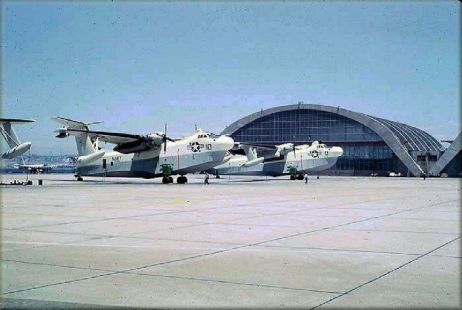
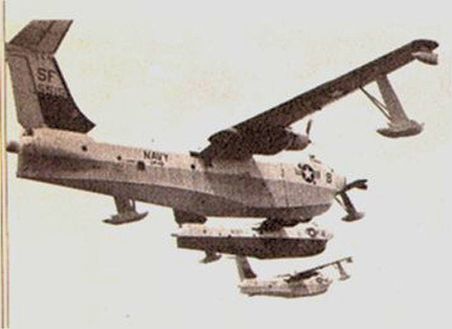
I was an aircrewman in seaplane squadron VP 48 (Patrol Squadron Forty-Eight). As the time approached for our deployment to Iwakuni, Japan, story-telling in regard to the flight across the Pacific increased. Our seaplanes had reciprocal engines and due to their range, the trip meant that we would be island-hopping across the ocean. We would first fly from San Diego to San Francisco. Then, we would go to Hawaii, Kwajalein, Midway, Guam, and Iwakuni. From San Francisco on, they were all 10 to 12 hour flights.

vp48p5m_01_10may2002

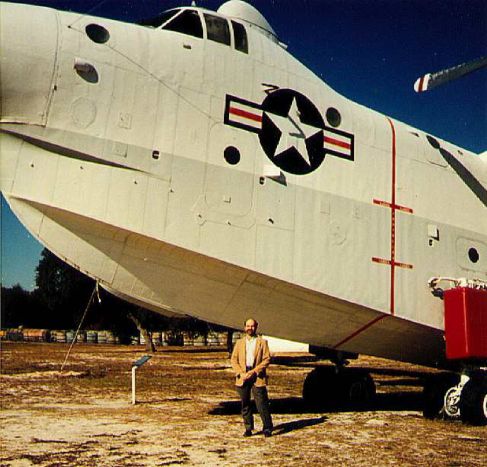
Martin Marlin P5M-2

Some of the most interesting stories we heard, and certainly the funniest, were about the Gooney birds of Midway Island. A Gooney bird is an albatross with a 7 foot wing span that looks beautiful and graceful in the air but is so clumsy it looks like a clown when taking off or landing.

We got to San Francisco okay, spent the night, and then on to Hawaii for the next night. The 3rd day we got to Kwajalein with no problem. We got up the next morning on Kwaj and it had been raining and the sky was ugly. After breakfast, we went down to the pier and took a boat out to our plane which was tied to a buoy in the harbor. After filling up with gas and lunch supplies (and coffee, of course) we hung the JATO bottles (jet assisted take-off). With a full load of gas and rough seas we would need some help getting in the air. There was a coral reef that formed the outer edge of the harbor so that pretty much defined the limit of our take-off run. The sea was a little choppy but the pilots thought we could get off alright. The pilot increased the power and we started our run down the sea lane. The choppy seas were beating the devil out of us but we got up to speed and they fired the first pair of JATO bottles. This was supposed to put us up on the “step” where we were planing just as you do in a motor boat when your speed is sufficient to cause you to ride on the crest of the waves. Normally, that first pair of JATO bottles gets you up on the step and then, when you have enough speed, you fire the second pair of bottles to lift off.

The pilot fired the 2nd pair of bottles in an effort to get up on the step but it didn’t help. We didn’t have enough speed to fly but we were sure closing on that coral reef at a pretty good rate. Our pilot stayed with it as long as he could but had to give up and pull the power off and abort. We taxied back toward the pier and tied up to a buoy and waited for the boat to bring us four more JATO bottles. The pilot, co-pilot, and navigator had all been watching the wind and the currents as we made our first attempt at taking off and after discussing it, decided that with a slight change in heading we could get enough lift to get off all right. We hung the new JATO bottles taxied back out into the sea lane and this time, got into the air and headed for Midway.

In the middle of the day, we passed the half-way point, the “point of no return”, and Kwajalein Air Control had handed us off to Midway Air Control. We were at 10,000 feet and probably doing 140 knots, and as far as you could see in any direction there was nothing but the beautiful blue Pacific. All of a sudden, the starboard engine belched out some smoke and started making some weird noises. The pilots shut down the engine and feathered the prop as the navigator checked his numbers and calculated our position. As the rest of the crew went to their emergency positions, I fired up the radar and took a couple of sweeps with the antenna. I could see for about 120 miles and there wasn’t a ship in sight. Meanwhile, the pilot had sent a Mayday call and was now talking to Midway Air Control. The pilot gave our current position, heading, airspeed, altitude, and all that stuff. Midway acknowledged and said that they were launching a Grumman UF-1 Search and Rescue plane that will meet us and accompany us to Midway. The Grumman is a smaller seaplane than our Martin P5M but if we went down they could drop us additional life rafts or supplies. For them to make an open-sea landing was not a practical idea.

Grumman_UF-1_Albatross_USN_in_flight_1950s

Grumman UF-1 Albatross

The pilot gave the word to jettison some of the on-board equipment that we could do without and the crew heaved it out the port hatch. The next thing to go would have been our clothing and personal gear but fortunately it didn’t come to that.

It seemed like it took forever for the Grumman to meet up with us. Our navigator figured out what time I should be able to spot him on radar and sure enough…there he was. When he was close enough to eyeball, we were thrilled! The flight on in to Midway was without incident and we made a smooth single-engine landing.

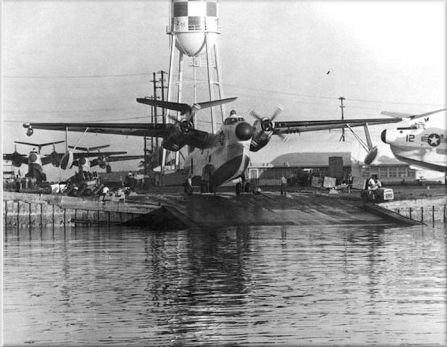
Midway Island had been a waypoint for seaplanes for many years. There was a large concrete ramp extending into the water for launching and recovering the flying boats. They had and maintained several sets of wheels also. The P5M didn’t have landing gear or wheels. The wheels were designed with floats and at the time of recovery were towed by a boat out to the airplanes and attached by a simple pin and clamp device. Then, a cable was attached to the tail at the keel position and the plane was towed up the ramp backwards by a heavy tractor-like piece of equipment known as a Buddha.

We went through the recovery process and after being towed up the ramp our plane was parked on the apron nearby. We were finally in Gooney Bird Land and surrounded by hundreds or thousands of the creatures.

Gooney Bird Landing

Albatross/Gooney Bird About To Make A Crash Landing

(notice the look of terror on its face)

We were on Midway Island almost a month. Most of that time was spent waiting for the new engine and some associated parts that turned out to be faulty. Most of those days waiting for parts were spent either swimming or sitting in the shade of our plane’s wing and watching the gooney birds. They were so graceful once airborne but looked so ridiculous when taking off or landing. Naturally, they walked or ran like a duck, all spraddle-legged and freaky looking. They had to run several yards before getting enough speed and lift to get into the air. After watching them, we decided that the most successful take-offs were those where the bird making the take-off run, ran across a bump or hill or berm that caused enough of an up-draft to give them the lift needed to get airborne.

Landings were really a challenge. Every square foot of ground had a bird sitting on it so there was no clear “runway”. And, the birds always came in too fast. You just knew that any attempt to run on those ugly little feet wasn’t going to work. But, they would come swooping down, lower those feet, and start stepping on the heads of every bird in their path. This went on for several feet until they finally stumbled and crashed.

There were a few birds that could make a decent landing and we didn’t know if they were smarter or just lucky. The birds acted much like an airplane making a landing on a short runway. As they made their approach, they would pull their hose up and into a full stall and then take the power off slowly and settle to the ground. Beating the wings slowly allowed them to control the descent. I’m supplying a link to a video that shows one bird making a good landing as I have just described.

Words can’t do justice to the actions of the gooney birds. Watch the video that I’m providing the link for. There’s a lot of funny stuff on the Internet. Do a search on “Gooney Birds of Midway Island, Gooney Bird take-offs, Gooney Bird landings, etc.” and the results will give you some good laughs.

http://bgamall.hubpages.com/hub/Albatross-Gooney-Bird-Humor

Dave Thomas
October 24, 2014


Judy

It was June of 1957 and I had graduated from boot camp at Great Lakes Naval Training Center, north of Chicago. I was beginning a 30 day “leave” and had taken trains from Chicago to Wichita. After arriving in Wichita, I walked the block or two to the bus depot and caught a bus to my home town of Augusta, 17 miles to the east.

We arrived in Augusta and stopped at the Bus Depot which in actuality was McDuffy’s Service Station. Getting off the bus, I felt like I was in a strange new world. I’d only been gone about 3 months but everything felt different and I wasn’t sure why. I was wearing “dress blues” with the neckerchief and white sailor hat so I felt a little conspicuous. Boot camp was like a vacation for me but it had done its job which was to cut the apron strings and teach you to stand on your own two feet and live a disciplined and pride-filled life.

I got my sea bag out of the belly of the bus and waited to cross the street at the only stop light in town. As I crossed the street, I saw Clarence “Judy” Williams, our neighbor from two doors down, coming toward me. Judy was at least 6’3″ tall and was as nice as he was big. As we met, he shook my hand and grinned and told me how proud he was to see me in my sailor suit. I should tell you that during WWII, Judy had been a “Seabee’ (C.B.= Construction Battalion). We grade school kids knew what outfits all the local guys were in and considered them all to be heroes. The job of the Seabees was to build roads and landing strips where needed, often under fire. I remember one cartoon showing a Seabee driving a bulldozer with one hand and firing a machine gun with the other.

We walked the block to our homes, talking “Navy talk” all the way. As we got to Judy’s house, he dropped off but shook my hand and told me again how proud he was to see me in uniform. Now, after all that, I felt like a million bucks! I was home and comfortable and proud to be in the Navy.

I guess what I want you to draw from this is that a kind deed such as Judy performed can have an effect that will keep a person warm for a lifetime. It’s been over 57 years and thinking about it still makes me feel good.

Here’s a footnote:

Thinking about this story, I realized that I didn’t know how or why “Judy” Williams got his name. I sent an e-mail to his daughter, Joyce, who is a couple of years older than me but still going strong. Joyce has been a friend since we played kick-the-can some 65 or 70 years ago. Joyce’s response to my question is a good story in itself so I’ll copy it here.

“Hi Dave-

Now, about my Dad. Will be interested in hearing how he ends up in a missive to your grandkids. He was the youngest by 8 years of 8 children. They lived on a farm, and were very hard working, kids included. (They did things different in those days.) A traveling show (circus) came to a nearby town, and apparently the whole family went. At least my Dad and some of the older kids. And this was a rare event. There was a puppeteer there doing a “Punch and Judy” show. I can’t remember how old my dad was, but, not very and he was really impressed, and talked of nothing else for weeks after. Consequently, he became known as Punch and Judy, eventually shortened to Judy.

Now the strange part that I can’t explain. They lived in Indiana. My mom and dad met in Chicago, and later married. Everyone in Augusta called him Judy, and his family back home in Indiana called him Clarence til the day he died. And in later years, he preferred Clarence. Too late, everyone knew him as Judy.

Joyce”

Dave Thomas
January 9, 2015