Eagle Feather and White Fawn

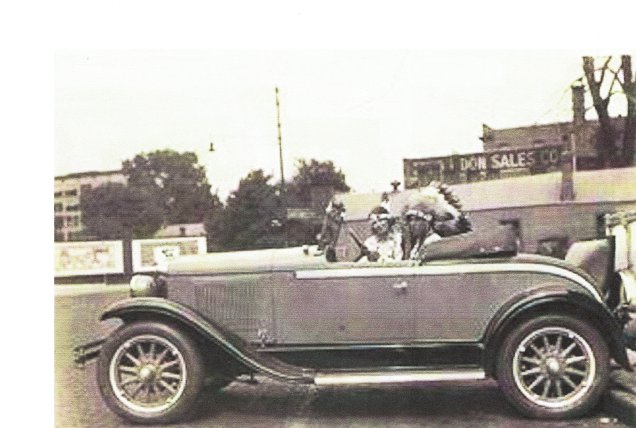
  Eagle-White Fawn-car

Chief Eagle Feather, a full-blooded Cherokee, toured the country’s vaudeville circuit and was billed as “America’s premier Indian tap dancer.” The Chief, also known as Frank Bell, married our cousin, Myrtle Thomas. The story goes that after their marriage, she was adopted by the tribe and given the name “White Fawn.” She joined Eagle Feather in his adventures as he persued his vaudeville career.
Eagle & White Fawn

Dave Thomas
September 16, 2015

Pictures from cousin Dave Dunn.

Serving Chili

These last few years I haven’t been in many small-town diners or cafes and I was wondering if they still serve chili like they used to. I’m asking because what I’ve seen lately in these plastic franchise eating places makes me wonder. Have we lost the art of serving chili or do those small-town folks still do it right? I’ll tell you how it used to be done and you can keep your eyes open and make sure it’s done right.

I’d go into the 7th Street Café, by Fowler’s Mobil Station, and sit down at the counter. The waitress would ask me “what’ll you have?” I’d say “chili” and she’d go turn the order in to the cook. Then she would come back and make sure I had everything I would need. First, she would come up with that little jug of vinegar. Next, she would make sure the catsup and mustard was at hand. Then, she’d go away and come back with one of those white bowls full of oyster crackers and set it right close. By now, the cook has got the chili up and she brings it to me with one of those big, round spoons. There it is…its perfect! Can you name a place today that will set you up with the fixin’s like that?

Dave Thomas
December 7, 2014


The Penguin Club


54a Penguin Club Jan. 1stSome cities have Polar Bear Clubs that award memberships on New Year’s morning to those who dive into the Hudson River or Lake Michigan or some other freezing cold body of water. Here in San Diego, we have the Penguin Club. To qualify, you must water ski a couple of laps around Mission Bay and then lie on a block of ice for a pre-determined period of time. I’ve got a couple of stories about Pat and Terri and the Penguin Club but first I’d like to tell you some of the things that transpired and got them to that shivering group.

Pat was working in the Auditing Department at Sears in San Diego. For many years, that was the only Sears store in the county. The first new store was built in the South Bay at Chula Vista though the original store was still the place to be. In the 1960’s, Sears Roebuck was the primo department store in the country. The commissioned sales people and the clerks were all well trained in both product knowledge and customer service. The benefit packages included great insurance and retirement plans.

Pat was working the Payroll desk in Auditing so each month she saw that the commissioned sales people were making a ton of money. More than once, she expressed a wish to have that kind of earning power.

Pat’s supervisor announced that the company making electric knives and fondue pots for Sears was scheduling demonstrations of their products at the Chula Vista store and it would be an opportunity for employees to make some extra money by conducting these demonstrations in their “off” hours. Pat was asked if she would like to take part in this. She acknowledged that she could use the money and though she didn’t know anything about either product, would like to give it a try. She was accepted and worked several shifts at this new job. It turned out that Pat not only enjoyed what she was doing but was very good at it. The story of her success was passed back up to the San Diego store and her supervisor.

Pat continued working the Payroll desk in the Auditing Department. This was the period when computers were being introduced as tools for business use. The computer necessary to do the administrative, book-keeping, and inventory functions of a store the size of Sears required a room larger than the average bedroom. During the infancy of the computer, life was just one mechanical problem or memory or software glitch after another.

The Auditing Department faced some kind of problem constantly with the reports from the computer. Pat’s co-workers became terrified when they heard the word “computer” and they had little success at troubleshooting. Pat had worked every desk in the department, had a solid understanding of them and fortunately had an uncanny knack for solving computer problems. She approached them in a matter-of-fact manner, without hysteria, and solved the problems using good book-keeping practices and common sense. She solved a number of problems that had baffled the “experts”. Her ability raised her profile in the office even higher than where it had been before. At one point, she suspected that an embezzler was at work but hadn’t as yet been able to pin down the department involved and come up with a suspect. She took some print-outs to her boss and explained why she felt something “fishy” was happening. Her boss looked over the reports and agreed that something didn’t feel right. He asked Pat to stay an hour every night, going over the reports, with a person from Security in the room, until she figured out what was going on. She worked at it for several days before turning over her findings. The result was that a man went to jail for embezzlement.

Pat’s supervisor told her that the management team had been considering her for the position as head of the Auditing Department. He said it would take another 2 or 3 years to acquire the experience she would need but they were confident that she could do it. Pat declined and was asked “why?” She said she needed to increase her income sooner than that and besides, wasn’t interested in heading a department of gossipy women.

One day, a problem occurred that the computer people couldn’t find. Auditors were due in from the home office in Chicago in a couple of days. Pat’s supervisor was under the gun and told her that if she could find the problem, he would help her transfer to sales. It took some doing but she found the answer and though he hated to lose her, her boss kept his promise.

Pat got her transfer and became the 4th woman working as a commissioned sales person at Sears Roebuck in San Diego. She was put to work in the Electronics Department selling TV’s, stereo systems, tape recorders, and other electronic items. The first thing she learned was that she had been dumped into the middle of an “old boys club.” The manager didn’t want any women working for him and the salesmen on the floor were sure that no women could possibly do their job. They treated her terribly! The manager withheld information about sales and merchandise and didn’t provide the day-to-day support that would help her learn the business. The salesmen were rude and withheld information and stole deals from her. If a referral or a returning shopper asked for her when she was out to lunch, the men would say it was her day off and would make a deal and write it up in their own names. They pulled every dirty trick you can think of. It was the same as stealing money right out of her pocket. She would come home at night, frustrated and crying and mad. I felt so bad, seeing her this way, I wanted to go to the store and have a little heart-to-heart talk with them. She said no, because that would just make it worse. She had to stand on her own two feet and learn how to out-sell them.

It was tough. Week after week, Pat studied the merchandise and memorized the specifications. Her sales figures started coming up and she was becoming more at ease on the floor. The salesmen started to loosen up, too. The first was the oldest guy in the group. I guess he realized that he had been brought up better than he had been acting and it was time to display some manners. The other guys softened up, too and the working environment became tolerable. Her sales figures steadily increased and she became one of the top salesmen in the store. A couple of times, she was Salesman of the Month at the store and once was 4th on the west coast. She was making a heck of a lot more money than I was as the Manufacturing Manager of an electronics company.

The “big ticket” salesmen, the people who earned the big money, always worked the weekends and took days off in the middle of the week. Several of them liked to water ski and had their own ski boats. They started to gather informally at Ski Beach, on Mission Bay, on Thursdays for a big skiing day. Pat had earned the respect of the group and she was asked if she would like to participate. She told them that she didn’t know how to water ski but would like to give it a try. She started attending the ski parties on Thursdays and loved it and soon discovered that she was good at it. It didn’t take long for her to graduate from two skis to one ski. At this point, she decided that she needed her own ski and soon after that she needed her own boat.

Pat watched the classifieds in the paper and soon located a good ski boat and trailer and we went out and bought it. We both had a lot to learn about the upkeep of boats and trailers when used in a salt water environment. And, since I had to work and wouldn’t be going with her, Pat had to learn how to hitch up the trailer, back it, pull it, gas up the boat, launch and recover it, and a thousand other things. She learned these things along with our daughter, Terri, who Pat was kidnapping from high school on Thursdays.

Pat told me that she and Terri were going to do the Penguin Club stuff on New Year’s morning and earn the shoulder patch and membership card. It sounded like fun so I went along as a spectator. Boats and equipment would be available so we didn’t have to take anything. There was a good crowd there and people were scattered around the parking lot and the beach and a television crew was there from one of the local stations. Pat and Terri went to get in line for their event. I got myself a cup of coffee and milled around while I waited for the girls to have their turn on the skis.

In the crowd, I spotted a guy that I had worked with for several years named Art Ahlquist. Art was waiting for some of his family to take their turn on the skis and ice block so we stood together and watched and talked and drank coffee. This Penguin Club event was at a different part of Ski Beach than where Pat usually skied. At her regular place, when you were done skiing you headed for shore, cast the tow rope aside and coasted right up to the water line and stepped off onto the beach. Here, the water was shallower so you couldn’t ride all the way in and would have to step off your ski earlier. Art and I watched as people glided in and stepped off their ski into the shallow water.

Pat’s turn came and I watched as she got up and was skiing around the bay. Art had been talking to someone else but turned back around to watch as Pat headed in and prepared to dismount. We could see that she was heading almost straight in, rather than paralleling the shore. Art, who was familiar with this beach said “Who’s that dumb s—t coming straight in?” About that time, the skag on her ski hits the mud and Pat lands face first in the water. “That dumb s—t is my wife”, I said. Pat got out of the water, freezing, and with a skinned nose from her fall. She sat on the block of ice, shivered until it was over and got her shoulder patch and official ID card.

Terri made it around the bay without incident (except for freezing) and did her time on the block of ice. She received her shoulder patch and card and about that time was approached by a member of the San Diego Water Ski Club. He said they wanted to form a pyramid and make a lap around the bay for the TV camera but one of their team couldn’t be there that morning. He went on to say that they had watched her ski and it appeared that she was good and could help them with their pyramid. She would be the person at the top so she wouldn’t have to worry about supporting any weight. She agreed to give it a try so they started instructing her right there on the beach about how the climbing sequence should work so she could get safely to the top. After a bit, they went down to the water and started off. Terri struggled a little but got to the top of the pyramid and had the tow rope in one hand and a flag raised high in the other. They made a lap around the bay with everyone looking good, and then told Terri it was time to dismount. She started trying to climb down and realized that no one had explained the proper way to get down or told her of the proper sequence for doing so. She soon knocked one of her cohorts off balance and the whole pyramid came tumbling down. It was quite a pile-up and Terri nearly had the earrings jerked from her head. They didn’t tear through the bottom of the ear lobes but they made some nasty looking gashes. She was mad and when they all got to the beach she made them show her the safe and proper way to get down. Terri was asked to join the ski club but she told them she would pass.

Water Ski Pyramid 1

This is a file photo from the Internet, just to refresh your memory on what a pyramid looks like on water skis. Terri said it was quite a thrill.

Dave Thomas
January 16, 2015
 

Aircraft Spotter Cards


aircraft spotter cards 1

I was five years old, a Kindergarten student, when the Japanese bombed Pearl Harbor on December 7, 1941. Naturally, at that age, I had no idea what that meant. As the days, weeks, and months went past, young and old received lessons every day in the meaning of war and the obscene way the young men of our town were called up and then sometimes returned home in caskets to their broken-hearted parents and friends and neighbors. We all learned about the rationing of food and gasoline and bubble gum and about War Bonds and rallies and restrictions of many kinds. As the men went off to war, the women took their places in the factories, war plants, and farms and churned out the goods we needed to support our servicemen and our country.

We all wanted to contribute to the war effort in any way we could and one of the most interesting ways for a kid to do that was to watch out for enemy aircraft. This may sound strange, considering that we lived in Kansas which is located right in the middle of our country. The Japanese flew in and bombed Pearl Harbor and the Germans were shooting rockets and buzz bombs at England so we didn’t know what they would be capable of doing next. Our enemies could possibly build secret air bases in Mexico or Canada or could launch carrier strikes from the Atlantic or Pacific or the Gulf of Mexico. We all had black curtains temporarily installed over each window in the house so that when the Civil Defense people conducted black-out drills as part of practice air raid drills we could take cover in our homes and be sure that no lights would give away the location of our town.

We kids were all excited about learning to identify all the aircraft in the skies so that we could sound the alarm in case of attack. The greatest aid in this endeavor was the pack of Aircraft Spotter Cards which were manufactured by the people who make Bicycle Playing Cards. These cards could be used as playing cards but their other purpose, and most important to our point of view, was to help identify the military aircraft of friend and foe. We learned to identify the P-40, the P-38 Lightning, the B-25, and the P-51 Mustang as well as the Jap Zero and the German Messerschmitt. It was comforting as well as fun to know these airplanes. As I said, we lived in Kansas but we were only 15 miles from Wichita, the location of an air base and the Boeing, Cessna, and Beech aircraft plants. For all we knew the enemy was liable to make a bombing run on those places at any time. We didn’t go around wringing our hands and crying out of fear but our resolve to be alert and prepared was great.

Dave Thomas
November 27, 2008

aircraft spotter cards 5                                                        aircraft spotter cards 4
aircraft spotter cards 2


A Shucky-darn Guy

I’ve known this guy for more than 45 years. He’s a quiet, soft-spoken man who never swears regardless of the provocation. If he hits his thumb with a hammer, he says “shucky-darn!” If he cuts his finger with a knife, he says “shucky-darn!” No matter how bad things get, he reacts about the same. You know this isn’t normal…this man has been in the Coast Guard and has been working as a lineman and a foreman for the electric company for forty years. He knows all the words but chooses not to use them..

I couldn’t believe it at first. I thought to myself that this guy is going to pinch his finger or something and then he’ll cuss a blue streak just like the rest of us normal people. I just couldn’t believe that he was actually a real shucky-darn guy. Over the years I kind of kept this in the back of my mind. I didn’t go nuts about this and try to trip him up or cause him to explode over some stressful event. I just noted his reactions like you note what is happening with the weather. For instance, it’s warm today or there’s a nice breeze blowing today.

Meanwhile, this is causing me to pay more attention to the people I come in contact with. Is this woman with the super sweet personality and the honey dripping from her lips a shucky-darn gal and is this man with the over-enthusiastic handshake a shucky-darn guy? Or, are they just blowing smoke at me while they cuss me and call me names under their breath? I don’t want to be cynical but sometimes it’s hard to get a fix on people and know if they are real or not.

My friend stayed the same. I guess it’s been almost 50 years now and he has been true to his principles and remained a Shucky-Darn Guy! Don’t worry, I still use all those bad words myself and if you’re not a shucky darn guy or shucky-darn gal I’ll still love ya’.

Dave Thomas
February 8, 2014


The B.N. & S.F.

Gene and Bonnie have a neighbor named “L.J.” who is a dispatcher for the Burlington Northern and Santa Fe Railroad. I didn’t know it but the two rail lines merged or one acquired the other a few years ago. The corporate headquarters for the company is here in Fort Worth, just off Western Center Boulevard. If you will recall, just after we get on I-35W and head for Fort Worth, you see a Joe’s Crab Shack and it is located on Western Center. The railroad owns several hundred acres there and it looks like a campus with beautiful buildings and beautiful trees and green lawns. There is a large pond where employees can fish if they practice “catch and release” and there are two miles of jogging trails. One of the buildings contains a large weight room.

The center of activity is a large building called the “bunker” because it is built like a wartime bunker with walls that are 3 feet thick to withstand high winds and tornados. There is also an emergency generator in the basement to ensure that there is no power interruption. The reason for all of these precautions is that all of the rolling stock and the rail lines owned by the Burlington Northern and Santa Fe are controlled from one room in this building known as Federal Control. It looks like the pictures you see of NASA’s Mission Control or the floor of the New York Stock Exchange with at least 100 cubicles, 400 or 500 people and even more computer monitors. The main room has no supporting columns and we were told that when it was built a few years ago, it was the largest free- standing room ever built. To give you an idea of the scale, one wall contains 9 movie screens and each looks to be as big as what you would see at your favorite AMC. One screen always shows the weather channel and the rest are changing every few minutes with up-to-date graphs and information necessary to run the business. One interesting screen shows the number of coal trains operating at the current moment. The BNSF averages the operation of 45 coal trains per day and the Union Pacific runs about 45 trains a day over track that is owned by the BNSF. The coal is mined in Wyoming and Colorado and shipped to power plants all over the country to generate power. Our host, L.J., was showing us around on his day off. He normally works three 12- hour days in a row and then has three days off. L.J.’s main duty is to supply locomotives to the 45 coal trains and keep track of the status of each. The rest of the screens show on-time performance and stuff like that.

We got to go through some railroad cars that are kept on the property. There is a gift shop and a museum that is quite interesting. The walls of the buildings were hung with southwest art. The whole layout was interesting and quite impressive.

Dave Thomas
2003


She Wanted To Know…

Pat and her group were big-ticket sales people. That meant that they were smart and aggressive and quick with a thought. A new man transferred in named Bill Deem. Bill was a big, nice-looking, guy with an anchor man voice. He was an ex-marine and a gentleman in the finest sense of the word. At first, he was quiet and maybe a little bit stuffy. Associating with a bunch of highly motivated, quick thinking sales people soon loosened him up.

Somehow, Bill developed a hernia and he took a leave of absence to have it repaired. The surgery went well and Bill healed up and returned to work. That first morning, the group gathered around him to welcome him back, ask how he was feeling, and ask what the doctor had said and had he placed any restrictions on him. Bill said that he made his final visit to the doctor the day before and everything went well. After the doctor finished his exam, Bill mentioned that his wife had a question she wanted him to ask of the doctor. The doctor cut in with “Yes, Bill, it’s ok for you to have sex.” “Well”, says Bill…”she really just wanted to know if I could take out the trash.”

Dave and Pat Thomas
March 4, 2015


Grandpa: To Bee…

Grandpa-To Bee Or Not To Bee

I think it was 1925 when they had a flood there in Augusta, Kansas that had the south end of town running-board deep. I remember my folks had pictures of Walnut Street in front of Grandpa’s house showing the old cars plowing through the water. Grandpa’s house, itself, was safe for it had been built with tall footings and the flood water only made it part way up the front steps.

Augusta was in a sensitive location. It had the Walnut River on the east and the Whitewater River on the west. After the flood the townspeople began talking about building a levee or dike that would protect the town on the east, south, and west sides. The higher ground on the north side was no problem. Grandpa, A.A. Thomas, was highly in favor of the protection offered by a dike and attended the City Council meetings where it was discussed. Of course, a project of this size and cost would require interaction with many county, state, and federal departments and agencies. Grandpa attended many meetings and as a homeowner and business owner (an addition to his home had been constructed to house a grocery store) he always put in his two cents worth.

If you were paying attention to him, you would have noticed that during any conversation regarding the levees or dikes, Grandpa would suggest that these ramparts should be protected from erosion and that the very best ground cover for this purpose was clover. Not many people realized that Grandpa was an entrepreneur with a new idea every minute. In this case, he hoped to set himself up as a beekeeper! He planned to place the hives at strategic places along the dikes and the bees could concentrate on the dikes and not waste time flying all over the county to collect the pollen. Thus, the bees could make more honey and Grandpa could prosper.

The dikes were eventually built but were sewn with prairie grass. Well, so much for that dream.

Dave Thomas
April 27, 2013


Quarry Story 3

Technically speaking, this is not a quarry story but since it took place on the road to the quarry I figured that’s close enough.

Have you ever ridden on an Army tank? Well, I did once, and that’s what this story is about. Pay close attention, learn, and then don’t ever do anything like it.

It was spring and we had been having our share of rain. The rivers were up and had overflowed their banks earlier in the week. The Walnut River, just south of town, was slowly returning to it’s normal size and we decided to check it out. I was 13 or so and my friend, Jack, was 15. You can get your driver’s license when you are 14 so Jack had gotten himself a job at a neighborhood grocery store, saved his money, and bought himself a 1935 Chevrolet. We headed for the river. It wasn’t much of a trip. From the edge of town, at what I remember was 4th Street, you crossed the Santa Fe railroad tracks and wandered down a country road for about a quarter mile to the steel bridge that crossed the Walnut River. It was one of those fine-looking steel bridges that looked like it had been made from a giant Erector Set.

The gravel road was still a little wet and muddy but we got to the bridge, crossed it, and continued along. About 100 yards south of the bridge was a place you could pull off the road and follow the tracks worn by many other cars to get closer to the river. At this point, the river bank was normally 5 or 6 feet above the river. It was a good place to fish from and we were told by older guys that it also served as a lover’s lane. We decided to check the river so Jack pulled off onto this track that paralleled the road and stopped and we got out. We looked at the river and messed around and finally got back in the car. Jack tried to drive off but the wheels started spinning. He was a good driver but couldn’t overcome the wet grass and mud and the fact that the ground sloped toward the river. I got out and tried to push but it didn’t do any good. We decided to walk back to town and call Jack’s Dad for help.

We got back to town and crossed the tracks and the first building in view at that time was the National Guard Armory. We decided to go in there and use the phone. The National Guard guy that took care of the Armory and answered the phone and did all the chores was a friend of ours named Billy Joe Davis. Billy Joe liked baseball and we had both played catch with him and hit a lot of fly balls and grounders with him. We told Billy Joe our story and asked to use the phone. Billy Joe said there wasn’t any point in making the call and upsetting Jack’s Dad because he’d be happy to pull us out. He said we should go out in the street and wait while he locked up and we could close the gate behind him when he came out. After a few minutes we heard an engine revving up and here comes Billy Joe driving a National Guard tank and yelling at us to shut the gate and climb on. We scrambled up onto the thing and Billy took off across the tracks. It just took a few minutes to get to the bridge and as we approached it, Jack and I looked at each other. Billy Joe may have crossed the bridge many times in a tank but it scared the devil out of us. That bridge looked pretty flimsy compared to this big chunk of iron we were riding on. Billy didn’t even slow down. He rolled over that bridge like it was him and Patton crossing the Rhine.

The rest of it was kind of anti-climatic. It just took a couple of minutes to get to the car. Billy Joe had brought a chain and he hooked up to Jack’s car and pulled us out. We thanked him and waved good-bye and headed back to town. I don’t even want to think of the possible consequences of “borrowing” a tank or running it off into the river. If you’ll excuse me I’ll just say “tanks for the memory”.

Dave Thomas
October 24, 2013


What’s a Chukker?


I believe it was the spring of 1965. In another month, that will be 50 years ago. I remember a lot of the details but the dates are hard to pin down.

To lay the groundwork for this story, let me say that total employment at Electro Instruments was probably about 250. I was Foreman of the Test Department and had 23 technicians working for me. Our job was to trouble-shoot the instruments coming off the assembly line and fix any wiring errors or cold solder joints and replace any defective electronic components. Once we had the unit running, we calibrated it with precision voltage standards and “sold” it to a Quality Control Inspector and also to a Department of Defense Inspector if it was to be shipped against a government contract. When we presented the unit to the Shipping Department it was the culmination of the efforts of every department in the plant.

One morning, I got a call from my boss, Pete Dreesen, the Director of Manufacturing. Pete said that his boss, Jim Zeigler, the Vice President of Operations had called and invited the two of us to lunch. I wasn’t sure what to make of this. Working stiffs like me didn’t ordinarily go to lunch with 2 levels of bosses, but I met Pete and Jim in the lobby at 11:30 and Pete drove us to a nearby restaurant.

I didn’t know Jim well, only having had a few brief conversations with him. It was normally business stuff, where he did the conversing and I did the listening. I knew he lived on some acreage on the outskirts of Alpine, a small town in the foothills east of San Diego. I had also heard that he had 7 kids so that’s probably why he had the big place. He was a nice guy and I liked him.

We were hardly sitting down in the restaurant before Jim announced that he wanted to start a company polo team. The three of us didn’t really know anything about polo so we started listing the things we thought would need to be answered in order to get this project off the ground. Jim mentioned that he had a couple of horses for his kids to ride but doubted they would make very good polo ponies. Jim and Pete both knew that I had a horse and asked about her. I told them that she was coming along but I bought her for her confirmation and sweet disposition and she wouldn’t be good for polo. Polo “ponies” are actually big, strong horses that love to run and are so competitive they will run over anything in their path. Jim said that was ok because he had been talking to the people that own Bright Valley Stables, up in Harbison Canyon, on the way to Alpine, and we might be able to work out a deal to rent horses from them. Also, they would give us lessons on riding English saddles and the fundamentals of polo.

Recruiting a team might be a tough job. We would be taking off work an hour or two before quitting time at least one day a week for English riding lessons. The hourly direct folks wouldn’t want to lose the pay. The salaried people could work extra hours if they needed to in order to stay on top of their jobs. A large percentage of our workforce was women. We had hired quite a few experienced women from the aerospace industry so they were older, more “grandmotherly”, types. Most of the rest of the women were young mothers that had to get home after work and pick up the kids at the baby sitters (Day Care was a term that hadn’t been invented yet). Our pool of riders was shrinking fast. We decided to post the story on the employee bulletin board so that we wouldn’t mistakenly exclude anyone that was interested.

We tried to think of anyone who rode horses for pleasure or knew anything about horses. The only horseman I knew was Steve Scott, a custodian working 2nd shift. Scotty was in his 60’s and his health wasn’t too good. He had come over from Brawley, California in the Imperial Valley where for years he had been the “Hay Boss” for a large cattle feeding outfit. Every year the city of Brawley holds the Brawley Cattle Call, a big western celebration featuring a parade and a rodeo. Scotty was one of the organizers of that annual event and even after moving to San Diego, returned to Brawley to take part in it. Scotty and I were having a cup of coffee one day before he went on shift and I mentioned that I had recently bought a horse but hadn’t saved up enough for a saddle yet. Scotty said he was too old to ride but had brought his saddle with him from Brawley and I was welcome to use it as long as I needed it. He brought the saddle, a fairly new roper, to work with him the next day. I used it for several months and returned it with thanks. I know this paragraph about Scotty hasn’t much to do with the polo story but Scotty was really a “good old boy” and I liked him a lot and enjoyed writing something about him so you could see him.

Getting back to business, our luncheon meeting lasted about 3 hours and we made plans and discussed obstacles until we thought we had covered everything. We knew we were facing an uphill battle but decided to take things in order and go as far as we could.

The first day of riding lessons, eight of us showed up, all managers or supervisors and all salaried. We had all ridden “western” but didn’t know one end of an English saddle from the other. The man who owned Bright Valley Stables had an accent and I think he must have been an Aussie rather than an Englishman. He was a good instructor and soon had us all mounted and riding around a ring. The lessons were fun and informative. We all enjoyed them because while riding around in circles in the ring he corrected our “seat” and the way we were posting and also talked to us about the tack and the rules of polo. It would be more exciting to tell you that somebody got thrown or that we had a runaway horse but nothing like that happened. We had a few lessons with most of the guys in attendance. Some weeks, one or the other of us would have to stay in the plant and take care of our department.

Jim knew of a Dr. Herring that lived in Lakeside, a town between our plant and Alpine. This Dr. Herring had a polo team that he sponsored and played on and Jim arranged for us to watch them play one Saturday morning. It was fun to watch the guys play. I don’t know if they were any good but it didn’t make any difference because they were having so much fun. One of the “attack” guys hit a pretty good drive and all of a sudden he and one of the defensive guys were in a mad dash to get to the ball. The collision was like those you hear in the NFL. Ker-Whap!!! The “attack” guy is knocked off his horse and hits the ground, breaking his forearm. Doc Herring took one look at the arm and loaded the guy in his car. He took him to his office in town, x-rayed and set the bone, and put a cast on it. They were back at the game in a little over an hour. The Doc wouldn’t let the guy back in the game. 

This broken arm was hard on our team as two of our members abruptly quit. They said they had come out for fun and that didn’t include broken bones.

Things kind of went downhill after that. It became harder and harder to get the group together. Managers and supervisors are in those positions partly due to a sense of responsibility and that makes it hard to abandon the challenges of the job in the middle of the afternoon and go play. We knew at the outset that it was going to be tough. Besides the other problems, we had no horses, no tack, no horse trailers, no cheap places to board horses, and certainly not enough discretionary income to float the whole thing. It was fun while it lasted.

Dave Thomas
February 6, 2015