Seaplane Story 5: JATO

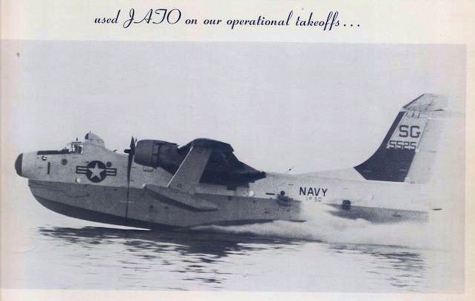
JATO (J-toe) or Jet Assisted Take Off is a quick way to get some altitude if you are faced with a short space or obstacles in your take off path. If you read the El Paso articles (Seaplane Story 3) you saw that they had to use JATO to get off that tiny lake.

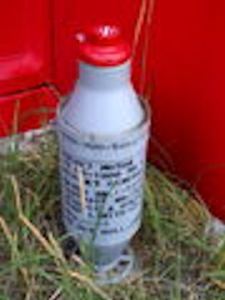
The JATO containers were referred to as “bottles” (see picture 05a). They are actually solid-fueled rockets. They are not as big in diameter as a 5 gallon can but probably stand 50% taller than a can. On the P5M seaplane 2 bottles were mounted on the rear port hatch and 2 bottles were mounted on the starboard hatch. They were fired as pairs, the lower pair and the upper pair. When airborne and clear of the sea lanes, the bottles were jettisoned.

OLYMPUS DIGITAL CAMERA

The most exciting JATO performance I saw was a demonstration piloted by our skipper, Commander “Hap” Hazard. I don’t know what the deal was but there were a lot of Captains and Admirals in the crowd. One of our planes had been stripped of the electronics gear and had a minimum gas load. The only people aboard were the pilot, co-pilot, and a senior mechanic.They started their take off run and almost immediately fired the JATO bottles and I’d swear that plane went almost straight up! You can imagine a fighter plane doing that but to see a giant seaplane was hard to believe.

05b On the step


The most exciting JATO run I was involved in was when we were on the way to Japan. We had flown from Hawaii to Kwajalein Atoll, spent the night, and now were ready to head for Midway Island. There was a small harbor formed by a coral reef that looked like it had been enhanced by man. We carried every ounce of gas we could get aboard and were really heavy. The sky was overcast and the sea was choppy. We started our take off run and at the appropriate time, the pilot fired the JATO bottles. We were rushing toward this coral reef but weren’t lifting off. The pilot finally had to abort. By the time we got more JATO bottles aboard, the sea had settled down a little and the pilot had a better feel for the weight and the conditions and we got airborne. That was the hairiest one I got to enjoy.

I was probably aboard for 10 or 15 JATO take offs and was always amazed at how much power you felt when the bottles ignited.

Dave Thomas
March 6, 2012, revised February 16, 2015 


Seaplane Story 3

Here’s an interesting video lasting only 2 or 3 minutes that outlines the development of the P5M-1.One of the interesting innovations was the incorporation of hydro-flaps. They are hydraulically operated appendages built into the rear of the hull that could be energized separately for steering or could be deployed at the same time and serve as brakes when the aircraft was in the water.

Another interesting part of the video is the take-off. As the plane gets up to speed it creates a “rooster tail” higher than those seen at the thunder boat races. At the tail of the plane is a 50mm machine gun turret that has a spectacular view during take-off. The turret was no longer armed or occupied so, with the pilot’s permission you could sit back there during take-off. You are facing backward and as the speed increases, the walls of water get higher and higher until it feels like you are looking down a canyon. What a ride!

http://www.livingwarbirds.com/martin/p5m-marlin.php

Here’s an interesting thing about water take-offs. Sometimes at dawn and for a short time thereafter, San Diego Bay is as smooth as a sheet of glass. No ships or boats have been moving to cause ripples or waves. It sounds like it would be perfect for take-off but you can’t develop any lift and get airborne. On a morning like this, the pilot calls the tower and tells them to watch out for surface traffic while we tear around the bay in circles and try to develop some waves.

I was doing some research and found a YouTube video about the crash of a Martin P5M-2 seaplane from VP-48, my squadron. It crashed in the Laguna Mountains 1/1/1959 on a flight to the Salton Sea. The pilot and co-pilot were killed but 8 members of the crew bailed out successfully. The 2 men in the crew that I knew best were Allen Van Dyke and William Little. The crew roster appears in the last few seconds of the video. Bill Little was an Aviation Electronics Technician First Class (AT1) and we worked out of the same shop so I saw him every day. Both guys said that bailing out was a hairy experience because the plane was just barely clearing the mountain tops.

http://youtu.be/p8d2JgrHrcU

Dave Thomas
March 15, 2012. Revised February 20, 2015 

—————————————————————————————————————

It’s for real: Seaplane ended up in and took off from Ascarate Lake

Trish Long / El Paso Times

POSTED: 05/08/2009 11:31:34 PM MDT

Dear Trish, my name is Eddie Bustamante. I’m not from here. I have heard from people that have lived here all their lives that a seaplane landed on Ascarate Lake many years ago. If it is true, what year? And how was it able to lift off the lake? I keep wondering if people are just pulling my leg. Can you help?

They’re not pulling your leg, Edward. On April 10, 1960, a U.S. Navy P5M Martin Marlin seaplane was made an emergency landing on the 3,000-foot long Ascarate Lake.

The pilot, Lt. M.T. Burke, said he made the decision to land in the “pond” when the starboard engine began cutting out every few minutes.

“The trouble started around Yuma,” Burke told the El Paso Times at the time. “But it didn’t get serious until we were 50 or 60 miles out of El Paso.” The officer decided to come to El Paso rather than try for Elephant Butte Lake.

Before landing, much of the fuel was dumped from the seaplane, which the El Paso Times article also referred to as a “flying boat.”

Burke and his crew had left San Diego en route to Baltimore, via Pensacola, Fla. The seven people on the flight were members of a ferrying group that transported planes across the nation.

The plane landed from south to north, then was towed with the assistance of a Sheriff’s Department boat piloted by Deputy Charlie Barker, and a County Recreation Department boat, handled by Earl Thurston, to the north end of the lake.

Additional personnel, tools and spare parts were flown in to help get the flying boat ready for takeoff while Burke held an “open house” so that Mayor Raymond Telles, County Judge Woodrow Bean and other City and County officials could inspect the seaplane — “a rarity in El Paso.”

The landing, however, wasn’t as complicated as the takeoff later.

Four rockets were added to the seaplane, it was stripped of all unnecessary equipment, and it carried a minimum load of fuel to make it as light as possible. The trees at the south end of the lake were soaked overnight and pushed over with bulldozers.

In the early morning of April 23, an Air Force helicopter hovered overhead and emergency crash trucks stood ready in case of trouble.

Capt. Ted Vogel of the El Paso Police Department and two members of the Sheriff’s Department Boat Patrol were also on watch, and Mexican police had an ambulance and fire truck ready on the Mexican side.

At 6:13 a.m., the 77,000-pound flying boat, using its extra jets and aided by small motorboats kicking up waves, took off successfully from Ascarate Lake.

The pilot was Lieut. Commander William L. Schad, and his co-pilot was Lieut. Gordon R. Williams. They flew from El Paso to Corpus Christi and then on to Baltimore, Md.
___________________________________________________________________________

The pilot mentioned in the next-to-last line, Lt. Cdr. William Schad was the plane commander of Crew 4, SF 4, of VP 48. He was a skilled pilot and I flew with him a number of times.
Dave T
 

Seaplane Story 4: Communicating

When a squadron returned from deployment in WESTPAC, sailors were discharged or transferred and were replaced by new men. Training took place all day, every day. Flight crews were flying almost every day and sometimes flew two or more hops per day. The Navy tries to fit all the activities into a standard day that ends at 4:00 PM. That way everything can be secured and the single men can be ready to hit the mess hall on time. However, with all the training flights going on I was never sure what time my last flight would get in.

For a couple of years, we lived in Navy housing in Coronado that was located right on San Diego Bay. It might have been 10 or 15 yards from our building to the water’s edge. Looking east, we had a great view of the bay and the San Diego skyline behind it.

When the seaplanes landed they came in from the ocean, heading east, and crossed over the Silver Strand which is the name of the isthmus connecting the city of Imperial Beach, on the south, with the city of Coronado, on the north. In some places the Strand is only 200 or 300 yards wide and accommodates the highway and a strip of public beach and that’s it. After crossing the Strand the planes turn to port (north) and fly up the bay. At the point where the plane passes our apartment in Navy Housing, they were probably only 50 or 75 yards off shore. Pat knew the side number of my plane so she recognized it when we flew past. Sometimes we would be shooting touch-and-go landings and would go past the house over and over. Pat would sometimes sit out on the grass and wave when we went by. We were close enough that I could recognize her from the plane. I had a window (or port) beside my position at the radar and one time, as we flew past. I picked up a white rag that I used to clean the radar screen and waved it at the window as we went past Pat. She saw the rag and later that evening we were talking about it and she said “why don’t you wave that rag when you go past for the last time of the day and I’ll know when to start supper?” It sounded great to me so that’s what we did from then on. Of course, it didn’t last long. The novice pilots learned how to land  and take off and the whole training atmosphere evolved and the flights got longer. Pat and I had a good thing going while it lasted.

Dave Thomas
Revised February 16, 2015 

Seaplane Story 2

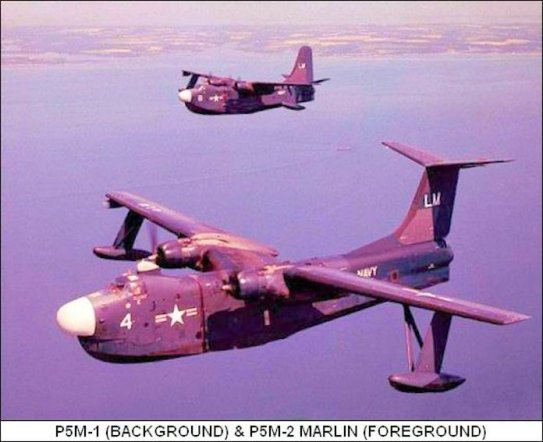
Two of the early seaplanes or “flying boats” used by the U.S. Navy were the PBY and the PBM. Then, from the early 1950’s through 1967 the Glenn L. Martin Company produced the P5M-1, P5M-2, and the Anti-Submarine Warfare version, the P5M-2S. When I joined VP-48 in June of 1958 they were flying the P5M-1 and had just returned two months previously from a 6 month deployment at Naval Air Station Iwakuni, Japan. Still flying the P5M-1, we deployed again to Iwakuni in April of 1959 for 6 months and after we returned we started taking delivery of the P5M-2’s. I don’t remember the details but after receiving just a couple of the -2’s we started receiving the P5M-2S, the “S” suffix meaning that the plane was equipped with the jazzy electronic gear of the new Anti-Submarine Warfare package. We had to obtain a “Secret” clearance just to work on the gear.

The first picture shows the difference between the appearance of the P5M-1 and P5M-2. On the “-1”, the horizontal stabilizer on the tail is down low, at the height of the fuselage. On the “-2”, they put the horizontal stabilizer at the top of the tail section and created that “flying tail” or T-tail” effect. Cool!

P5M-1 & P5M-2

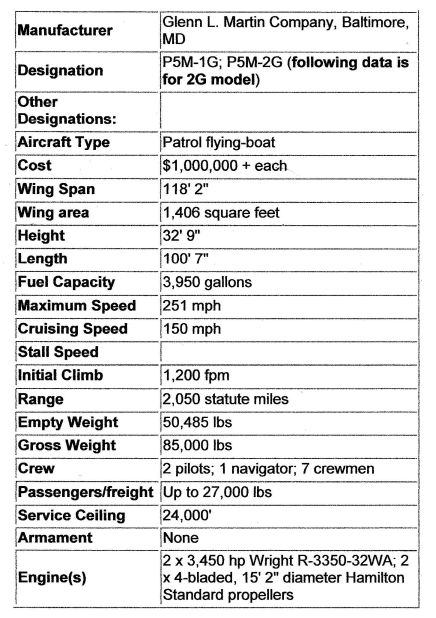
The second image is a spec. sheet. It says that the cruising speed was 150 knots but as I recall it was more like 140 knots. We didn’t move too fast.

02b P5M-2 Specs

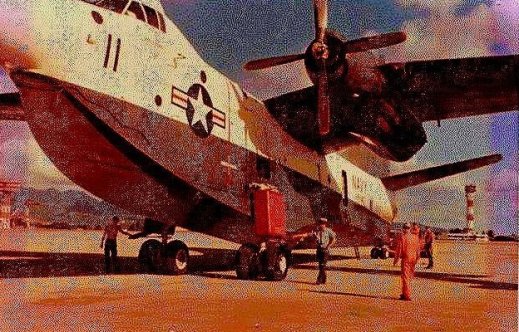
The third picture was included to show the size of the aircraft. Also, notice the red rectangle above the tires on the port side and the green rectangle above the tires on the starboard side. Those are flotation chambers. After the plane is launched and is in the water, a crew member throws a lever, setting the wheels adrift and they are towed away from the aircraft. This plane can only take off and land on water.

Moving P5M

That bulbous white nose is a radome housing a parabolic dish antenna that was at least 4 feet in diameter. I don’t remember exactly but I do remember that when working on the antenna I could bend a little at the waist and neck and could move clear around the front of the antenna. The radome must have been almost 6 feet at its maximum diameter.

Dave Thomas
February 29, 2012, revised February 16, 2015


Wal-Mart Greeters

Gary Casner sent an e-mail about the Admiral who was a Wal-Mart Greeter. I’ve enjoyed the story a couple of times before and it always reminds me of my own “Greeter” story.

Four or five years ago, Gene Maness and I were drinking coffee at our favorite McDonalds’s in Keller, Texas. We were mouthing off at each other as we usually did and started talking about getting part-time jobs just to keep ourselves busy. We discussed several possibilities and discarded each of them for one reason or another. Finally, we got to Wal-Mart Greeter and things started looking up. A new Wal-Mart Super Center was just opening up a couple of blocks from where we lived. It looked perfect! There would be no commute to speak of and if your wife needed some groceries or something you could pick them up on the way home and save a trip.

As we continued to discuss the benefits of working at Wal-Mart I mentioned that we would get to hug the good-looking girls as they came in, just as they do in the Wal-Mart commercials. Maness, who was always a “the glass is half-empty” kind of guy, says “do we have to hug the ugly ones, too?’ Well, I had no idea but I remembered that we were going to attend a Homeowner’s Association meeting that would be held at a neighborhood school Thursday evening and that the Manager of the new Wal-Mart would be introduced to the community there. This would be a perfect time for us to ask some questions.

We arrived at the meeting a little early and quickly spotted a guy wearing a Wal-Mart ID badge. We went over and introduced ourselves and before I could blink an eye, Maness says” If we went to work as Wal-Mart Greeters we would hug all the good-looking girls that came through the door but we want to know if we would have to hug the ugly ones, too?” The manager who was pretty quick on the uptake (that’s why he was the manager) said “Yes, you would have to hug the ugly ones, too. We are an equal opportunity company and try to treat all our customers in the same way.” That killed the whole deal for us…it was time to go back to square one and think about other opportunities.

Dave Thomas
November 12, 2012


Cattle Drives

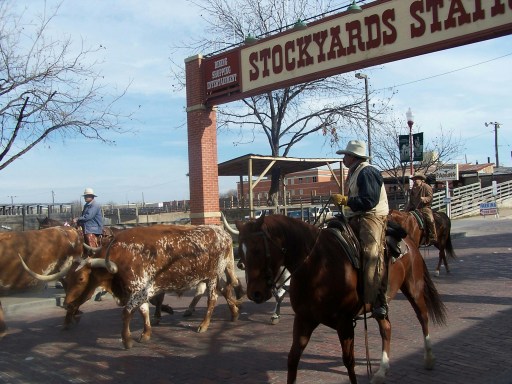
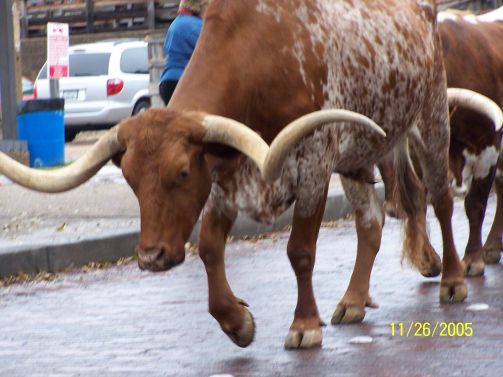
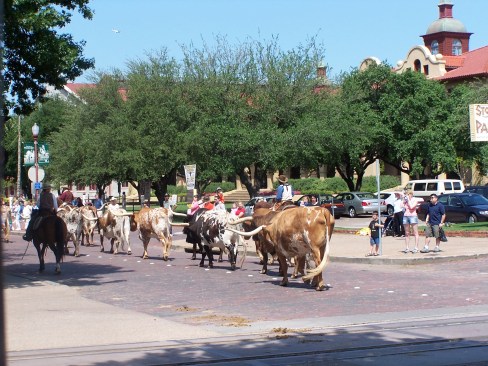
When we lived in Keller, Texas one of the things I enjoyed most was driving down to Old Fort Worth to watch the cattle drive. Fort Worth is the only city in the world with its own herd of longhorns. Twice a day, at 11:30 and 4:00, they have a cattle drive. There are 4 or 5 cowboys driving the cattle up 2 blocks of Exposition Avenue just to honor the city’s tradition of being Cow Town USA. They use 15 head of longhorns of various colors and horn configurations to make up their trail herd.We’ve talked to the cowboys many times and found that half of them work for the Fort Worth Parks Department and the other half are police officers.

100_0041

Brindle Lhorn

54-012

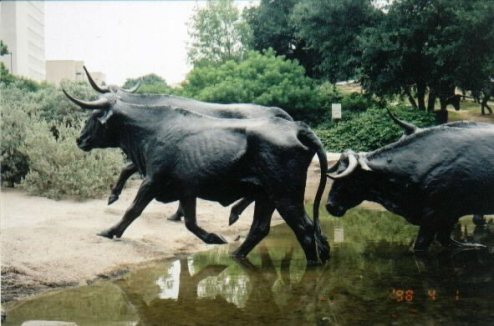
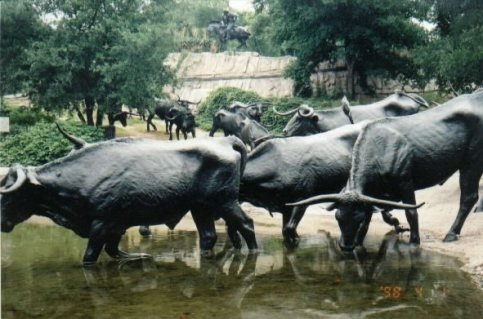
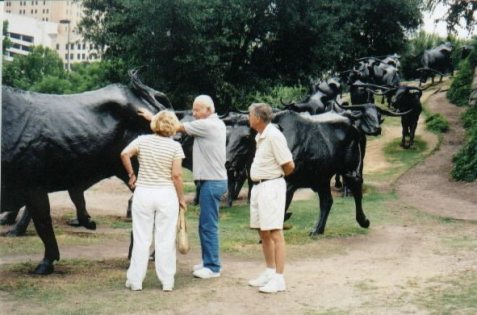
Over in Dallas there is a big concourse known as Pioneer Plaza. It features a static cattle drive with 15 sculptured longhorns and 2 cowboys on horseback. The figures are 25% larger than life. and show amazing detail. The herd is winding around a small knoll and down a slope and fording a creek.

Longhorn 2

Longhorn 3

Longhorn 1

There is a large, bronze plaque in the sidewalk that shows the trail brands and gives the name of the trail bosses or ranches they come from.

Dave Thomas
July 23, 2014


Old Mrs. Coates

It was about 8:00 AM on one of those joyous summer mornings with the sun shining and heavy dew glistening on the leaves and grass. I had just finished my third grade year and was thankful to be free. I was on the way to visit my Great-grandma Minnie, who lived several blocks from us. It was always a special treat to be invited to breakfast with Grandma Minnie because she always fixed me her special bread pudding with raisins in it.

As I got closer to Grandma’s I could see that her across-the-street neighbor, old Mrs. Coates, was out on her front porch enjoying her morning tea. I yelled, “Good morning, Mrs. Coates!” She yelled back, “Good morning, David, how are you this morning?” (I should explain that Mrs. Coates had a voice that was loud and clear and you could hear her clear to the end of the block.) I responded “I’m OK, how are you?” She bellows back, “Well, David, I had a wonderful bowel movement this morning so I know it will be a great day!” This was more information than a little kid could handle and I felt my face turning red as I ran for Grandma’s door and a chance to get out of sight.

Dave Thomas
March 31, 2012


Grandpa and Billy the Goat

Grandpa, A.A. Thomas, always had something interesting going on. One day I rode my bike down to visit Grandpa and Grandma. I might have been 11 or 12 years old and Grandpa was at least 80. When I got to the house, Grandma said Grandpa was out in the back yard so I went on out there. It turned out that Grandpa had bought himself a cute little billy goat. He was putting the finishing touches on a pen he had built for it. He told me he had named the little critter, Billy, and that I could get in the pen and play with him. Billy was a friendly little guy and enjoyed being petted and fussed over so I played with him that day and pretty often in the days that followed.

Then, for some reason I didn’t get down to see Billy for quite a spell and when I did go to visit, I couldn’t believe my eyes. Cute little Billy, the kid goat, had turned into a full-sized ram with a fine set of horns. Grandpa said he was still just a playful little guy and I should just go on in and give him some attention. Well, Billy was glad to see me and I enjoyed petting him and messing with him. I noticed that he had tipped over his water bucket so I thought I would refill it. I stooped over to pick it up and wham… I got knocked flat when Billy charged up and butted me in the behind. It turns out that “little” Billy had learned how to use those horns and loved butting anyone dumb enough to turn their back on him. Grandpa was laughing so I knew I had been set up. Grandma heard the commotion and came out and chewed on Grandpa and told him  he should be ashamed of himself. Grandpa just laughed more and said “that darned Billy has got me a dozen times!”

I saw Billy a few more times but one day I got there and Billy’s pen was empty. When I asked Grandpa of Billy’s whereabouts, he just said “he got me one time too many!”

Dave Thomas
April 26, 2013


Izzie-3 Problem Solving

9-Problem Solving

I have lived with cats all my life and enjoyed them. You feed them, water them, take care of them, and enjoy the affection you get from them. The problem though is that for most of your life you don’t have enough time to observe them. As a retired person, I’ve been learning things that I wish I had known all these years. Cats are thinkers but you have to quietly watch them for some time in order to pick up on the subtle things that are going on in their little heads.

When Izzie, the inside cat, and I first started going for walks, she checked out everything by smelling, looking, and listening and sometimes by touching with her paws and I’m certain that she committed every detail to memory. One event that convinced me of how observant she is and how she can asses a situation and solve a problem by breaking it down into step-by-step solutions is the “gate” story.

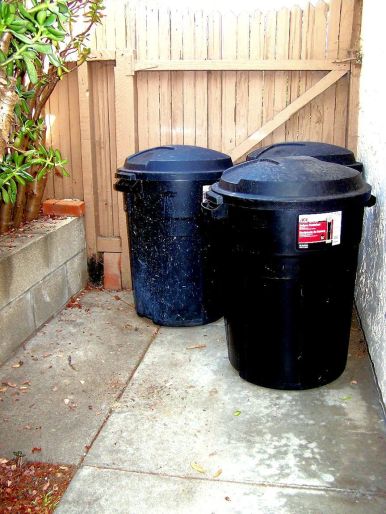
We walked across the backyard and made a right turn and went up the side of the house toward the front where the trash cans are kept. We got there and she stopped and sat back on her haunches. I noticed that she was staring at the top of the gate and continued to do so for a couple of minutes. It finally dawned on me that she was trying to figure out how to get over that gate. I knew that she understood the constraints of the leash and that she probably couldn’t make a direct frontal assault on the gate. After a bit, she looked to the left and saw the retaining wall. She walked over to it and stood on her hind legs and put her front feet on top of the wall. I saw her muscles flex as she pulled on it and tested it for stability and strength. When she was satisfied that it was okay she hopped up on top of it.

Next, she looked at the closest trash can and put her front paws on it. As before, she looked around carefully and then hopped onto the trash can lid. She took another look at the top of the gate from her new vantage point and evidently decided she could do better. She looked over at the adjoining trash can, extended her front legs and placed her paws on the cover. She looked around carefully and then gingerly stepped across to the second can. Now, she sat back on her haunches and again stared at the top of the gate. All this time I had been holding the leash and she knew well what her limits were. You could almost see the wheels turning in her little brain as she assessed the situation. Suddenly she stood up,  placed her front paws on the horizontal brace at the top of the gate and made a mighty leap. Fortunately, I was ready, and caught her in mid-air just as she cleared the top. She wasn’t trying to get away. She only wanted to see what was on the other side. She held on to the top of the gate and I held onto her as we stood there for a couple of minutes and watched the cars go by on the street.

It’s interesting to note that the next day, having memorized the procedure; she just walked right up to the retaining wall and made the series of jumps that carried her to the top of the gate. I was impressed by the way she sized up the problem, broke it down into manageable steps, executed her plan, and then remembered it the next day.

Dave Thomas
December 2, 2013

Fired!

If you read my story “AVS Honey”, you will remember that in 1950, after I graduated from 8th grade, I had a 3 or 4 week period before I was to spend the summer in Arizona with my Grand-dad. I told you about the AVS Honey job because it was interesting and it was fun. I almost forgot that for 3 or 4 days prior to AVS Honey, I had a job in a filling station. Maybe I’m blocking it out of my memory because I got fired. Here’s how it happened.

In Kansas, you could get a restricted driver’s license when you were 14 years old. As a result, the schools offered a driver’s training course to 13 year old 8th graders. I took the course and learned the rudiments of driving and how to take care of a car.

Bill Nutter and Ray Tarman took over the management of a Socony-Vacuum (later, Mobil) station. This is the station that had been run by a man named “Heavy” Stevens at the south end of Augusta where State Street and Walnut Street come together.

Just before school was out, my Mom happened to see Bill Nutter down town and visited with him a little. After Bill told about his new business, Mom told him about me needing a short term job and asked if he could use me at his new place. Bill said it so happened that he had hired a college kid for the summer but this kid wouldn’t be out of school for another 3 weeks or so. He told Mom that he could use some help until the college kid showed up and that I should come down and talk to him. I hurried down and talked to Bill and he agreed to hire me.

Back in those days, the gas stations or filling stations were more correctly called “service” stations. A customer pulling into a station for any amount of gasoline expected to have their windshield washed, oil checked, and radiator water level checked. And, if requested, the air pressure in their tires would be checked. Beyond that, if requested, the attendant would grab a whisk broom and sweep out the car.

The work stuff didn’t bother me. I could do all the necessary things or sweep the driveway with no problem. My shortcoming proved to be that I didn’t know enough about cars or engines. Bill or Ray would be working on a car and I would have to interrupt them so they could help me locate something. The first day, it was a cab-over truck and I couldn’t find the dipstick to check the oil level. The next day, I couldn’t find the gas cap on a customer’s car. Earlier models were easy to find. They were normally in plain sight, a shiny chrome thing sticking out of a rear fender. The manufacturers were just starting to get tricky and hide them behind little doors in the rear fender wells. However, on my second day at the station, I had no idea where the gas cap was on this guy’s car. Trying to look “cool” (rather than stupid) I walked into the grease rack and asked Bill where the thing was. “It’s behind the license plate”, he says. “No kidding?”, I say. Sure enough, there it was.

The 3rd day, I was really intense. I wasn’t going to miss anything. The morning went well but in the middle of the afternoon, here comes this late model Cadillac. The driver told me to “fill it up” so I got the hose and was ready to start pumping gas. I’m in trouble again…I can’t find the gas cap! I checked the fenders, the license plate, and the trunk with no luck. Finally admitting to myself that I had failed again, I went in and got Bill out from under the hood of a car and asked him to show me where the gas cap was on a Cadillac. Bill doesn’t say anything but walks over to the left side of the car, takes hold of the tail-light and swings it up and out of the way. There’s the gas cap! The tail-light lens is hinged! That was just too damned cute for words. Who puts a gas cap in a tail light? I gassed up the car and got the man on his way.

At quitting time that night, Bill told me that I just didn’t know enough about cars and they wouldn’t be able to use me after all. I understood and there were no hard feelings.

Dave Thomas
February 12, 2016