This Is No Bull!

I’m still thinking about animals and their ability to figure things out. I learned early on that even bulls can solve problems and put 2 and 2 together when they have the motivation to do so.

I was 11 or 12 and had spent the night on the farm with my great-great uncle, Will Church, and Aunt Ella. I had breakfast and was in a pen currying Prince, the pinto pony I was going to ride later. Next to the pen I was in, was the corral. I say “corral” but it was sturdy enough to stop an Army tank. The fence poles were at least as big as railroad ties and the fencing itself was 3″ pipe. There were 2 sections of pipe strung between the posts. The lower one was maybe 2 feet above ground and the upper one was maybe 5 feet high. The land naturally fell away to the east toward a spring-fed creek that was 10 or 15 yards east of the fence. You could see that on the east side of the corral the dirt had washed out as a result of many years of run-off from the rains. The distance from the ground to the lower pipe at that point may have been more like 30 “or 36”.

So, there’s this super corral and standing right in the middle of it is Griffin, Uncle Will’s prize shorthorn bull. Griffin is just standing there and staring out into the adjoining pasture. The dairy herd had been milked and turned out and they were strung out in a line across the pasture as they headed for their favorite loafing spot.

I could hardly believe what I saw next. Old Griffin sidles up to that east fence where the wash-out is the greatest. He drops down on his front knees and lowers his body to the ground. Then he starts shoving with his hind legs and wiggling and twists and grunts and kicks until, all of a sudden, he is on the other side of the fence. He slid under it! He gets to his feet and takes off at a fast walk after that bunch of fine-looking cows that are just going over the hill. A little bit of thinking and planning will get you where you want to be.

Dave Thomas
August 19, 2014


The B.N. & S.F.

Gene and Bonnie have a neighbor named “L.J.” who is a dispatcher for the Burlington Northern and Santa Fe Railroad. I didn’t know it but the two rail lines merged or one acquired the other a few years ago. The corporate headquarters for the company is here in Fort Worth, just off Western Center Boulevard. If you will recall, just after we get on I-35W and head for Fort Worth, you see a Joe’s Crab Shack and it is located on Western Center. The railroad owns several hundred acres there and it looks like a campus with beautiful buildings and beautiful trees and green lawns. There is a large pond where employees can fish if they practice “catch and release” and there are two miles of jogging trails. One of the buildings contains a large weight room.

The center of activity is a large building called the “bunker” because it is built like a wartime bunker with walls that are 3 feet thick to withstand high winds and tornados. There is also an emergency generator in the basement to ensure that there is no power interruption. The reason for all of these precautions is that all of the rolling stock and the rail lines owned by the Burlington Northern and Santa Fe are controlled from one room in this building known as Federal Control. It looks like the pictures you see of NASA’s Mission Control or the floor of the New York Stock Exchange with at least 100 cubicles, 400 or 500 people and even more computer monitors. The main room has no supporting columns and we were told that when it was built a few years ago, it was the largest free- standing room ever built. To give you an idea of the scale, one wall contains 9 movie screens and each looks to be as big as what you would see at your favorite AMC. One screen always shows the weather channel and the rest are changing every few minutes with up-to-date graphs and information necessary to run the business. One interesting screen shows the number of coal trains operating at the current moment. The BNSF averages the operation of 45 coal trains per day and the Union Pacific runs about 45 trains a day over track that is owned by the BNSF. The coal is mined in Wyoming and Colorado and shipped to power plants all over the country to generate power. Our host, L.J., was showing us around on his day off. He normally works three 12- hour days in a row and then has three days off. L.J.’s main duty is to supply locomotives to the 45 coal trains and keep track of the status of each. The rest of the screens show on-time performance and stuff like that.

We got to go through some railroad cars that are kept on the property. There is a gift shop and a museum that is quite interesting. The walls of the buildings were hung with southwest art. The whole layout was interesting and quite impressive.

Dave Thomas
2003


She Wanted To Know…

Pat and her group were big-ticket sales people. That meant that they were smart and aggressive and quick with a thought. A new man transferred in named Bill Deem. Bill was a big, nice-looking, guy with an anchor man voice. He was an ex-marine and a gentleman in the finest sense of the word. At first, he was quiet and maybe a little bit stuffy. Associating with a bunch of highly motivated, quick thinking sales people soon loosened him up.

Somehow, Bill developed a hernia and he took a leave of absence to have it repaired. The surgery went well and Bill healed up and returned to work. That first morning, the group gathered around him to welcome him back, ask how he was feeling, and ask what the doctor had said and had he placed any restrictions on him. Bill said that he made his final visit to the doctor the day before and everything went well. After the doctor finished his exam, Bill mentioned that his wife had a question she wanted him to ask of the doctor. The doctor cut in with “Yes, Bill, it’s ok for you to have sex.” “Well”, says Bill…”she really just wanted to know if I could take out the trash.”

Dave and Pat Thomas
March 4, 2015


Grandpa: To Bee…

Grandpa-To Bee Or Not To Bee

I think it was 1925 when they had a flood there in Augusta, Kansas that had the south end of town running-board deep. I remember my folks had pictures of Walnut Street in front of Grandpa’s house showing the old cars plowing through the water. Grandpa’s house, itself, was safe for it had been built with tall footings and the flood water only made it part way up the front steps.

Augusta was in a sensitive location. It had the Walnut River on the east and the Whitewater River on the west. After the flood the townspeople began talking about building a levee or dike that would protect the town on the east, south, and west sides. The higher ground on the north side was no problem. Grandpa, A.A. Thomas, was highly in favor of the protection offered by a dike and attended the City Council meetings where it was discussed. Of course, a project of this size and cost would require interaction with many county, state, and federal departments and agencies. Grandpa attended many meetings and as a homeowner and business owner (an addition to his home had been constructed to house a grocery store) he always put in his two cents worth.

If you were paying attention to him, you would have noticed that during any conversation regarding the levees or dikes, Grandpa would suggest that these ramparts should be protected from erosion and that the very best ground cover for this purpose was clover. Not many people realized that Grandpa was an entrepreneur with a new idea every minute. In this case, he hoped to set himself up as a beekeeper! He planned to place the hives at strategic places along the dikes and the bees could concentrate on the dikes and not waste time flying all over the county to collect the pollen. Thus, the bees could make more honey and Grandpa could prosper.

The dikes were eventually built but were sewn with prairie grass. Well, so much for that dream.

Dave Thomas
April 27, 2013


Quarry Story 3

Technically speaking, this is not a quarry story but since it took place on the road to the quarry I figured that’s close enough.

Have you ever ridden on an Army tank? Well, I did once, and that’s what this story is about. Pay close attention, learn, and then don’t ever do anything like it.

It was spring and we had been having our share of rain. The rivers were up and had overflowed their banks earlier in the week. The Walnut River, just south of town, was slowly returning to it’s normal size and we decided to check it out. I was 13 or so and my friend, Jack, was 15. You can get your driver’s license when you are 14 so Jack had gotten himself a job at a neighborhood grocery store, saved his money, and bought himself a 1935 Chevrolet. We headed for the river. It wasn’t much of a trip. From the edge of town, at what I remember was 4th Street, you crossed the Santa Fe railroad tracks and wandered down a country road for about a quarter mile to the steel bridge that crossed the Walnut River. It was one of those fine-looking steel bridges that looked like it had been made from a giant Erector Set.

The gravel road was still a little wet and muddy but we got to the bridge, crossed it, and continued along. About 100 yards south of the bridge was a place you could pull off the road and follow the tracks worn by many other cars to get closer to the river. At this point, the river bank was normally 5 or 6 feet above the river. It was a good place to fish from and we were told by older guys that it also served as a lover’s lane. We decided to check the river so Jack pulled off onto this track that paralleled the road and stopped and we got out. We looked at the river and messed around and finally got back in the car. Jack tried to drive off but the wheels started spinning. He was a good driver but couldn’t overcome the wet grass and mud and the fact that the ground sloped toward the river. I got out and tried to push but it didn’t do any good. We decided to walk back to town and call Jack’s Dad for help.

We got back to town and crossed the tracks and the first building in view at that time was the National Guard Armory. We decided to go in there and use the phone. The National Guard guy that took care of the Armory and answered the phone and did all the chores was a friend of ours named Billy Joe Davis. Billy Joe liked baseball and we had both played catch with him and hit a lot of fly balls and grounders with him. We told Billy Joe our story and asked to use the phone. Billy Joe said there wasn’t any point in making the call and upsetting Jack’s Dad because he’d be happy to pull us out. He said we should go out in the street and wait while he locked up and we could close the gate behind him when he came out. After a few minutes we heard an engine revving up and here comes Billy Joe driving a National Guard tank and yelling at us to shut the gate and climb on. We scrambled up onto the thing and Billy took off across the tracks. It just took a few minutes to get to the bridge and as we approached it, Jack and I looked at each other. Billy Joe may have crossed the bridge many times in a tank but it scared the devil out of us. That bridge looked pretty flimsy compared to this big chunk of iron we were riding on. Billy didn’t even slow down. He rolled over that bridge like it was him and Patton crossing the Rhine.

The rest of it was kind of anti-climatic. It just took a couple of minutes to get to the car. Billy Joe had brought a chain and he hooked up to Jack’s car and pulled us out. We thanked him and waved good-bye and headed back to town. I don’t even want to think of the possible consequences of “borrowing” a tank or running it off into the river. If you’ll excuse me I’ll just say “tanks for the memory”.

Dave Thomas
October 24, 2013


Holy Molar!

Our son, Doug, was having trouble with a wisdom tooth. An out-patient appointment was scheduled with an Oral Surgeon. Doug was in his late teens but since we knew they would have to knock him out, his Mother, Pat, drove him in. The surgery went well but Doug is a big guy and they had to give him a pretty hefty dose of the anesthetic. On the way home, he was awake but was kind of goofy.

They got home okay and Pat needed to go to the grocery store. She told our daughter, Terri, that Doug was still “out of it” and she should keep an eye on him so he wouldn’t hurt himself or try to go anywhere.

Pat bought her groceries and when she got close to home she could see Terri sitting on the grass of the front yard and watching Doug. Doug’s little red, Ford Courier pickup was sitting out front and Doug was inside the cab. When Pat got out of the car she could see that Doug had removed the inner panels from both doors of the truck and was now working on the headliner. Doug’s eyes were still kind of glazed over as she asked him what he was doing. He told her it was a job that needed to be done so he thought he should get right on it. Pat told him to stop and then turned to Terri and asked her why she had let Doug do something crazy like that. Terri said, “Well, you said not to let him get hurt and I thought he would be okay with this.”

Dave Thomas
January 18, 2015


Bat Stuff

In 1974, we rented a 35 foot RV for our trip back to Kansas to visit our folks. Russ and Doug would be 16 in the fall and we figured this might be our last chance for a big family vacation trip. Terri was going to be 13 so she was old enough to share the grown-up attractions along the way and enjoy the trip also. So that Terri would have a buddy to share things with, we invited Susan Trivett as she and Terri were good friends of the same age.

The boys were typical teenagers, rebellious, and not about to admit that they might be enjoying something. Also, this was that sad time in history when all boys thought they should have long hair hanging down to their shoulders. I hated it but at the same time was proud that they took care of their hair and kept it clean.

We took the southern route and made it all the way to Las Cruces, NM the first night. The next morning we got up and headed for Carlsbad Caverns. At the Caverns, we took the tour and all enjoyed the spectacular sights. The boys were in their teenage mode and complaining about everything though we were pretty sure that they were paying strict attention to the tour guide and taking it all in. We enjoyed visiting the different chambers and hearing the stories of the guide. We were all fascinated when we heard about the number of bats living in the cave and about the thousands of tons of bat guano that had been deposited on the floors.

We reached the end of the tour and headed back outside. The boys, though absorbing the wealth of information dispensed by the tour guide, had complained non-stop. Russ had been particularly bad about it, so Pat, in an effort to lighten things up, (and maybe get back at him a little) told Russ that it looked like he had some of that bat guano in his hair. Susan chimed in and said she saw it, too. The rest of us jumped in and started pointing and laughing and Russ was completely mortified. He ran to the nearest restroom, wetted some towels and started scrubbing his hair. I don’t remember how long he worked at it but it was some time before he realized it was all a joke. Always a good sport, his face turned red but he was able to laugh a little. We had a great trip and shared a lot of sights and Pat and I believe that the kids will have nothing but good memories of the trip.

Dave Thomas
February 21, 2015


Seaplane Story 8: Oops!

We were flying a routine patrol of the China Sea. We left Naval Air Station, Iwakuni and flew across Japan’s Inland Sea which is so picturesque with what seems to be hundreds of islands. They are mountain peaks sticking out of the water and are tilled and farmed right up the hillside to the top. We flew past the southern tip of Korea and were soon scooting along just south of China. It was a stormy day with lots of wind and big black clouds that blocked our view of water most of the time. The wind became so violent we decided to cage the radar antenna to avoid damage. To “cage” the antenna means to put the system on stand-by which locks the antenna in a straight ahead position and doesn’t allow the normal side-to-side scanning operation. We tooled along like this, thinking that we would soon run out of the storm and could resume a normal patrol. All of a sudden there was a break in the clouds and we could see the surface of the water. There was a strip of yellow against the normal brownish color of the sea. looked like a yellow river was flowing into the sea. That’s exactly what it was…the Yellow River! Everybody was yelling as I switched on the radar and the first sweep showed that we were just a couple of miles off shore. We were in the middle of the Cold War and we didn’t know if we would be greeted by the Chinese Air Force or if the anti-aircraft guns would start firing. Our pilot, Lt. Surovik, jerked that plane around and we got the heck out of there. Oops!

Another time, we were tooling along our assigned course and the crewman  who was sitting at the port lookout station in the aft section of the plane comes up on the intercom and says” look out the port side!” We looked out our windows and there was a Russian MIG flying along side us with a Chinese pilot at the controls. Oops! In order to slow down to our speed the guy had his flaps down and his dive brakes extended. He didn’t smile or wave but just stared at us and gave us the “stink eye.” We were in International airspace but there was no one around and he could have bagged us and no one would have ever known what happened. Oops again!

Dave Dunn asked if we ever had any obstructions in the sea lanes when we were taking off or landing in the bay. It was pretty rare to have a problem. The sea lanes were  marked by a series of buoys and the locals were aware of the traffic. Also, when air operations were being conducted there was always a Navy Crash Boat on station. It was painted International Orange and could move fast to herd errant boats away. The seaplanes also had their own Control Tower and the Air Traffic Controllers were supposed to watch for trouble. It did happen that one evening, at dusk, we were coming in and had a little problem. Evidently, the Air Traffic Controllers were tired and weren’t paying attention. I heard our pilot request clearance to land. The tower came back with a “Cleared to land.” The next thing I heard was our pilot saying “Crap!” And then, he said, “Tower, look to your right, at 2 o’clock!” It turned out there was a destroyer chugging right up the bay. Oops! The tower told us to take a wave-off and go around again and then apologized. Well, we went around and then landed and got the wheels on and got pulled up the ramp. The pilot was the first one out of the hatch and said he was going down to the tower to have a little talk with the boys. Well, our pilot, Lt. Surovik,  was 6 foot 5 inches tall and looked like he ate horse shoes for breakfast and picked his teeth with a crow bar. Our crew was happy that we wouldn’t be in the tower when he got there. Oops, oops, and oops!

One day a crew was preparing for a JATO take-off for a training flight. The Ordinance man, Smith, loaded the JATO bottles on a fork lift and headed for the plane. As you will recall, the JATO bottles are hung from the crew hatches (doors) in the aft section of the plane. Smith was approaching the plane slowly, slipping the clutch and trying to baby up to it. We all knew that this particular fork lift had a “trick” clutch that should have been replaced a long time ago but this guy thought he could handle it. Well, all of a sudden the clutch engaged and the fork lift leaped forward plunging the forks through the skin of the aircraft on either side of the hatch! Oops! The forks didn’t strike any of the structural members. They just went through the skin so the damage was minor. However, the damage to Smith’s ego was mighty big and we rubbed it in every chance we got. Oops!

Dave Thomas
March 10, 2012. Revised February 17, 2015

What’s a Chukker?


I believe it was the spring of 1965. In another month, that will be 50 years ago. I remember a lot of the details but the dates are hard to pin down.

To lay the groundwork for this story, let me say that total employment at Electro Instruments was probably about 250. I was Foreman of the Test Department and had 23 technicians working for me. Our job was to trouble-shoot the instruments coming off the assembly line and fix any wiring errors or cold solder joints and replace any defective electronic components. Once we had the unit running, we calibrated it with precision voltage standards and “sold” it to a Quality Control Inspector and also to a Department of Defense Inspector if it was to be shipped against a government contract. When we presented the unit to the Shipping Department it was the culmination of the efforts of every department in the plant.

One morning, I got a call from my boss, Pete Dreesen, the Director of Manufacturing. Pete said that his boss, Jim Zeigler, the Vice President of Operations had called and invited the two of us to lunch. I wasn’t sure what to make of this. Working stiffs like me didn’t ordinarily go to lunch with 2 levels of bosses, but I met Pete and Jim in the lobby at 11:30 and Pete drove us to a nearby restaurant.

I didn’t know Jim well, only having had a few brief conversations with him. It was normally business stuff, where he did the conversing and I did the listening. I knew he lived on some acreage on the outskirts of Alpine, a small town in the foothills east of San Diego. I had also heard that he had 7 kids so that’s probably why he had the big place. He was a nice guy and I liked him.

We were hardly sitting down in the restaurant before Jim announced that he wanted to start a company polo team. The three of us didn’t really know anything about polo so we started listing the things we thought would need to be answered in order to get this project off the ground. Jim mentioned that he had a couple of horses for his kids to ride but doubted they would make very good polo ponies. Jim and Pete both knew that I had a horse and asked about her. I told them that she was coming along but I bought her for her confirmation and sweet disposition and she wouldn’t be good for polo. Polo “ponies” are actually big, strong horses that love to run and are so competitive they will run over anything in their path. Jim said that was ok because he had been talking to the people that own Bright Valley Stables, up in Harbison Canyon, on the way to Alpine, and we might be able to work out a deal to rent horses from them. Also, they would give us lessons on riding English saddles and the fundamentals of polo.

Recruiting a team might be a tough job. We would be taking off work an hour or two before quitting time at least one day a week for English riding lessons. The hourly direct folks wouldn’t want to lose the pay. The salaried people could work extra hours if they needed to in order to stay on top of their jobs. A large percentage of our workforce was women. We had hired quite a few experienced women from the aerospace industry so they were older, more “grandmotherly”, types. Most of the rest of the women were young mothers that had to get home after work and pick up the kids at the baby sitters (Day Care was a term that hadn’t been invented yet). Our pool of riders was shrinking fast. We decided to post the story on the employee bulletin board so that we wouldn’t mistakenly exclude anyone that was interested.

We tried to think of anyone who rode horses for pleasure or knew anything about horses. The only horseman I knew was Steve Scott, a custodian working 2nd shift. Scotty was in his 60’s and his health wasn’t too good. He had come over from Brawley, California in the Imperial Valley where for years he had been the “Hay Boss” for a large cattle feeding outfit. Every year the city of Brawley holds the Brawley Cattle Call, a big western celebration featuring a parade and a rodeo. Scotty was one of the organizers of that annual event and even after moving to San Diego, returned to Brawley to take part in it. Scotty and I were having a cup of coffee one day before he went on shift and I mentioned that I had recently bought a horse but hadn’t saved up enough for a saddle yet. Scotty said he was too old to ride but had brought his saddle with him from Brawley and I was welcome to use it as long as I needed it. He brought the saddle, a fairly new roper, to work with him the next day. I used it for several months and returned it with thanks. I know this paragraph about Scotty hasn’t much to do with the polo story but Scotty was really a “good old boy” and I liked him a lot and enjoyed writing something about him so you could see him.

Getting back to business, our luncheon meeting lasted about 3 hours and we made plans and discussed obstacles until we thought we had covered everything. We knew we were facing an uphill battle but decided to take things in order and go as far as we could.

The first day of riding lessons, eight of us showed up, all managers or supervisors and all salaried. We had all ridden “western” but didn’t know one end of an English saddle from the other. The man who owned Bright Valley Stables had an accent and I think he must have been an Aussie rather than an Englishman. He was a good instructor and soon had us all mounted and riding around a ring. The lessons were fun and informative. We all enjoyed them because while riding around in circles in the ring he corrected our “seat” and the way we were posting and also talked to us about the tack and the rules of polo. It would be more exciting to tell you that somebody got thrown or that we had a runaway horse but nothing like that happened. We had a few lessons with most of the guys in attendance. Some weeks, one or the other of us would have to stay in the plant and take care of our department.

Jim knew of a Dr. Herring that lived in Lakeside, a town between our plant and Alpine. This Dr. Herring had a polo team that he sponsored and played on and Jim arranged for us to watch them play one Saturday morning. It was fun to watch the guys play. I don’t know if they were any good but it didn’t make any difference because they were having so much fun. One of the “attack” guys hit a pretty good drive and all of a sudden he and one of the defensive guys were in a mad dash to get to the ball. The collision was like those you hear in the NFL. Ker-Whap!!! The “attack” guy is knocked off his horse and hits the ground, breaking his forearm. Doc Herring took one look at the arm and loaded the guy in his car. He took him to his office in town, x-rayed and set the bone, and put a cast on it. They were back at the game in a little over an hour. The Doc wouldn’t let the guy back in the game. 

This broken arm was hard on our team as two of our members abruptly quit. They said they had come out for fun and that didn’t include broken bones.

Things kind of went downhill after that. It became harder and harder to get the group together. Managers and supervisors are in those positions partly due to a sense of responsibility and that makes it hard to abandon the challenges of the job in the middle of the afternoon and go play. We knew at the outset that it was going to be tough. Besides the other problems, we had no horses, no tack, no horse trailers, no cheap places to board horses, and certainly not enough discretionary income to float the whole thing. It was fun while it lasted.

Dave Thomas
February 6, 2015
 

Seaplane Story 1

Outbound

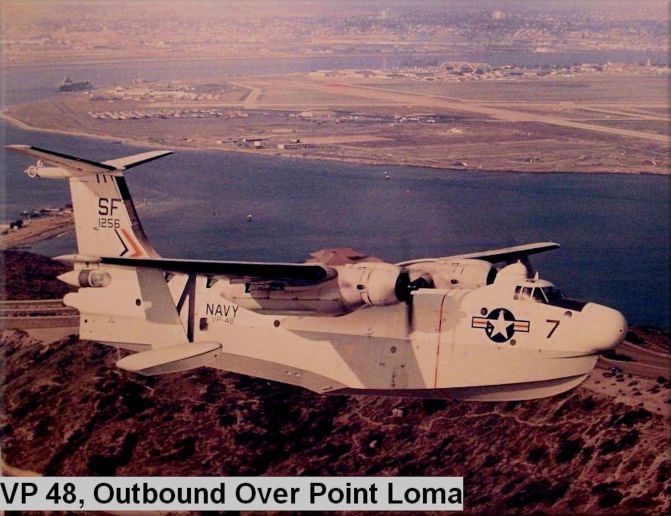
As I was going through some pictures this morning I found this picture I can use in this seaplane story but can also tie to some family history.

The picture I’ve attached is of a Martin Marlin P5M-2 seaplane. The tail identification, “SF”, indicates that it belongs to Patrol Squadron Forty-Eight (VP-48) and the “7” tells you that this plane is #7 of a 12 plane contingency. So, this plane’s call name is “Sugar Fox 7”. I flew in Sugar Fox 7 a number of times but was normally in Sugar Fox 1, the skipper’s plane, as I was the lead technician in that crew.

The P5M-2 was an Anti-Submarine Warfare (ASW) aircraft and was packed with sophisticated electronic gear in order to hunt submarines. Once a sub was located, the plane was capable of firing rockets or dropping bombs on the target. The cylinder hanging under the starboard wing, near the pontoon strut, was a 1 million candle-power searchlight that created a lot of excitement when you caught a sub running on the surface at night and illuminated him. The plane normally carried a crew of 10 or 11 men with varying job assignments.

In the picture, the plane is heading west and is flying parallel to the edge of Point Loma, a peninsula that juts out into the Pacific. The water that is shown just above the seaplane, from left to right, is the San Diego Channel, connecting San Diego Bay with the Pacific.

Finally getting to the point of my story, on the ground, below Sugar Fox 7, and located along the hillside, is Fort Rosecrans National Cemetery. Among the many veterans buried there you will find the gravesite of our cousin, Donald L. Thomas, a WWI veteran. His wife, Loyce, is buried in the same plot. From their resting places there is a beautiful view to the south of the city of San Diego, the San Diego Channel, North Island Naval Air Station, the city of Coronado, and on the horizon, Tijuana, Mexico. Of course, looking to the right, you see the beautiful blue Pacific.


Dave Thomas
March 13, 2012, revised February 15, 2015